


Physics around us: from a first experiment to your own lab Lesson 70 of 74
High or loud: why are they different?
Compare two sounds to separate frequency, amplitude and the weakening of sound with distance.
Question and prediction
A piano can play a high quiet note and a low loud note. ‘High’ describes perceived pitch; ’loud’ describes the strength of the sound as heard. Predict first: if you move away from a speaker, does its number of vibrations per second change?
New words without gaps
For a simple sound, pitch mainly follows frequency: more cycles per second usually means a higher pitch. Loudness depends on vibration amplitude and on how much sound energy reaches the ear; it is not another name for frequency. Distance from the source matters too. In open space a wave spreads its energy across a growing area, so sound normally weakens with distance. Reflections indoors complicate the picture.
Work through supplied data
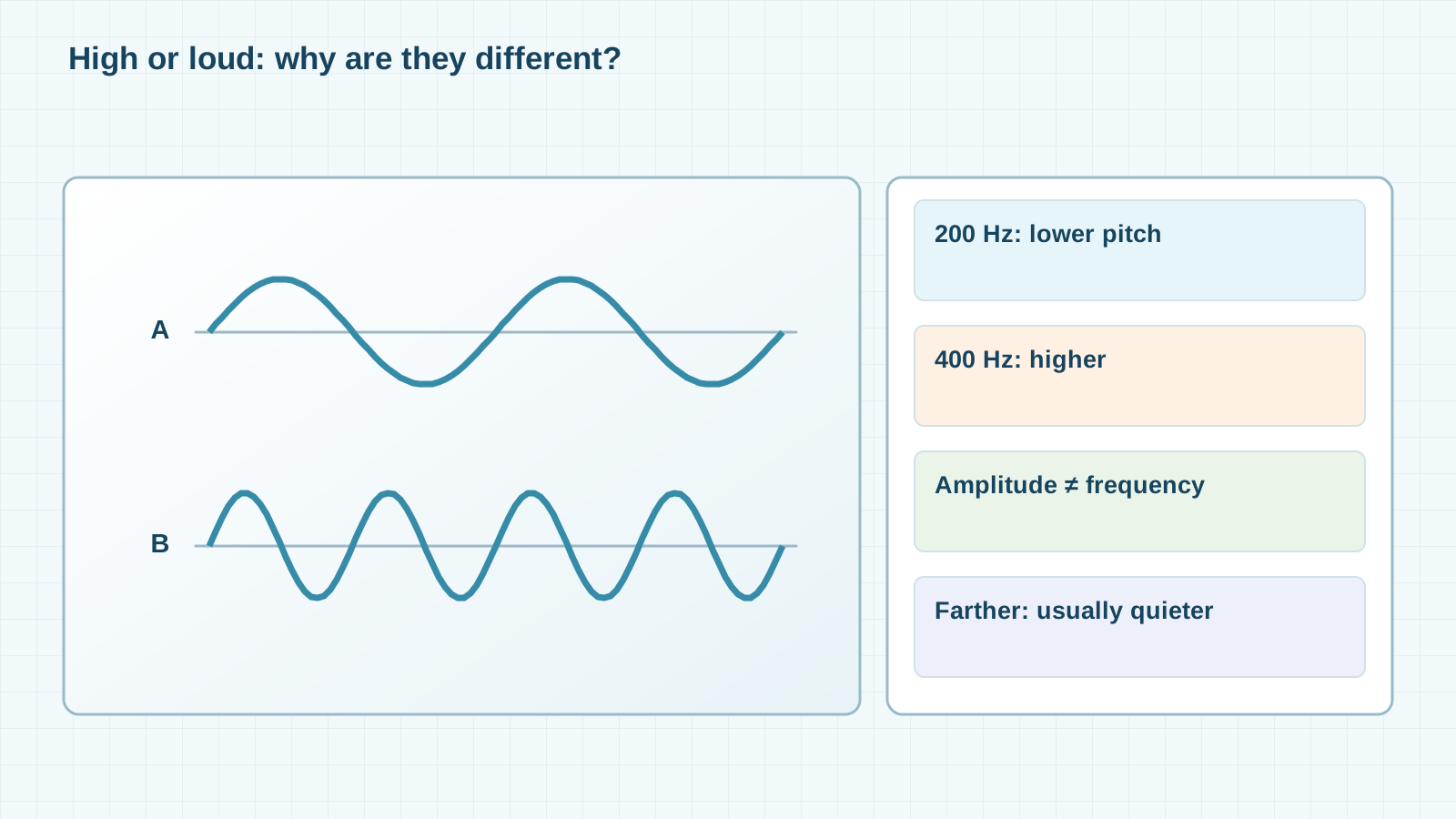
One supplied signal has frequency 200 Hz and small amplitude. A second has 400 Hz and the same amplitude. The second is generally perceived as higher, but the data do not say it is twice as loud. A third signal is 200 Hz with greater amplitude at the same listener: its pitch is about the same, while perceived strength changes. The diagram gives no calibrated decibel scale.
Test safely
Use only a comfortable volume. Hum two notes quietly or compare prepared recordings at low level; do not turn the volume up for the experiment. Ask someone which note is higher without prompting them to say ’louder’. Never test close to a loud speaker.
A common mistake
It is wrong to read ‘400 Hz’ as 400 units of loudness. Hertz counts cycles, not strength of perception. Even a high sound can be quiet. Moving away from a stationary source usually leaves its frequency unchanged; what changes is delivery to the ear.
Support diagram
Transfer to another case
An alarm keeps the same pitch but sounds quieter through a closed door. Name one change at the source and one along the path that could explain it. How would you test them separately?
Check your understanding
Close the text and explain the left-to-right drawing to a new learner. Name an observation, a teaching assumption and something the evidence does not prove. Then answer the transfer question without a hint and check units or direction against the diagram. If you disagree, return to the first unfamiliar word rather than memorising a sentence. A spoken explanation, a drawing and a measurement are different kinds of evidence: label each honestly.
Lab notebook page
Add a line to My World Lab Notebook: question → prediction → controlled conditions → changed condition → observation or calculation → conclusion → limit. Put a scale on a drawing or mark it ‘schematic’. If you ran no experiment, write ‘supplied calculation’, not ‘we measured’. Revisit the entry after the next lesson and note what became clearer.
Next lesson: Why does a mirror show an object to one side? Draw the law of reflection
If you have found a mistake or a typo in this article, tell us about it
Comments (0)
Log in to leave a comment →
No comments yet. Be the first.