


Physics around us: from a first experiment to your own lab Lesson 71 of 74
Why does a mirror show an object to one side? Draw the law of reflection
Trace light rays, distinguish the normal from the surface and check angles on a square grid.
Question and prediction
Look into a small mirror. You see light from an object that the mirror directs into your eye; the mirror is not the object’s light source. Turn the mirror and the apparent position changes. Before drawing, point out the path: object → mirror → eye. Never use sunlight or a laser for this activity.
New words without gaps
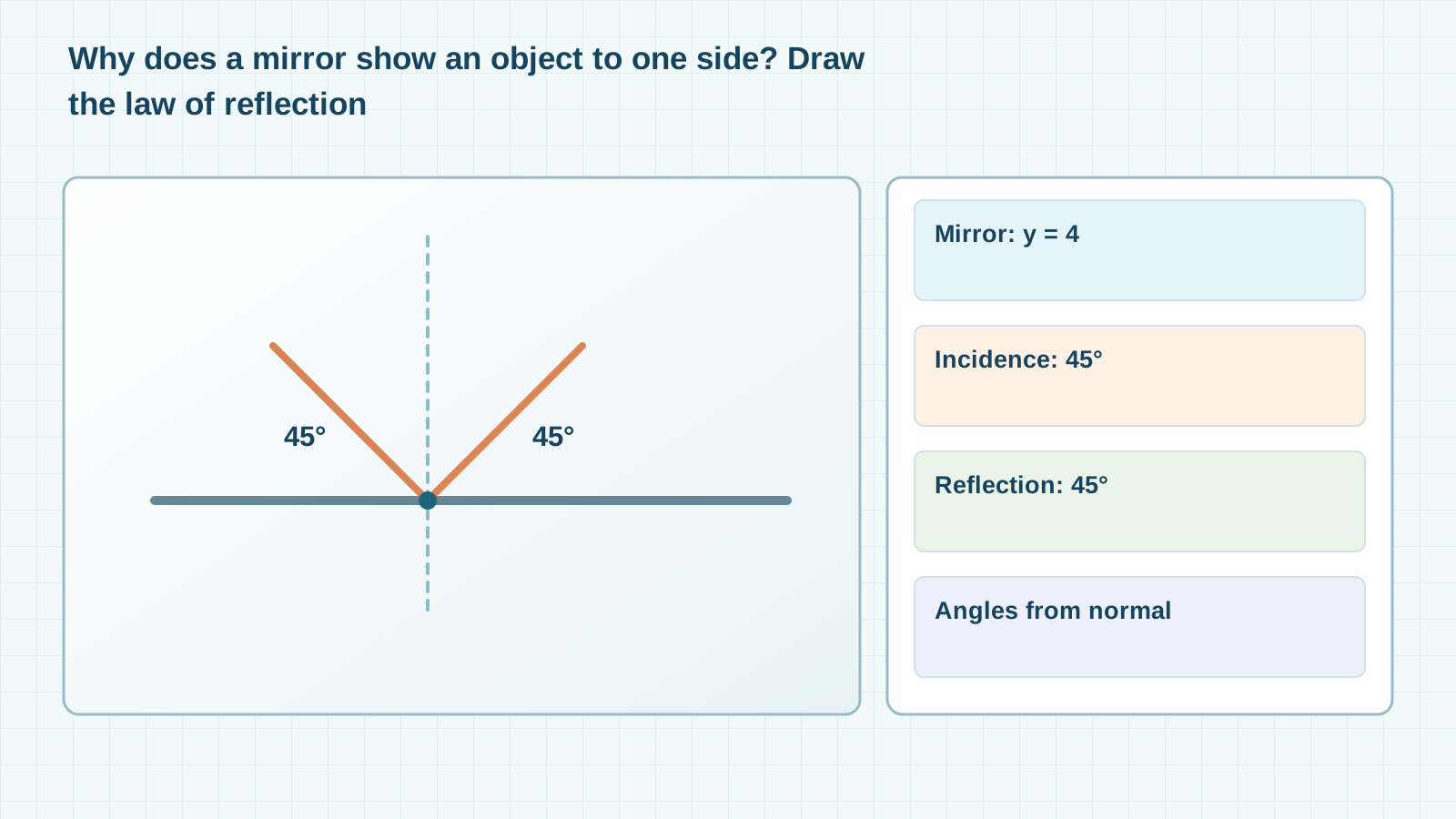
A light ray is a line showing light’s direction in a geometric model, not a visible thread. An incident ray goes towards a boundary and a reflected ray leaves it. The normal is an imaginary line perpendicular to the surface at the meeting point. The angle of incidence and angle of reflection are measured from the normal, not the mirror surface. For specular reflection the two angles are equal.
Work through supplied data
In the supplied drawing the mirror is horizontal and the normal vertical. On an equal-square grid the ray travels from (2,2) to (4,4), then from (4,4) to (6,2). Each ray makes 45° with the normal. Equal horizontal and vertical steps confirm it. The coordinates name grid squares, not centimetres on a real mirror.
Test safely
Put a safe small mirror on a desk. Use a pencil diagram and ordinary room light; do not shine a torch into anyone’s eyes. Draw the normal at a right angle to the surface and compare angles with a protractor. Multiple mirrors require a separate path for each reflection.
A common mistake
A common error is measuring from the mirror without saying so. In this special picture that also gives 45°, but a ray at 30° to the normal is at 60° to the surface. The mirror redirects light from the object; it does not create it.
Support diagram
Transfer to another case
A new ray makes 30° with the normal. At what angle to the normal does it leave? What angle does it make with the surface? Label both.
Check your understanding
Close the text and explain the left-to-right drawing to a new learner. Name an observation, a teaching assumption and something the evidence does not prove. Then answer the transfer question without a hint and check units or direction against the diagram. If you disagree, return to the first unfamiliar word rather than memorising a sentence. A spoken explanation, a drawing and a measurement are different kinds of evidence: label each honestly.
Lab notebook page
Add a line to My World Lab Notebook: question → prediction → controlled conditions → changed condition → observation or calculation → conclusion → limit. Put a scale on a drawing or mark it ‘schematic’. If you ran no experiment, write ‘supplied calculation’, not ‘we measured’. Revisit the entry after the next lesson and note what became clearer.
Next lesson: Why does a pencil look broken in water? Light at a boundary
If you have found a mistake or a typo in this article, tell us about it
Comments (0)
Log in to leave a comment →
No comments yet. Be the first.