

Physics around us: from a first experiment to your own lab Lesson 74 of 74
Checkpoint: design an optical signal for a door
Bring together a light path, reflection and an honest test of a safe model device.
Question and prediction
Lesson 66 let you encode ‘door open’ as an electrical signal. Now design a paper model: an LED module points at a small mirror on a moving door, and a fixed screen shows a light spot. Turning the door changes the reflected direction. Predict which of two positions puts the spot inside a drawn target.
New words without gaps
An optical signal carries a message by light. A position sensor here is only the chosen rule ‘spot in target = door closed’; a drawing does not become a reliable security device. A controlled condition is something kept unchanged in a comparison: source, mirror, screen and distances. As in the previous block, people choose a message code; a physical quantity does not say ‘closed’ on its own.
Work through supplied data
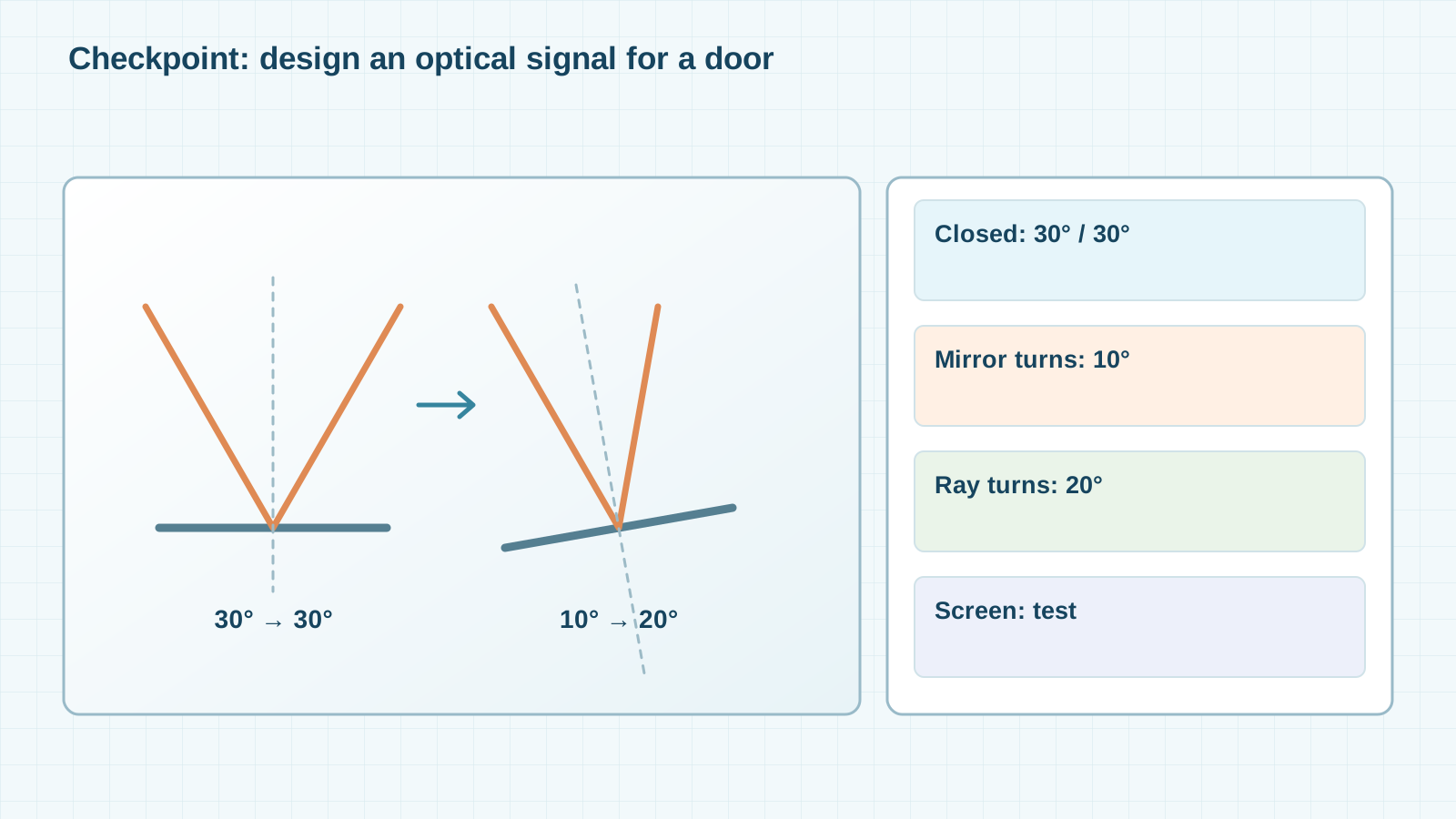
Supplied table: with the door closed the mirror normal is vertical, and a ray incident at 30° reflects at 30° to the normal, making a spot on target. When the door opens, the mirror turns 10°. If the incoming ray stays fixed, the reflected ray rotates by 20° in the ideal plane-mirror model, moving the spot outside the target. The diagram shows angles, not exact millimetres at the screen. Mirror turn and reflected-ray turn are not equal.
Test safely
First run a paper test: draw both mirror positions, normals and rays. If desired, use a ready low-power LED module and small safe mirror with adult supervision; use no laser, sunlight or mains equipment. Repeat several closures, recording hits and false signals instead of one success.
A common mistake
One hit does not prove reliability. Repeat trials, secure the mount and check changing ambient light. Light also does not need air like sound; it crosses empty space. Without a screen distance, the spot’s shift cannot be stated in centimetres.
Support diagram
Transfer to another case
Replace the mirror with rough white card. Will a narrow reflected ray and one predictable spot remain? Name the model feature that fails and a safe way to test it.
Check your understanding
Close the text and explain the left-to-right drawing to a new learner. Name an observation, a teaching assumption and something the evidence does not prove. Then answer the transfer question without a hint and check units or direction against the diagram. If you disagree, return to the first unfamiliar word rather than memorising a sentence. A spoken explanation, a drawing and a measurement are different kinds of evidence: label each honestly.
Lab notebook page
Add a line to My World Lab Notebook: question → prediction → controlled conditions → changed condition → observation or calculation → conclusion → limit. Put a scale on a drawing or mark it ‘schematic’. If you ran no experiment, write ‘supplied calculation’, not ‘we measured’. Revisit the entry after the next lesson and note what became clearer.
If you have found a mistake or a typo in this article, tell us about it
Comments (0)
Log in to leave a comment →
No comments yet. Be the first.