

Physics around us: from a first experiment to your own lab Lesson 73 of 74
How does a lens make an image, and why does the screen matter?
Separate object, rays and real image, and learn when a converging lens can form one.
Question and prediction
Place a magnifying glass between a desk lamp and white paper. At some distances the paper shows a bright, inverted image of the lamp. Never look at the Sun through a lens or focus sunlight onto paper: it can heat up. A paper ray diagram without a lamp is safer and sufficient here.
New words without gaps
A lens is a transparent body with curved surfaces that redirects rays. A converging lens can bring parallel rays approximately to a focus. In the thin-lens model, the distance from its centre to the focus is focal length f. A real image forms where transmitted rays actually meet; a screen can catch it. If the object is inside the focal length, no real image forms on a screen behind the lens.
Work through supplied data
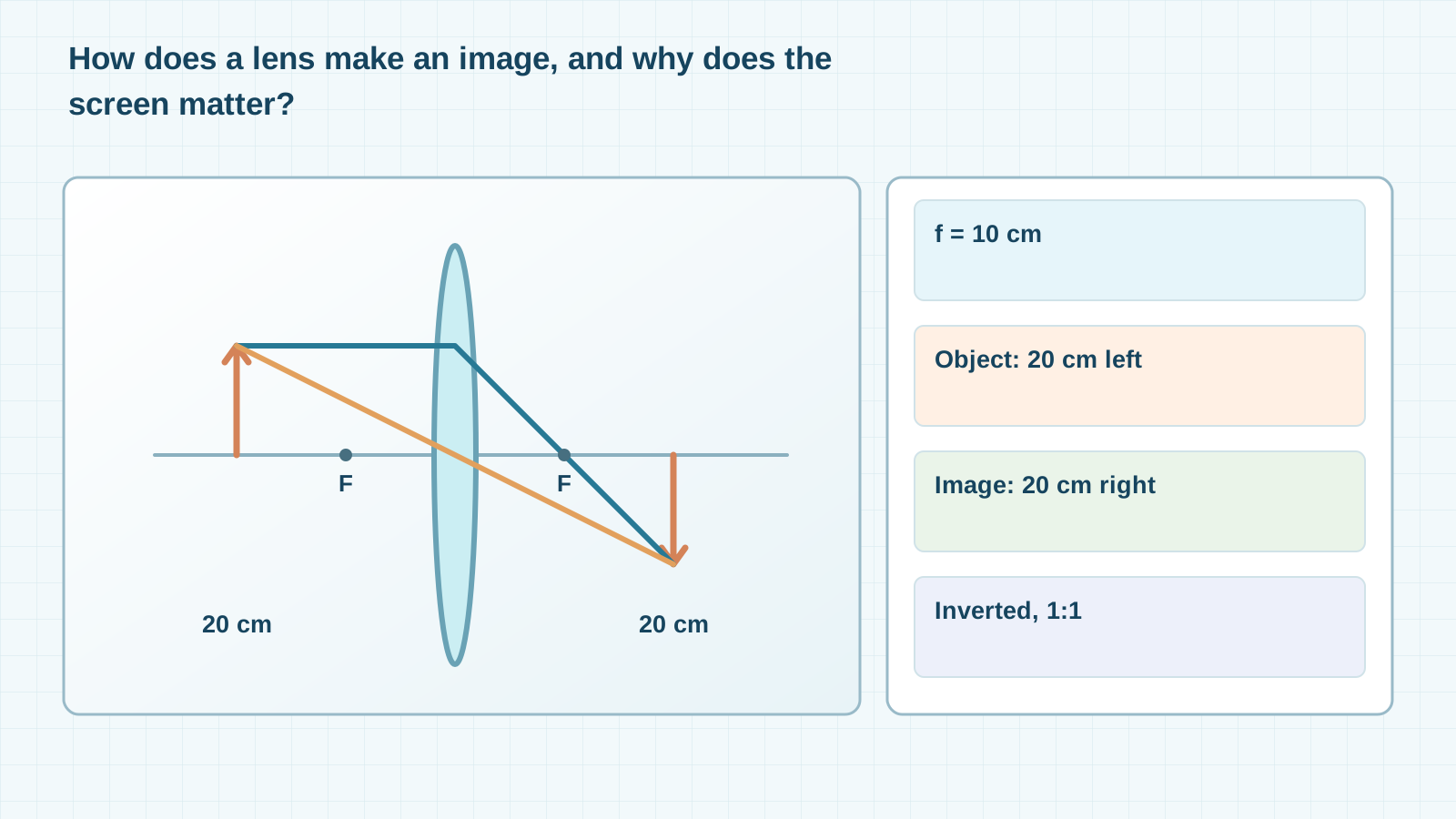
Supplied example: f = 10 cm, and the object is 20 cm left of a thin lens. The equation 1/f = 1/dₒ + 1/dᵢ gives 1/10 = 1/20 + 1/dᵢ, hence dᵢ = 20 cm right. In the diagram, one ray runs parallel to the main axis then through the right focus; another passes the lens centre with negligible deflection. Their meeting below the axis gives an inverted image of equal height in the ideal model.
Test safely
Draw on squared paper with a scale of one square to 5 cm and check the intersection. If using a small LED lamp and lens, keep them steady and avoid shining into eyes. A real lens has thickness and aberrations; the exact numerical result belongs to the teaching model.
A common mistake
The image does not always form at the focus. That is where parallel rays from a distant source meet; an object at 20 cm with f = 10 cm forms its image at 20 cm. Also, not everything seen through a lens is a real image that paper can catch.
Support diagram
Transfer to another case
Move the object to 5 cm from the same lens with f = 10 cm. Why can a screen on the right no longer catch a real image? What would an eye looking through the lens see?
Check your understanding
Close the text and explain the left-to-right drawing to a new learner. Name an observation, a teaching assumption and something the evidence does not prove. Then answer the transfer question without a hint and check units or direction against the diagram. If you disagree, return to the first unfamiliar word rather than memorising a sentence. A spoken explanation, a drawing and a measurement are different kinds of evidence: label each honestly.
Lab notebook page
Add a line to My World Lab Notebook: question → prediction → controlled conditions → changed condition → observation or calculation → conclusion → limit. Put a scale on a drawing or mark it ‘schematic’. If you ran no experiment, write ‘supplied calculation’, not ‘we measured’. Revisit the entry after the next lesson and note what became clearer.
Next lesson: Checkpoint: design an optical signal for a door
If you have found a mistake or a typo in this article, tell us about it
Comments (0)
Log in to leave a comment →
No comments yet. Be the first.