


Physics around us: from a first experiment to your own lab Lesson 69 of 74
Why does a ruler make sound, and does sound need air?
Connect a vibrating source to pressure changes in air and see why sound does not cross a vacuum.
Question and prediction
Press a ruler against a table and bend its free end gently. While it vibrates you hear a sound; as motion dies away, so does the sound. You do not see a stream of air travelling from desk to ear, but neighbouring regions pass a pressure change along. Predict what changes if the free part of the ruler is shorter.
New words without gaps
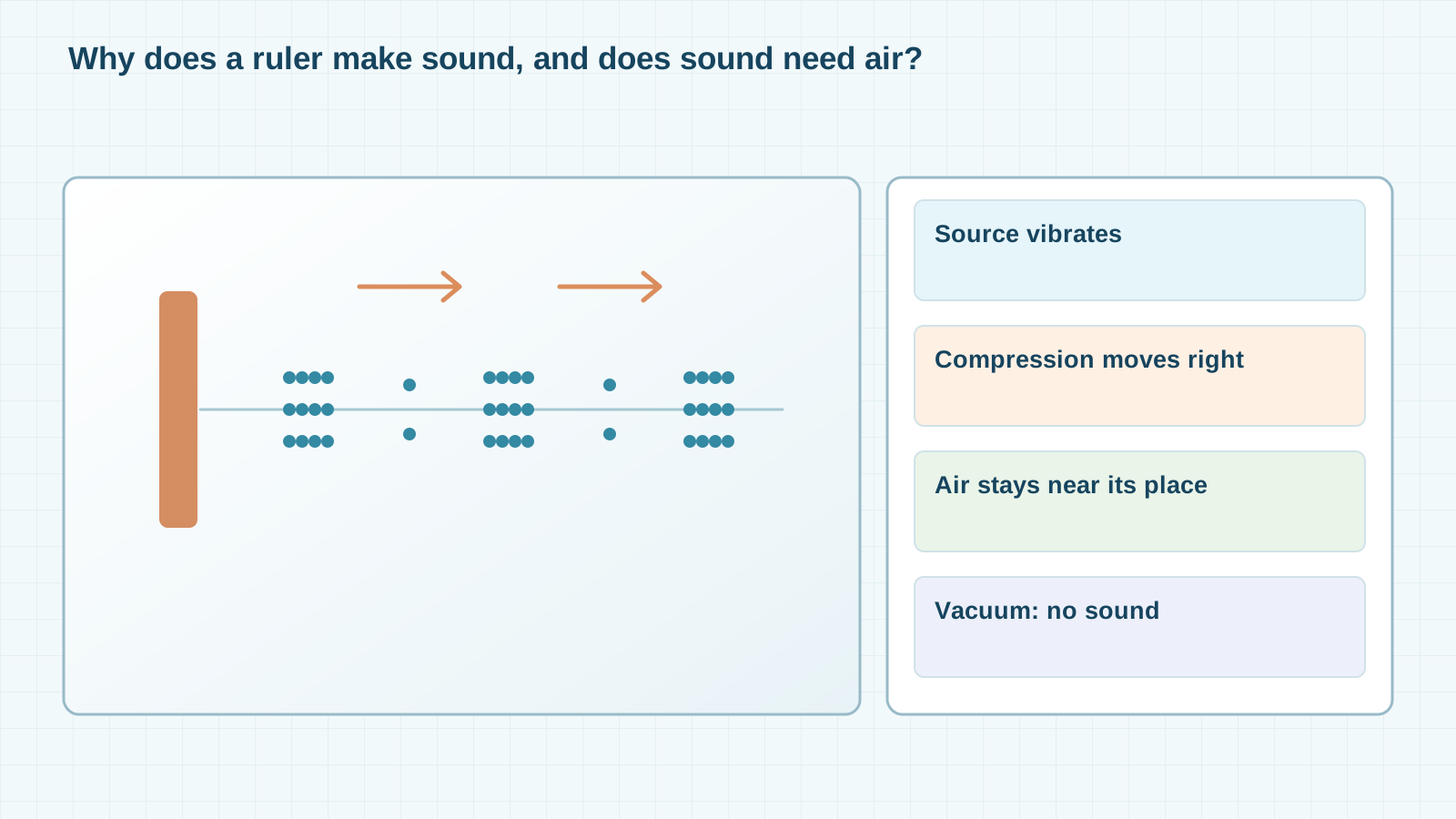
A sound source vibrates and disturbs a medium. A sound wave in air consists of alternating compression and rarefaction regions travelling away from the source. Longitudinal means that particles of the medium oscillate approximately along the direction of travel. Amplitude is the greatest displacement from rest; it relates to the size of the vibration, but perceived loudness also depends on distance and hearing. Sound cannot travel through empty space without a medium.
Work through supplied data
In the teaching diagram, air markers remain near their mean positions while compressions pass to the right. This is qualitative: no sound speed can be calculated from it. Sound in ordinary air travels much faster than the ruler’s visible motion, but the ruler need not travel to the listener.
Test safely
Try this quietly without striking the table or putting anything near an ear. Keep the free length fixed and vary only the initial bend, then change length separately. Record what you hear as observation; label the compression explanation as a model.
A common mistake
A loud sound does not prove that air particles fly all the way from source to ear. Nor can we claim that any ruler produces just one exact frequency: shape and clamping matter. The compression drawing leaves out details of real sounds.
Support diagram
Transfer to another case
Two people on the Moon can see a hammer strike metal, but no air lies between them. Can one hear the other’s strike directly? What safe means could carry a message instead?
Check your understanding
Close the text and explain the left-to-right drawing to a new learner. Name an observation, a teaching assumption and something the evidence does not prove. Then answer the transfer question without a hint and check units or direction against the diagram. If you disagree, return to the first unfamiliar word rather than memorising a sentence. A spoken explanation, a drawing and a measurement are different kinds of evidence: label each honestly.
Lab notebook page
Add a line to My World Lab Notebook: question → prediction → controlled conditions → changed condition → observation or calculation → conclusion → limit. Put a scale on a drawing or mark it ‘schematic’. If you ran no experiment, write ‘supplied calculation’, not ‘we measured’. Revisit the entry after the next lesson and note what became clearer.
If you have found a mistake or a typo in this article, tell us about it
Comments (0)
Log in to leave a comment →
No comments yet. Be the first.