

Physics around us: from a first experiment to your own lab Lesson 72 of 74
Why does a pencil look broken in water? Light at a boundary
Separate changes of direction and speed from the frequency that stays fixed at a boundary.
Question and prediction
A pencil dipped into a clear glass of water looks displaced at the surface. The pencil is whole: the light path from its submerged part to your eye changes. Describe what you see before explaining it. The glass has not changed the object’s actual shape.
New words without gaps
Refraction is a change in the direction of light when it passes between media and its speed changes. The boundary here is the water surface. The normal is again perpendicular to it. From air into water an angled ray usually bends towards the normal; from water into air it bends away. Frequency does not change at the boundary, while speed and wavelength do. A ray along the normal keeps its direction even though its speed changes.
Work through supplied data
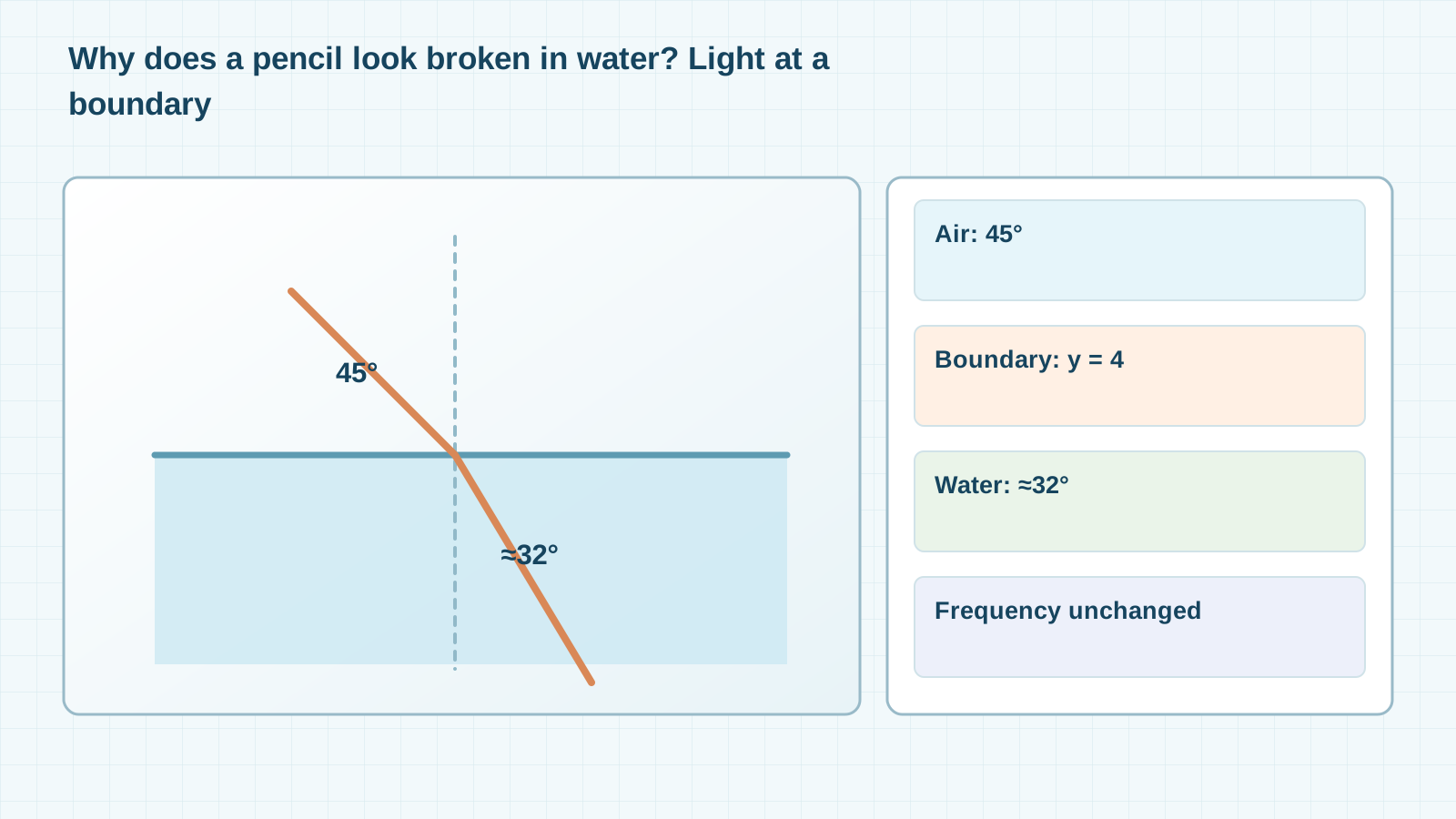
The supplied diagram has an incident angle of 45° to the normal and a transmitted angle of about 32° in water. These are teaching values, not a student’s glass measurement. Compare each line to the vertical normal: the water angle is smaller. Do not calculate a refractive index from a sketch before learning Snell’s law and the required conditions.
Test safely
Use a pencil and an ordinary smooth-edged glass. Look from the side and above while keeping the pencil still. Draw rays on paper; sunlight, lasers and electrical gear near water are unnecessary. Record that the apparent displacement is the seen position, not a break in the object.
A common mistake
It is wrong to say the surface pushes the pencil or that the light’s frequency changes on entering water. It is also wrong to expect a change of direction for a ray arriving exactly along the normal. Its speed changes, but its symmetric path remains straight.
Support diagram
Transfer to another case
A ray leaves water for air at an angle to the normal. Which way does it bend? What can you say without calculation, and what needs the exact properties of both media?
Check your understanding
Close the text and explain the left-to-right drawing to a new learner. Name an observation, a teaching assumption and something the evidence does not prove. Then answer the transfer question without a hint and check units or direction against the diagram. If you disagree, return to the first unfamiliar word rather than memorising a sentence. A spoken explanation, a drawing and a measurement are different kinds of evidence: label each honestly.
Lab notebook page
Add a line to My World Lab Notebook: question → prediction → controlled conditions → changed condition → observation or calculation → conclusion → limit. Put a scale on a drawing or mark it ‘schematic’. If you ran no experiment, write ‘supplied calculation’, not ‘we measured’. Revisit the entry after the next lesson and note what became clearer.
Next lesson: How does a lens make an image, and why does the screen matter?
If you have found a mistake or a typo in this article, tell us about it
Comments (0)
Log in to leave a comment →
No comments yet. Be the first.