


Physics around us: from a first experiment to your own lab Lesson 86 of 92
How can two carbon atoms be different?
Hold the proton count fixed and change only the neutrons.
Question and prediction
Two cards both say ‘carbon’, yet one model nucleus contains more pieces. Must a card be wrong? Recall yesterday’s three clues: protons define the element, neutrons have no charge, and changing electrons need not change the element. Predict which change can make two atoms of the same element different.
New words without gaps
Isotopes are atoms of one element with the same number of protons but different numbers of neutrons. Mass number counts protons plus neutrons in the nucleus; it is not a precise mass in grams. C-12 means carbon with mass number 12. The nucleus is the atom’s central region containing protons and neutrons. A stable isotope does not spontaneously decay; an unstable one may change. We will define ‘radioactive’ in the next lesson.
Work through supplied data
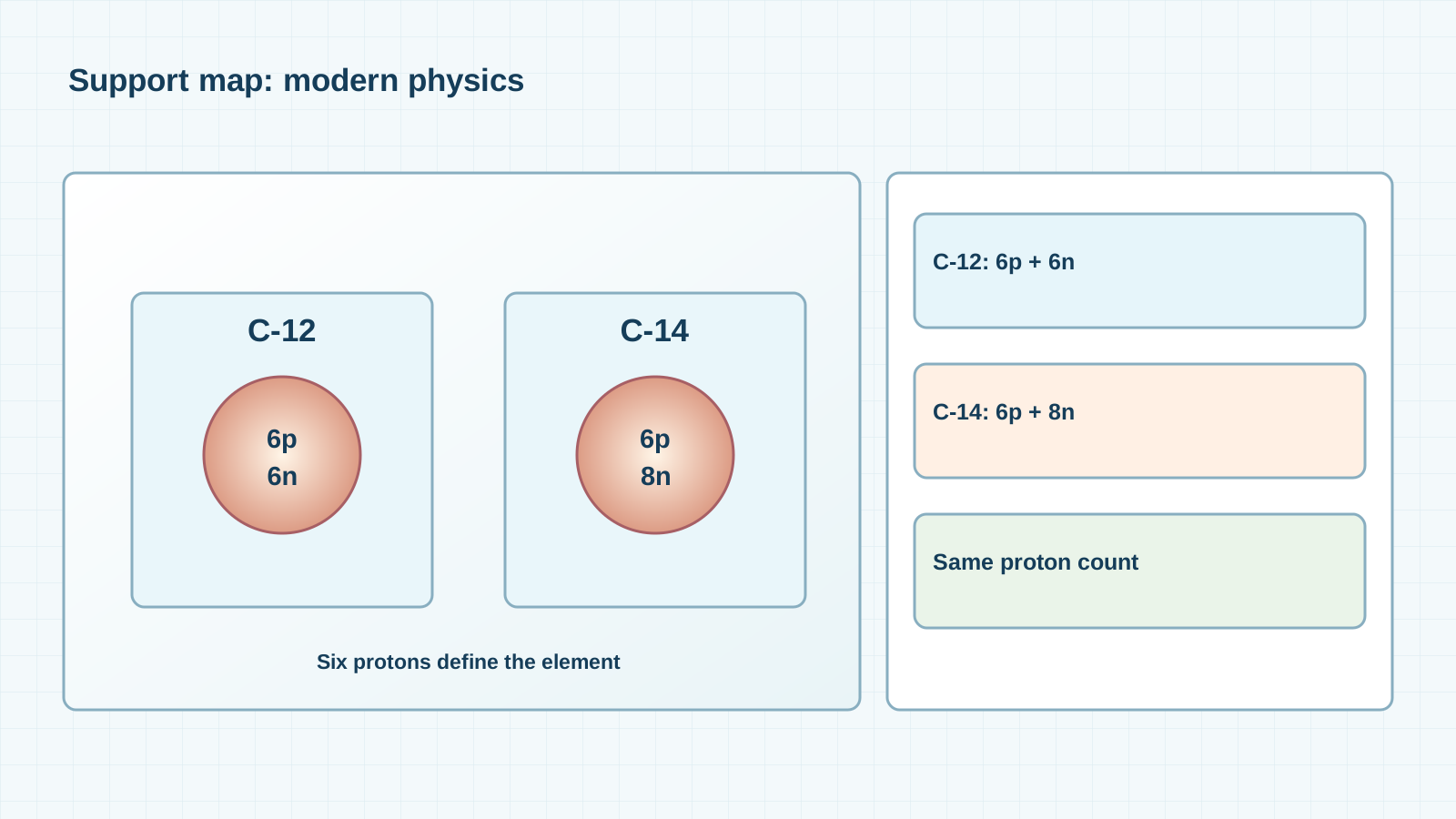
Compare supplied cards. C-12 has 6 protons and 6 neutrons, while C-14 has 6 protons and 8 neutrons. Thus 6 + 6 = 12 and 6 + 8 = 14. Both have atomic number 6 because atomic number means proton count. As neutral atoms both have 6 electrons. The drawing does not claim a true scale for the nuclei; its symbols are for counting only.
Test safely
Make two paper nucleus cards and six separate electron cards for each. In a table list protons, neutrons, mass number, electrons and net charge. Compare proton counts first, then neutron counts. Do not attempt to make or extract isotopes from materials at home: counting paper cards is all this task requires.
A common mistake
Mistake: thinking C-14 has fourteen protons. Fourteen counts both kinds of nuclear particle; the proton count stays six. Transfer: how would you label an atom with 6 protons and 7 neutrons? How many electrons make it neutral? Explain each step.
Support diagram
Check your understanding
Close the text and explain the left-to-right drawing to a new learner. Name an observation, a teaching assumption and something the evidence does not prove. Then answer the transfer question without a hint and check units or direction against the diagram. If you disagree, return to the first unfamiliar word rather than memorising a sentence. A spoken explanation, a drawing and a measurement are different kinds of evidence: label each honestly.
Lab notebook page
Add a line to My World Lab Notebook: question → prediction → controlled conditions → changed condition → observation or calculation → conclusion → limit. Put a scale on a drawing or mark it ‘schematic’. If you ran no experiment, write ‘supplied calculation’, not ‘we measured’. Revisit the entry after the next lesson and note what became clearer.
Evidence source: www.iaea.org.
If you have found a mistake or a typo in this article, tell us about it
Comments (0)
Log in to leave a comment →
No comments yet. Be the first.