


Physics around us: from a first experiment to your own lab Lesson 85 of 92
Can a school drawing really show an atom?
Find what an atomic model explains and what it cannot show.
Question and prediction
Salt dissolves in water. Has it vanished, or are its particles spread through the glass? Predict what remains when the water evaporates. Recovering salt supports conservation of matter, but it is not a photograph of an atom. Recall the heat block: particles may move even while a material looks still.
New words without gaps
An atom is the smallest unit that retains the chemical identity of an element. An element is a type of atom defined by its number of protons. A proton has positive electric charge and sits in the tiny central nucleus; a neutron is also in the nucleus but has no electric charge. An electron has negative charge and is described by a probability distribution around the nucleus. Probability tells where a measurement is more likely to find it, not the path of a tiny orbiting ball. A circular track in a drawing is a teaching aid. A neutral atom has as many electrons as protons.
Work through supplied data
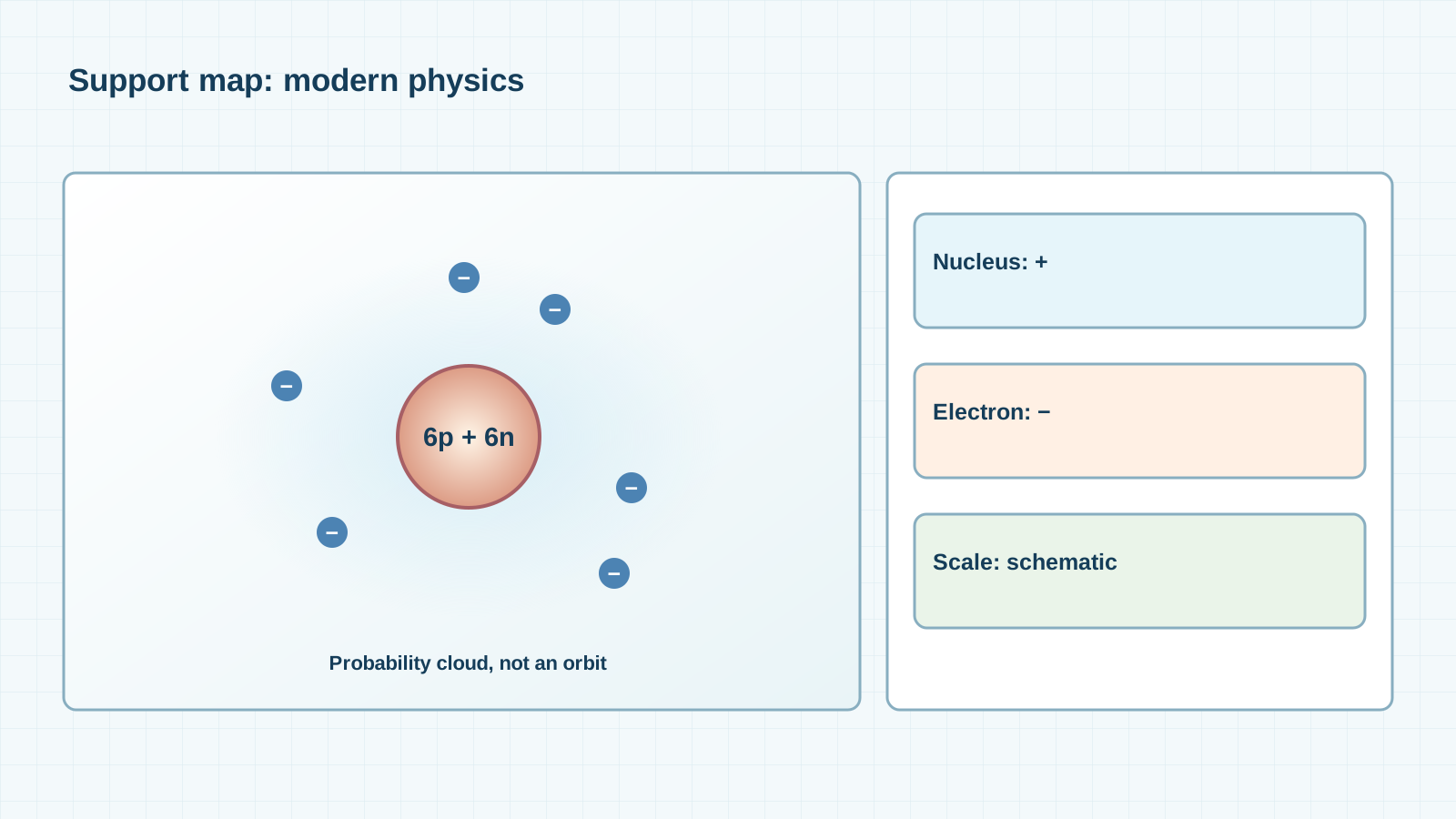
Supplied example: a common carbon atom has 6 protons, 6 neutrons and 6 electrons. Its nucleus contributes +6 charge units; electrons contribute −6; total charge is 0. The map enlarges every particle on purpose. It shows composition and charge signs, but neither distances nor measured electron paths. If the ring were a real trajectory, we would need observations of that trajectory; the diagram supplies none.
Test safely
Cut out six ‘+’, six ‘0’ and six ‘−’ paper cards. Build the model, then remove one ‘−’. Did the element change, or only its overall charge? Six protons remain, so it is still carbon, now a positive ion. An ion is an atom or group of atoms with nonzero net charge. This is a paper model; do not try to dismantle real atoms at home.
A common mistake
Mistake: calling coloured balls an atomic photograph. A drawn ring is not a measured electron orbit either. Transfer: if the nucleus has seven protons, can it still be carbon? Use the definition of element, then name one limitation of the card model.
Support diagram
Check your understanding
Close the text and explain the left-to-right drawing to a new learner. Name an observation, a teaching assumption and something the evidence does not prove. Then answer the transfer question without a hint and check units or direction against the diagram. If you disagree, return to the first unfamiliar word rather than memorising a sentence. A spoken explanation, a drawing and a measurement are different kinds of evidence: label each honestly.
Lab notebook page
Add a line to My World Lab Notebook: question → prediction → controlled conditions → changed condition → observation or calculation → conclusion → limit. Put a scale on a drawing or mark it ‘schematic’. If you ran no experiment, write ‘supplied calculation’, not ‘we measured’. Revisit the entry after the next lesson and note what became clearer.
Evidence source: openstax.org.
If you have found a mistake or a typo in this article, tell us about it
Comments (0)
Log in to leave a comment →
No comments yet. Be the first.