

Physics around us: from a first experiment to your own lab Lesson 76 of 84
Does the Sun cross the sky, or do we turn with Earth?
Separate apparent daily motion from Earth's rotation.
Question and prediction
The Sun appears in the eastern sky in the morning and leaves in the west. On a merry-go-round, still surroundings seem to move. Could an observer’s rotation explain this familiar sky pattern? Predict before turning the model.
New words without gaps
The rotation axis is an imagined line through Earth’s poles. Rotation is turning about an axis; one full turn is 360°. Earth rotates from west to east. The Sun and stars therefore appear to move in the opposite direction. A solar day is about 24 hours. The exact apparent motion of the Sun also depends on Earth’s yearly orbit.
Work through supplied data
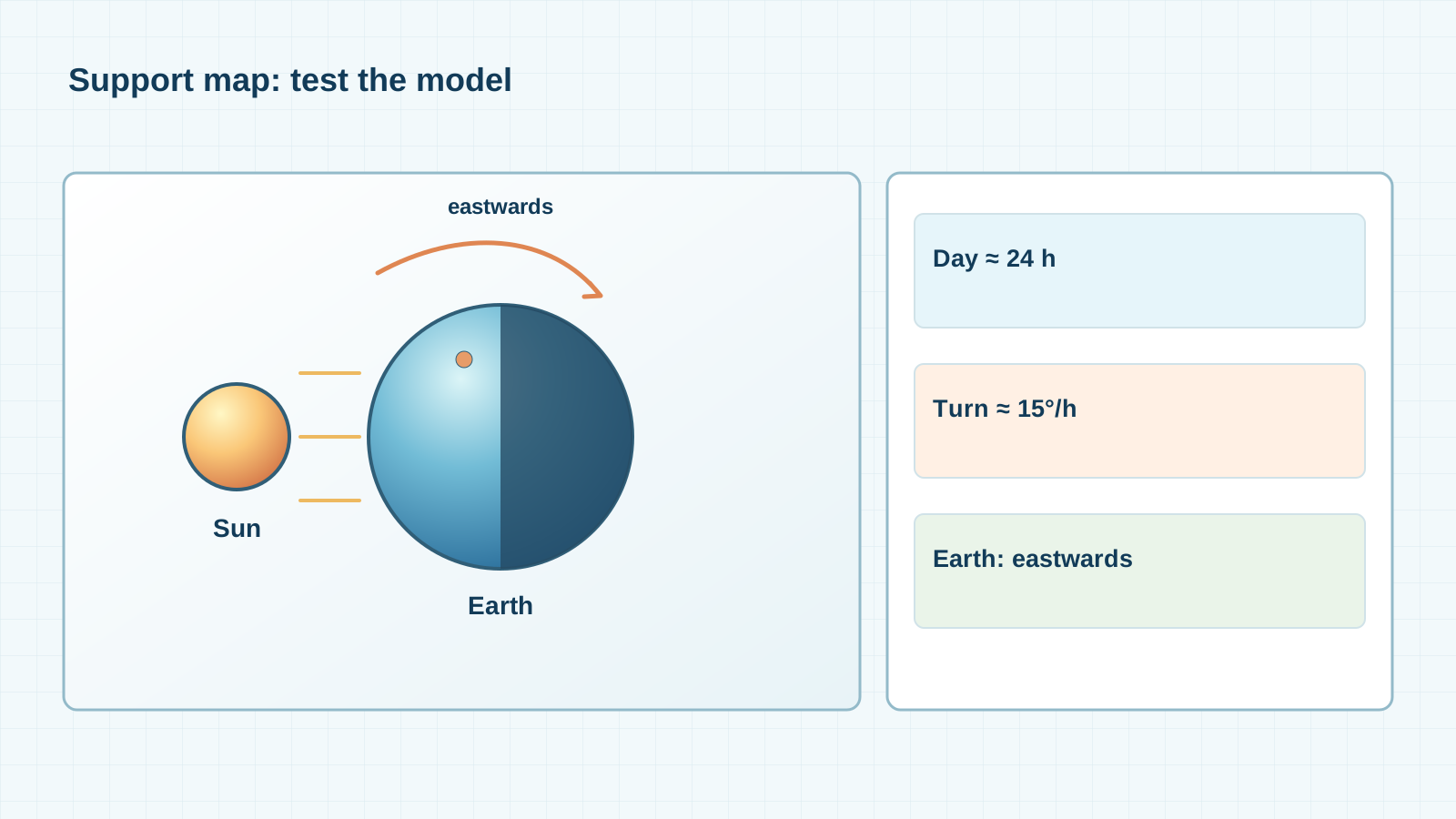
In a simple model, 360° ÷ 24 h = 15° per hour. This is an average turning angle per solar day, not a promise that each object moves along the horizon by exactly 15° each hour. In the diagram Earth turns east and the apparent sky motion points west. Only the hemisphere facing the lamp is lit.
Test safely
Mark your location on a globe or ball. Put a stationary lamp to one side and turn the globe from west to east. Record when the mark enters and leaves the lit half. Never shine a bright lamp into eyes. Write what the model explains and what it does not yet explain, such as seasonal changes in day length.
A common mistake
A common mistake is attributing day and night to Earth’s yearly trip around the Sun. That motion is much slower than the daily turn. New case: if a model globe makes a full turn in 12 hours, how long is a quarter turn?
Support diagram
Check your understanding
Close the text and explain the left-to-right drawing to a new learner. Name an observation, a teaching assumption and something the evidence does not prove. Then answer the transfer question without a hint and check units or direction against the diagram. If you disagree, return to the first unfamiliar word rather than memorising a sentence. A spoken explanation, a drawing and a measurement are different kinds of evidence: label each honestly.
Lab notebook page
Add a line to My World Lab Notebook: question → prediction → controlled conditions → changed condition → observation or calculation → conclusion → limit. Put a scale on a drawing or mark it ‘schematic’. If you ran no experiment, write ‘supplied calculation’, not ‘we measured’. Revisit the entry after the next lesson and note what became clearer.
Source for values and model: NASA Science.
If you have found a mistake or a typo in this article, tell us about it
Comments (0)
Log in to leave a comment →
No comments yet. Be the first.