


Physics around us: from a first experiment to your own lab Lesson 81 of 84
Why does an orbiting satellite not fall straight down?
Join gravity to sideways speed and a curved path.
Question and prediction
Throw a soft ball horizontally: it moves forward and down. Imagine increasing its sideways speed while Earth’s surface curves away beneath it. Why can a fast satellite keep ‘falling’ without reaching the ground? This is a thought model, not an invitation to launch objects.
New words without gaps
Gravity is attraction between bodies with mass. An orbit is a path on which gravity continually changes the direction of motion. Sideways velocity points along the path; gravitational force points approximately towards Earth’s centre. Acceleration can mean a change in speed or direction. A low orbit must be above dense air, otherwise drag slows the satellite. It is not free of Earth’s gravity.
Work through supplied data
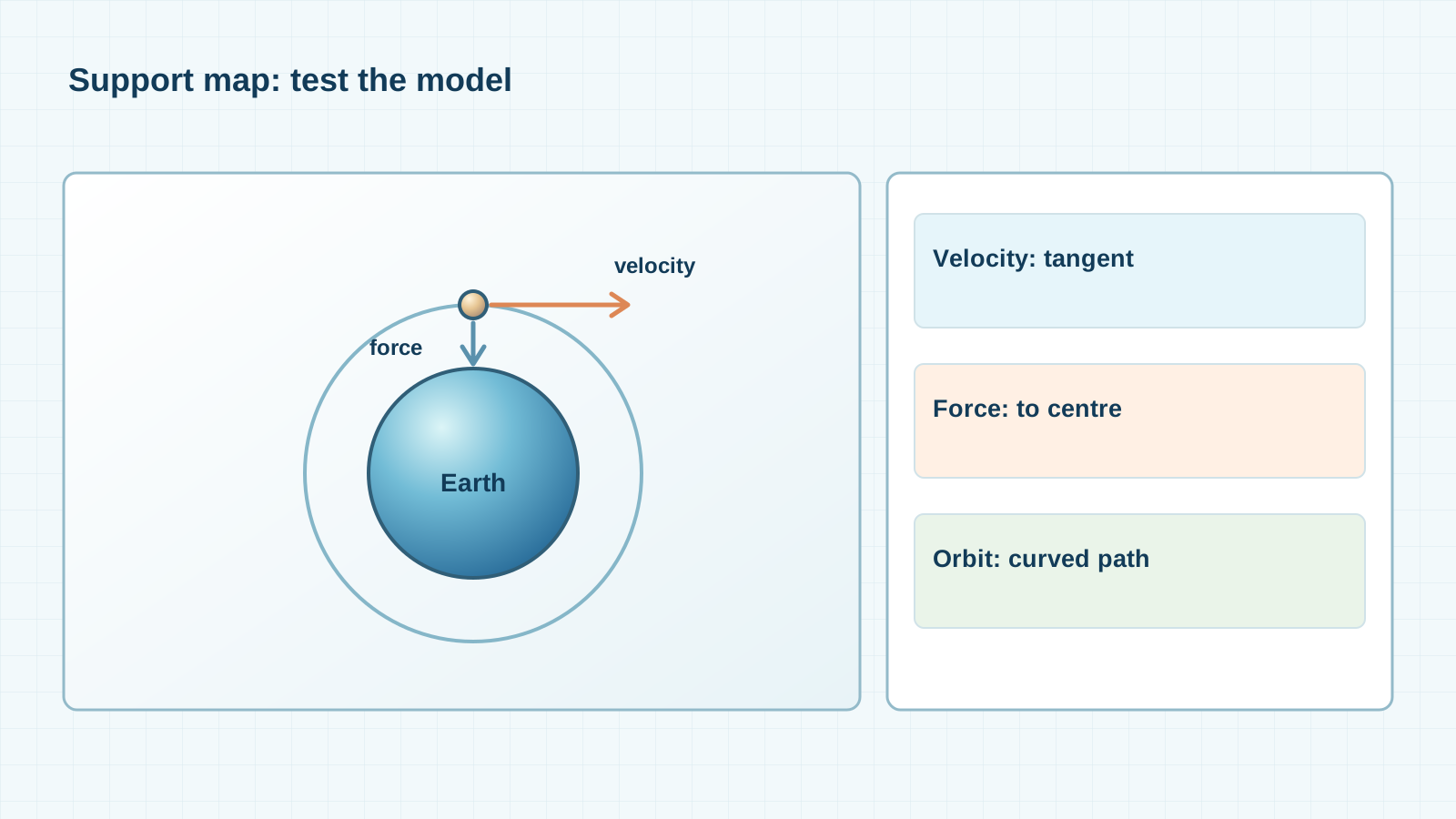
In the supplied drawing at point A the velocity arrow points right and the force arrow points down towards Earth’s centre. A short time later the direction of travel has turned. This does not mean the force points forward. A circular orbit just above an airless Earth would require roughly 7.9 km/s; actual orbits vary in height and shape. The number is not measured from the drawing and does not describe every satellite.
Test safely
Draw Earth as a circle and mark point A. Use two colours for velocity tangent to the path and force towards the centre. Extend a short section of path and explain why a straight line differs from an orbit. Do not drop or throw objects from heights; the paper model is enough.
A common mistake
Mistake: weightlessness means no gravity. In orbit a satellite and objects inside it fall together. New case: if gravity vanished instantly while sideways velocity remained, which way would the object travel in this model?
Support diagram
Check your understanding
Close the text and explain the left-to-right drawing to a new learner. Name an observation, a teaching assumption and something the evidence does not prove. Then answer the transfer question without a hint and check units or direction against the diagram. If you disagree, return to the first unfamiliar word rather than memorising a sentence. A spoken explanation, a drawing and a measurement are different kinds of evidence: label each honestly.
Lab notebook page
Add a line to My World Lab Notebook: question → prediction → controlled conditions → changed condition → observation or calculation → conclusion → limit. Put a scale on a drawing or mark it ‘schematic’. If you ran no experiment, write ‘supplied calculation’, not ‘we measured’. Revisit the entry after the next lesson and note what became clearer.
Source for values and model: NASA Science.
Next lesson: Why are the planets crowded together on posters?
If you have found a mistake or a typo in this article, tell us about it
Comments (0)
Log in to leave a comment →
No comments yet. Be the first.