

Physics around us: from a first experiment to your own lab Lesson 77 of 84
Why is a calendar year longer than 365 days?
Distinguish Earth's daily spin from one trip around the Sun.
Question and prediction
New Year returns after many sunrises, but two motions are involved. A runner can turn on the spot while moving round a track. Which motion corresponds to a day and which to a year? Give a prediction before reading the calculation.
New words without gaps
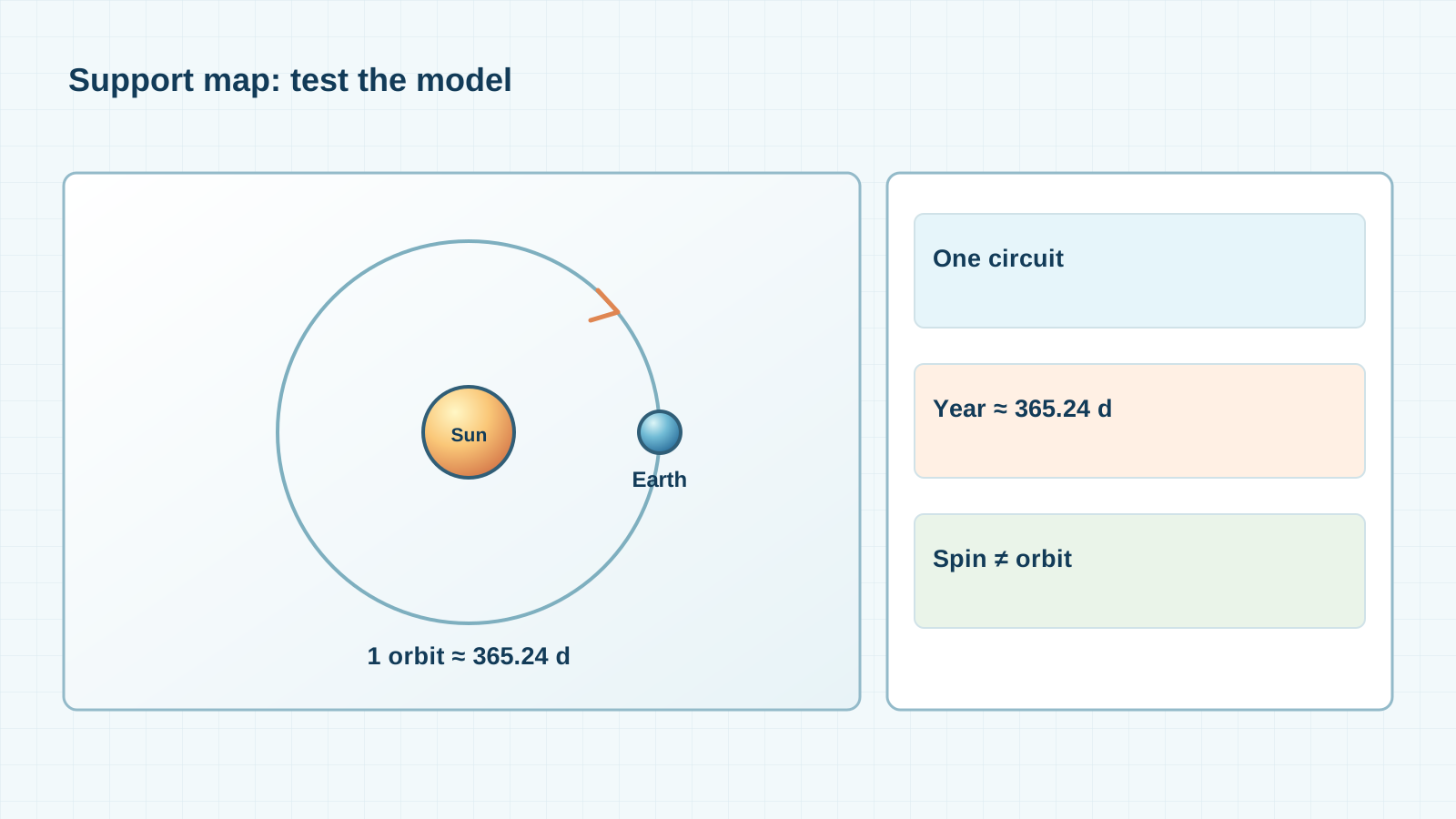
An orbit is a body’s path around another body under gravity. An orbital period is the time for one complete circuit. Earth travels around the Sun; the year tied to the recurrence of seasons is about 365.24 solar days. This is not exactly the same as Earth’s orbital period measured against distant stars. An ellipse is an elongated circle-like shape; Earth’s orbit is close to circular in our teaching drawing.
Work through supplied data
With rounded numbers, four years accumulate about 4 × 0.24 = 0.96 day. That motivates calendar corrections, though the full leap-year rule is more precise than ’every fourth year’. The diagram gives one circuit and an approximate day count, not Earth’s speed everywhere on the path. Orbital speed is not constant.
Test safely
Draw the Sun and four Earth positions on a nearly circular orbit. On a separate small globe draw one daily spin. Label the two clocks ‘rotation’ and ‘revolution’. If available, compare the dates of the same season in two neighbouring years rather than claiming the drawing measured them.
A common mistake
Leap years do not occur because Earth stops or makes an extra orbit. They correct the fractional number of days in a year. New case: by the rough 0.24 day-per-year estimate, how many days accumulate over ten years?
Support diagram
Check your understanding
Close the text and explain the left-to-right drawing to a new learner. Name an observation, a teaching assumption and something the evidence does not prove. Then answer the transfer question without a hint and check units or direction against the diagram. If you disagree, return to the first unfamiliar word rather than memorising a sentence. A spoken explanation, a drawing and a measurement are different kinds of evidence: label each honestly.
Lab notebook page
Add a line to My World Lab Notebook: question → prediction → controlled conditions → changed condition → observation or calculation → conclusion → limit. Put a scale on a drawing or mark it ‘schematic’. If you ran no experiment, write ‘supplied calculation’, not ‘we measured’. Revisit the entry after the next lesson and note what became clearer.
Source for values and model: NASA Science.
Next lesson: Why can summer be warm when Earth is farther from the Sun?
If you have found a mistake or a typo in this article, tell us about it
Comments (0)
Log in to leave a comment →
No comments yet. Be the first.