

Physics around us: from a first experiment to your own lab Lesson 78 of 84
Why can summer be warm when Earth is farther from the Sun?
Test axis tilt and daylight length instead of a distance guess.
Question and prediction
June is usually warm in Kazakhstan and December cold, while Australia has opposite seasons. If Earth–Sun distance alone caused seasons, should both hemispheres of one planet not warm together? Predict which model explains the difference.
New words without gaps
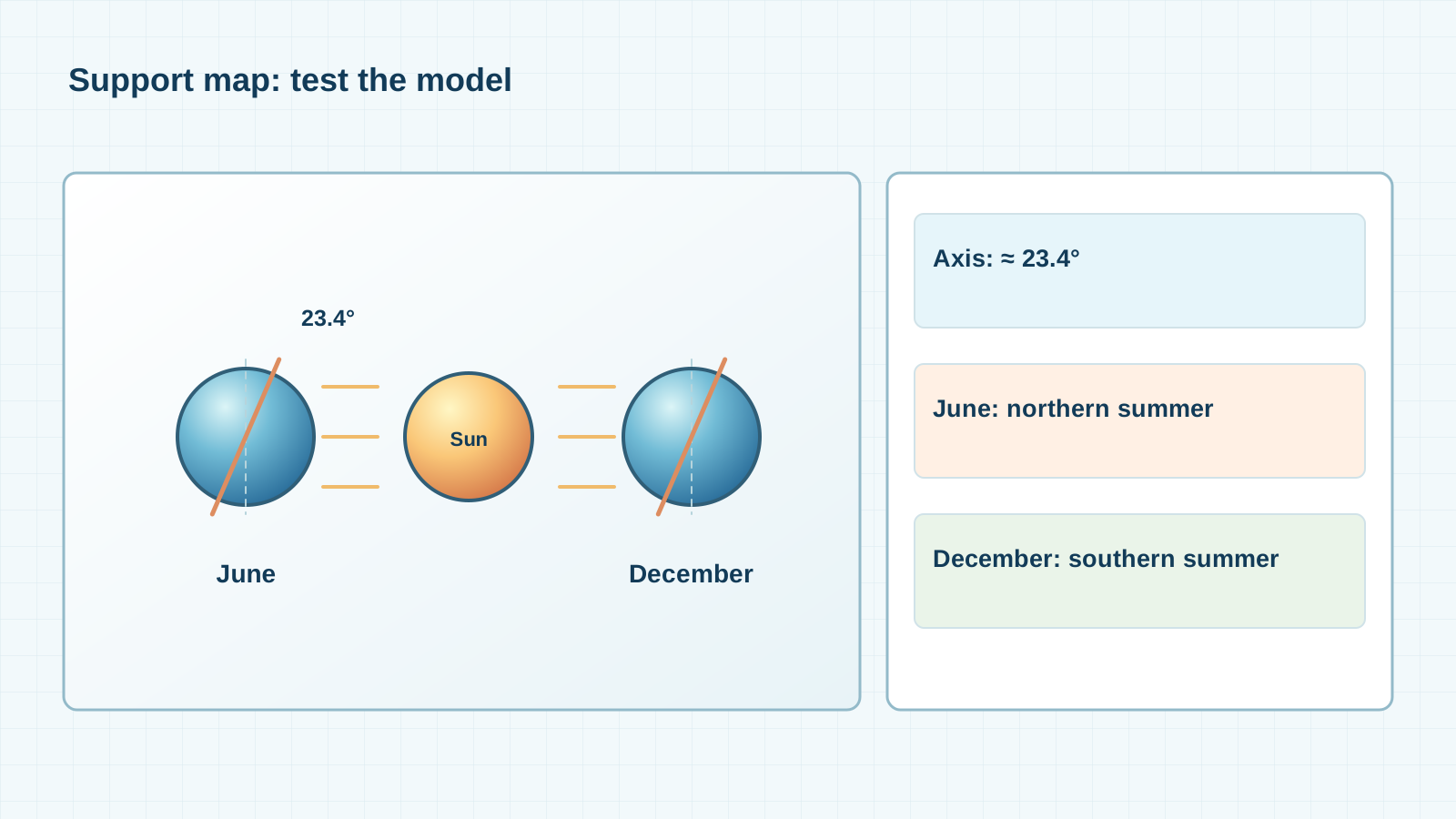
A hemisphere is one half of Earth divided at the equator. Earth’s axis is tilted about 23.4° from the perpendicular to its orbital plane and keeps nearly the same direction in space during a year. When the northern hemisphere tilts toward the Sun, sunlight arrives more directly and the daylight interval is longer. On average more solar energy reaches each unit of area. The southern hemisphere has the opposite conditions.
Work through supplied data
In a supplied model, the same beam covers 10 cm² on flat paper and 20 cm² on slanted paper. For equal energy and time, each square centimetre in the second case receives half as much. This models ray geometry only; real temperatures also depend on clouds, air, oceans and delayed warming. The diagram shows northern summer in June and southern summer in December.
Test safely
Use a globe and a stationary lamp. Mark the north-pole direction. Move the globe to opposite sides of the lamp without changing the direction the axis points within the room. Compare beam angles and the time a marked spot stays lit. Do not use the lamp as a heating experiment or stare into a bright bulb.
A common mistake
A common error is re-aiming the axis toward the Sun at every orbital position; that would erase the seasonal change. Distance alone also fails: Earth is closer to the Sun around January. Why is July winter in Australia?
Support diagram
Check your understanding
Close the text and explain the left-to-right drawing to a new learner. Name an observation, a teaching assumption and something the evidence does not prove. Then answer the transfer question without a hint and check units or direction against the diagram. If you disagree, return to the first unfamiliar word rather than memorising a sentence. A spoken explanation, a drawing and a measurement are different kinds of evidence: label each honestly.
Lab notebook page
Add a line to My World Lab Notebook: question → prediction → controlled conditions → changed condition → observation or calculation → conclusion → limit. Put a scale on a drawing or mark it ‘schematic’. If you ran no experiment, write ‘supplied calculation’, not ‘we measured’. Revisit the entry after the next lesson and note what became clearer.
Source for values and model: NASA Science.
If you have found a mistake or a typo in this article, tell us about it
Comments (0)
Log in to leave a comment →
No comments yet. Be the first.