

Physics around us: from a first experiment to your own lab Lesson 83 of 84
Do we look into the past when we see a star?
Light travel time, light-years and galaxies without mystery.
Question and prediction
You see a lamp a little after its light leaves it. Across a room the delay is imperceptible; across space it matters. If the Sun’s brightness changed, would we know at once? Treat this as a thought question, not a prediction of an event.
New words without gaps
Light travels through vacuum at about 300,000 km/s. A light-year is the distance light covers in a year, not a measure of a star’s age. A galaxy is a vast gravitationally bound system of stars, gas and dust. Ours is the Milky Way and the Sun is one of its stars. Incoming light tells us about the time it was emitted, but one image cannot reveal an object’s entire history.
Work through supplied data
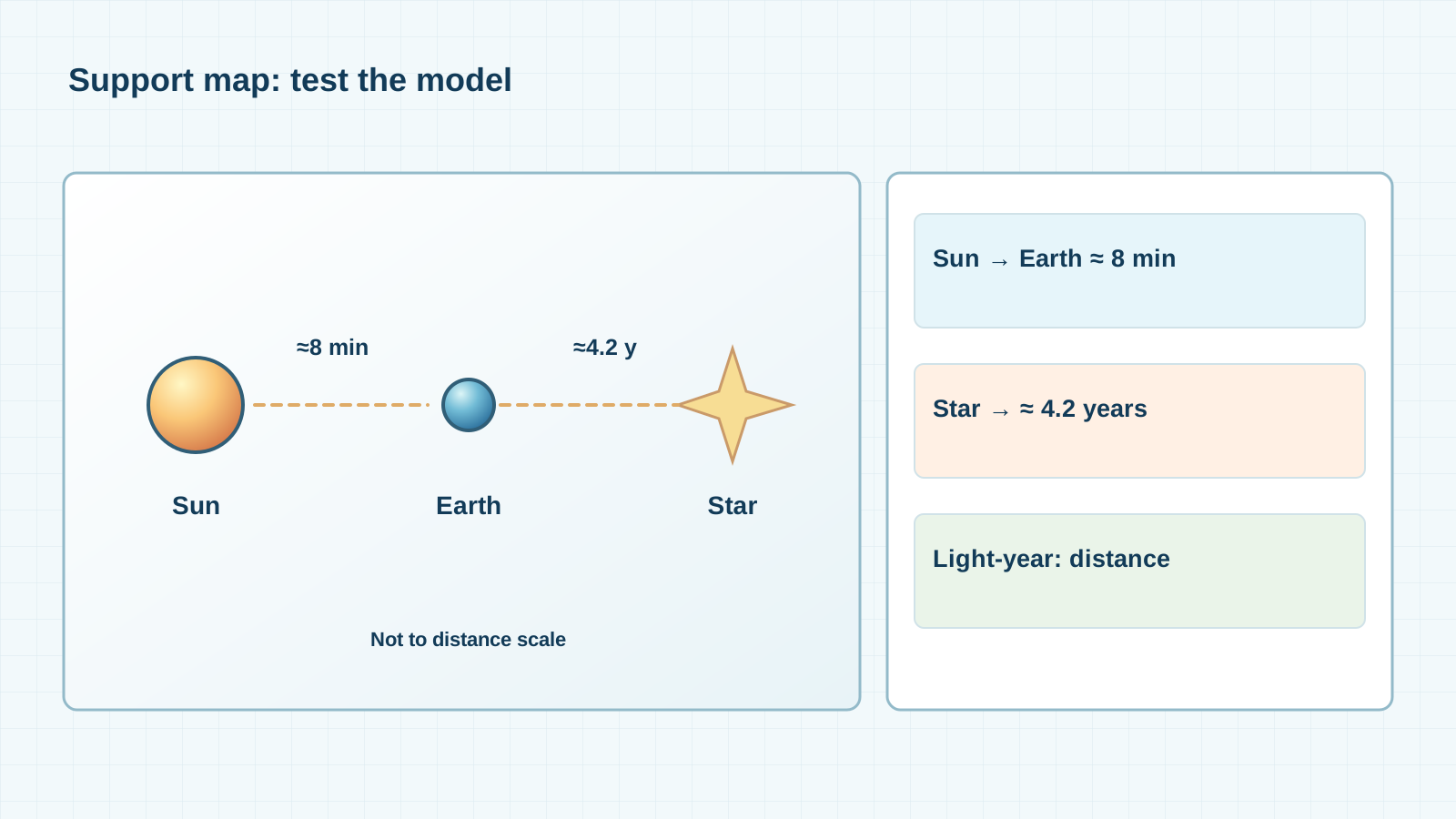
The average Sun–Earth distance is about 150 million km: 150,000,000 ÷ 300,000 ≈ 500 s, or about 8 min 20 s. Light from Proxima Centauri, the nearest star after the Sun, takes about 4.2 years. Thus we see it as it was then, not its simultaneous state on Earth. Numbers are rounded; the diagram compares delays, not the spatial scale of the distances.
Test safely
Write two columns: distance and light travel time. Divide a supplied distance by speed and check units: kilometres divided by kilometres per second leaves seconds. For a distant star use the supplied travel time; do not claim to measure it by eye. Draw source → light path → observer.
A common mistake
Mistake: a light-year is a calendar year of observation or every Milky Way star is visible unaided. New case: about how many minutes does light take across 300 million km at our rounded speed?
Support diagram
Check your understanding
Close the text and explain the left-to-right drawing to a new learner. Name an observation, a teaching assumption and something the evidence does not prove. Then answer the transfer question without a hint and check units or direction against the diagram. If you disagree, return to the first unfamiliar word rather than memorising a sentence. A spoken explanation, a drawing and a measurement are different kinds of evidence: label each honestly.
Lab notebook page
Add a line to My World Lab Notebook: question → prediction → controlled conditions → changed condition → observation or calculation → conclusion → limit. Put a scale on a drawing or mark it ‘schematic’. If you ran no experiment, write ‘supplied calculation’, not ‘we measured’. Revisit the entry after the next lesson and note what became clearer.
Source for values and model: NASA Science.
Next lesson: The sky as a lab: explain a day, a season and a Moon phase
If you have found a mistake or a typo in this article, tell us about it
Comments (0)
Log in to leave a comment →
No comments yet. Be the first.