

Physics around us: from a first experiment to your own lab Lesson 79 of 84
Where does the Moon go between full moons?
A phase is the visible share of its sunlit half, not Earth's shadow.
Question and prediction
The Moon sometimes looks round and sometimes like a thin crescent. Take a ball and a side lamp: half the ball stays lit, yet an observer at different angles sees different shares of that half. Predict when the full bright disc becomes visible.
New words without gaps
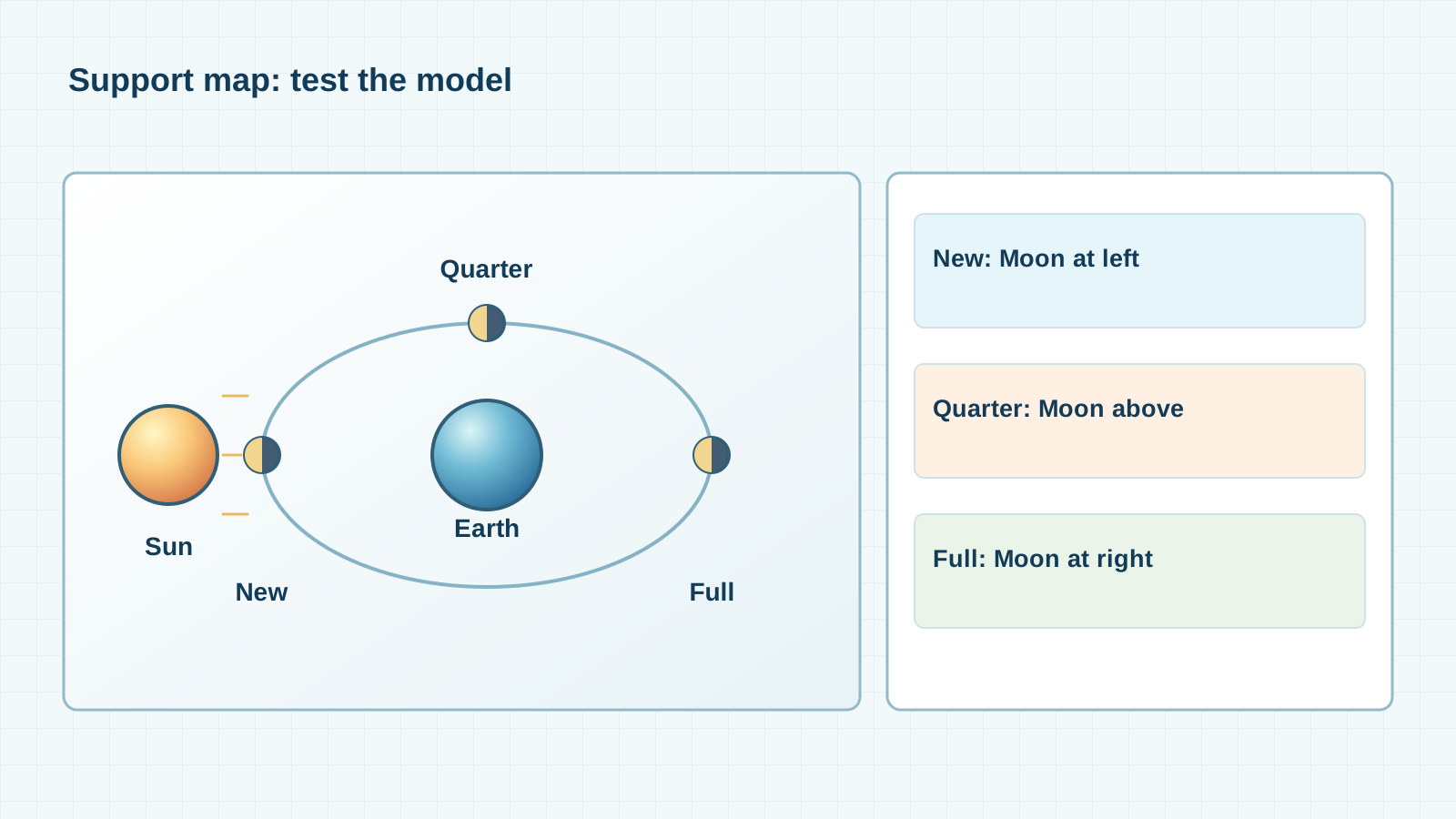
A lunar phase is the portion of the Moon’s sunlit half visible from Earth. At new moon the Moon lies roughly between Earth and Sun; its lit side mostly faces away from us. At full moon Earth lies roughly between Sun and Moon, so we see almost all the lit side. At first and last quarter about half the visible disc is bright. A full cycle of phases relative to the Sun takes about 29.5 days, not exactly four weeks.
Work through supplied data
In the supplied top-view diagram sunlight travels left to right: Sun left, Earth centre. Moon to Earth’s left means new moon; above Earth means a quarter; to Earth’s right means full moon. These are positions viewed from above, not pictures of the Moon’s appearance in the sky. The quarter observer sees roughly half the visible disc lit. Actual visibility and brightness vary with location and conditions.
Test safely
Hold a small ball at arm’s length and turn relative to a fixed lamp. Watch how much of its illuminated half you see; do not use the Sun as the lamp. Draw three positions and label light source and observer. A sketch is evidence of your model, not a measurement of a real lunar phase.
A common mistake
Mistake: a crescent is Earth’s shadow. Earth’s shadow normally misses the Moon; that is a special eclipse case for the next lesson. Why does a full Moon normally appear roughly opposite the Sun in the sky?
Support diagram
Check your understanding
Close the text and explain the left-to-right drawing to a new learner. Name an observation, a teaching assumption and something the evidence does not prove. Then answer the transfer question without a hint and check units or direction against the diagram. If you disagree, return to the first unfamiliar word rather than memorising a sentence. A spoken explanation, a drawing and a measurement are different kinds of evidence: label each honestly.
Lab notebook page
Add a line to My World Lab Notebook: question → prediction → controlled conditions → changed condition → observation or calculation → conclusion → limit. Put a scale on a drawing or mark it ‘schematic’. If you ran no experiment, write ‘supplied calculation’, not ‘we measured’. Revisit the entry after the next lesson and note what became clearer.
Source for values and model: NASA Science.
If you have found a mistake or a typo in this article, tell us about it
Comments (0)
Log in to leave a comment →
No comments yet. Be the first.