

Physics around us: from a first experiment to your own lab Lesson 80 of 84
Why is there no eclipse at every new moon?
Add the Moon's tilted orbital plane to the familiar phase diagram.
Question and prediction
New moon occurs each month, but solar eclipses are much rarer. A flat Sun–Moon–Earth line suggests the Moon’s shadow should always hit Earth. What third dimension did this drawing lose?
New words without gaps
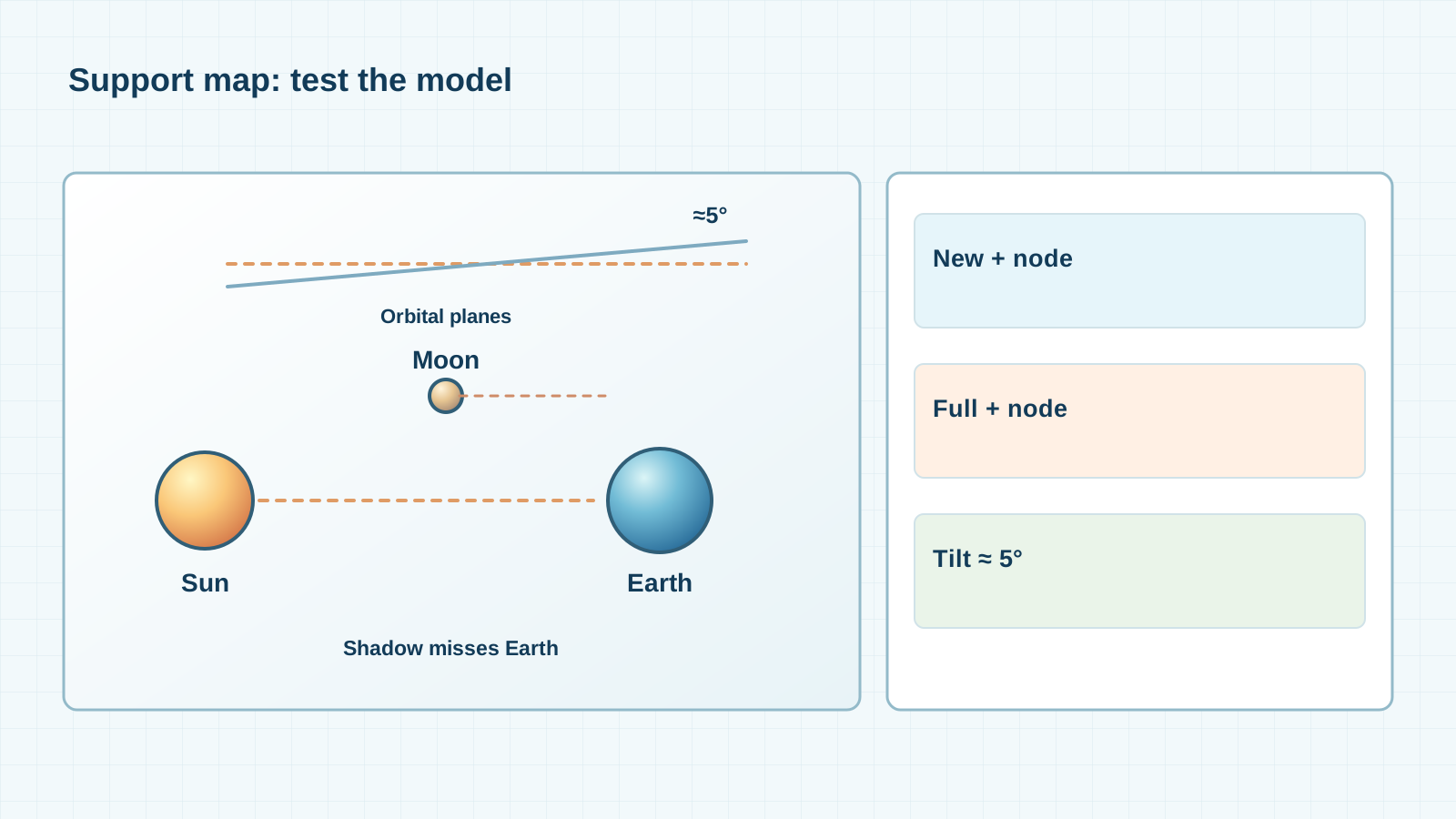
An eclipse occurs when one body enters another’s shadow or blocks its light for an observer. In a solar eclipse the Moon lies between Sun and Earth and its shadow reaches part of Earth. In a lunar eclipse Earth lies between Sun and Moon and the Moon crosses Earth’s shadow. An orbital plane is an imagined flat surface containing a body’s path. The Moon’s orbital plane is tilted about 5° relative to Earth’s orbital plane. A node is a crossing point of the two planes.
Work through supplied data
Supplied logic: new moon plus nearness to a node permits a solar eclipse; full moon plus nearness to a node permits a lunar eclipse. A phase alone is insufficient. The diagram separates the orbital planes in height, showing why at most new moons the lunar shadow misses Earth above or below. Body sizes and distances are not to scale.
Test safely
Make a paper model: draw Earth’s orbital plane on a sheet, then tilt a thin cardboard ring for the Moon’s orbit. Mark two plane crossings. Move a marker around the ring and find when alignment and a crossing coincide. Never look directly at the real Sun; observing a solar eclipse requires certified eye protection.
A common mistake
Mistake: every new moon must cause a solar eclipse, or every quarter phase is a shadow. Transfer: if the full Moon is well above Earth’s orbital plane, will a lunar eclipse occur? Explain using the crossing points.
Support diagram
Check your understanding
Close the text and explain the left-to-right drawing to a new learner. Name an observation, a teaching assumption and something the evidence does not prove. Then answer the transfer question without a hint and check units or direction against the diagram. If you disagree, return to the first unfamiliar word rather than memorising a sentence. A spoken explanation, a drawing and a measurement are different kinds of evidence: label each honestly.
Lab notebook page
Add a line to My World Lab Notebook: question → prediction → controlled conditions → changed condition → observation or calculation → conclusion → limit. Put a scale on a drawing or mark it ‘schematic’. If you ran no experiment, write ‘supplied calculation’, not ‘we measured’. Revisit the entry after the next lesson and note what became clearer.
Source for values and model: NASA Science.
Next lesson: Why does an orbiting satellite not fall straight down?
If you have found a mistake or a typo in this article, tell us about it
Comments (0)
Log in to leave a comment →
No comments yet. Be the first.