

Physics around us: from a first experiment to your own lab Lesson 75 of 84
Why does the Moon almost touch Earth in many drawings?
Build one honest scale model and separate object size from separation.
Question and prediction
A textbook often puts Earth, Moon and Sun side by side. Would they fit on the page if sizes and distances used the same scale? Before calculating, predict where the Moon would be if Earth’s diameter became one centimetre.
New words without gaps
A scale is a rule matching a model length to a real length. Diameter runs through a sphere’s centre from one edge to the other. The average Earth–Moon centre distance is about 384,000 km; Earth’s diameter is about 12,700 km and the Moon’s about 3,500 km. Average matters because the actual separation changes. A drawing without a common scale may show order but cannot give a trustworthy comparison of gaps.
Work through supplied data
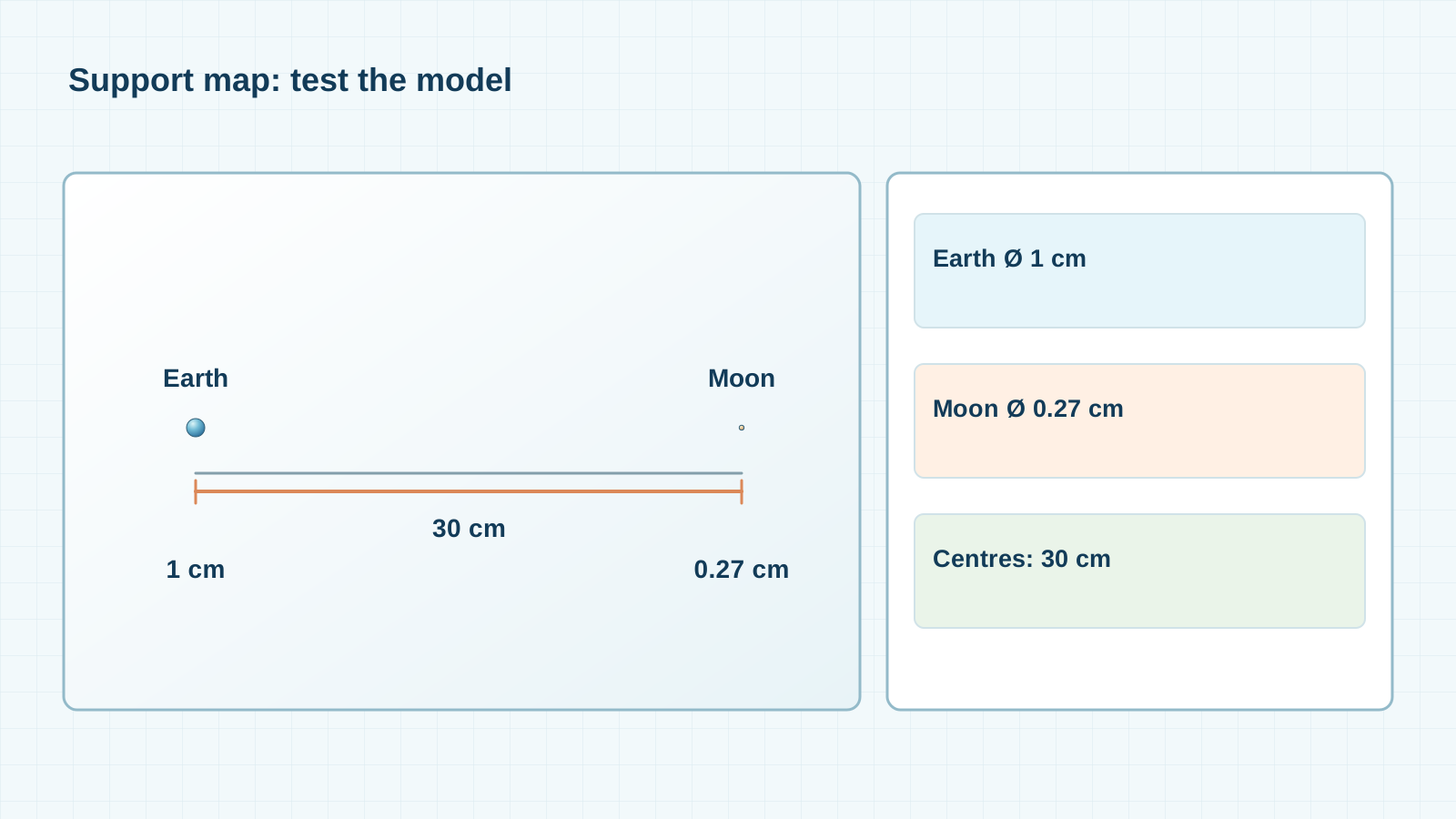
Supplied calculation: 384,000 ÷ 12,700 ≈ 30. With a model Earth 1 cm wide, the Moon’s centre is about 30 cm from Earth’s centre; its diameter is about 0.27 cm. Make Earth 10 cm wide and the Moon is about 3 m away, not 30 cm. Numbers are rounded. The diagram uses the first case: Earth 1 cm, Moon 0.27 cm, centre separation 30 cm.
Test safely
Draw a 1 cm circle. Measure 30 cm from its centre and draw a second circle roughly 3 mm wide. Mark the ruler and distinguish centre-to-centre distance from the gap between surfaces. Explain why enlarging both bodies while keeping them close destroys the common scale.
A common mistake
Mistake: an object that looks large in the sky must be large or close. Apparent angular size depends on both physical size and distance. Transfer question: if the model Earth’s diameter doubles, where must the Moon’s centre move? Show one proportion.
Support diagram
Check your understanding
Close the text and explain the left-to-right drawing to a new learner. Name an observation, a teaching assumption and something the evidence does not prove. Then answer the transfer question without a hint and check units or direction against the diagram. If you disagree, return to the first unfamiliar word rather than memorising a sentence. A spoken explanation, a drawing and a measurement are different kinds of evidence: label each honestly.
Lab notebook page
Add a line to My World Lab Notebook: question → prediction → controlled conditions → changed condition → observation or calculation → conclusion → limit. Put a scale on a drawing or mark it ‘schematic’. If you ran no experiment, write ‘supplied calculation’, not ‘we measured’. Revisit the entry after the next lesson and note what became clearer.
Source for values and model: NASA Science.
Next lesson: Does the Sun cross the sky, or do we turn with Earth?
If you have found a mistake or a typo in this article, tell us about it
Comments (0)
Log in to leave a comment →
No comments yet. Be the first.