


Physics around us: from a first experiment to your own lab Lesson 92 of 92
How does energy from a nucleus reach an electrical outlet?
Build the conversion chain and mark where our model stops.
Question and prediction
At a thermal power station, a turbine turns a generator. If the fuel changes, must every part of the route to an outlet change? Before reading, write familiar links: heat warms a working fluid, its flow turns a turbine, and a generator converts rotation to electrical energy. Now ask where the heat originates in this example.
New words without gaps
Nuclear fission splits a heavy nucleus into lighter parts while releasing energy and neutrons. A controlled chain reaction is a sequence of fissions whose rate is regulated. A reactor is an installation that sustains and controls this reaction while removing heat. A turbine is a machine turned by a flow; a generator converts rotation into electrical energy. A loop is a path for a heat-carrying fluid; power plants arrange loops differently. Radiation protection and radioactive materials require specialists and strict procedures.
Work through supplied data
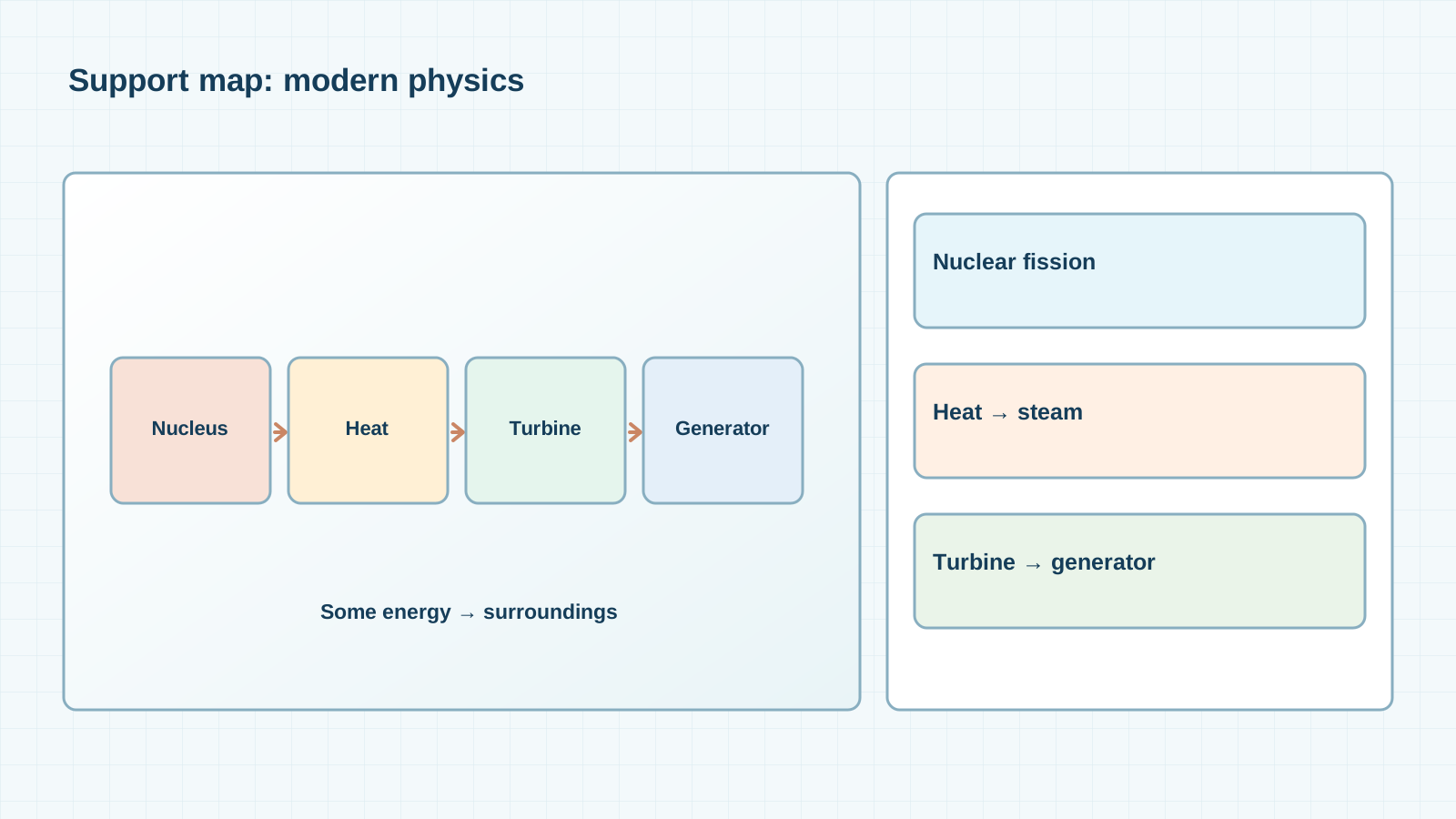
Schematic chain: fission → heat → warmed coolant and steam in an appropriate design → turbine rotation → generator → electricity. Steam is not made directly inside every type of reactor and need not travel to the turbine in the same loop; designs differ. The three stages on the right of the map are not a piping diagram of a real station. Energy is not created from nothing: it changes form, and some leaves for the environment as heat.
Test safely
Make a final notebook page with three columns: ‘what we know’, ‘which source supports it’, and ‘what the drawing omits’. Cite IAEA for the plant chain; return to earlier lessons for atoms and photons. Mark heat leaving the system in another colour and state that you did not measure how much. This is a paper investigation: do not experiment with radioactive materials or attempt to build a reactor.
A common mistake
Mistake: claiming a reactor directly produces electrical current, or that all released energy becomes electricity. Checkpoint: explain the whole chain to a beginner without skipping ‘coolant’, ’turbine’ or ‘generator’. Name one verified fact, one simplification in your drawing and one question that requires data from a specific plant.
Support diagram
Check your understanding
Close the text and explain the left-to-right drawing to a new learner. Name an observation, a teaching assumption and something the evidence does not prove. Then answer the transfer question without a hint and check units or direction against the diagram. If you disagree, return to the first unfamiliar word rather than memorising a sentence. A spoken explanation, a drawing and a measurement are different kinds of evidence: label each honestly.
Lab notebook page
Add a line to My World Lab Notebook: question → prediction → controlled conditions → changed condition → observation or calculation → conclusion → limit. Put a scale on a drawing or mark it ‘schematic’. If you ran no experiment, write ‘supplied calculation’, not ‘we measured’. Revisit the entry after the next lesson and note what became clearer.
Evidence source: www.iaea.org.
If you have found a mistake or a typo in this article, tell us about it
Comments (0)
Log in to leave a comment →
No comments yet. Be the first.