


Physics around us: from a first experiment to your own lab Lesson 88 of 92
Are sunlight, X-rays and radioactivity the same thing?
Separate types of radiation and learn protection without handling sources.
Question and prediction
Sunlight and an X-ray image both involve ‘radiation’. Do they affect matter in the same way? First identify what they share: energy travels away from a source. Then ask whether one particle or photon has enough energy to remove an electron from an atom. That boundary matters more than the frightening word on a label.
New words without gaps
Radiation is energy travelling as waves or particles. Ionization removes an electron from an atom or molecule, leaving a charged particle called an ion. Ionizing radiation can cause this change; X-rays, gamma rays and some decay particles qualify. Visible light does not normally ionize matter. Dose describes exposure received, while source activity describes decays per unit time: they are different quantities. The label ‘radioactive’ alone does not calculate one person’s dose.
Work through supplied data
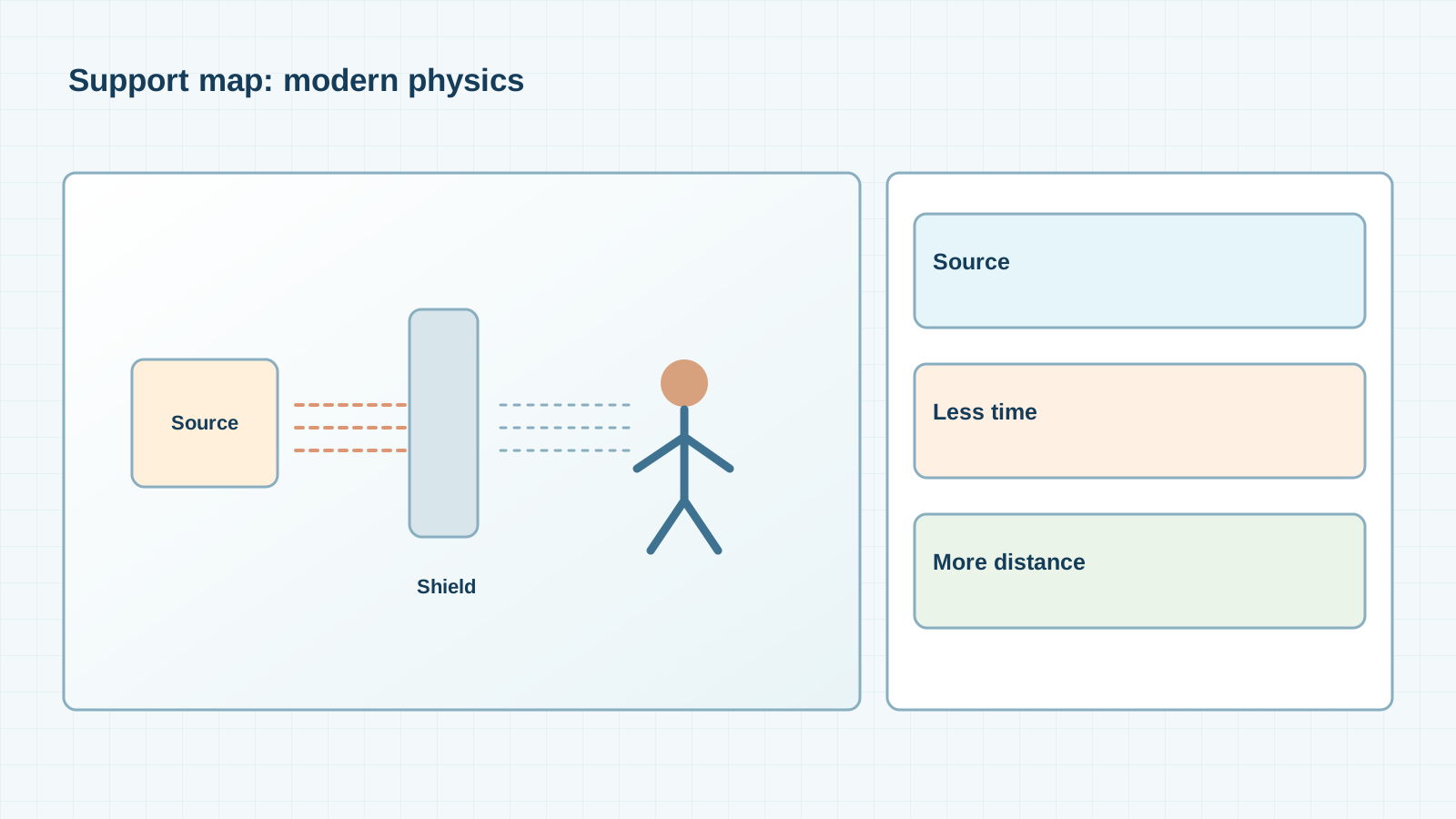
Qualitative example: an external source stays behind the boundary of a protected area. Less time near it, greater distance and a suitable barrier between person and source can reduce exposure. The useful barrier depends on radiation type and energy; paper and a thick shield are not interchangeable for every kind. Our diagram shows directions for action, not a universally safe distance or thickness.
Test safely
On paper, draw a source, a person and a protective barrier. Write three questions for a trained specialist: what radiation type, what measured dose rate at the person’s location, and what shield has been designed for it? Mark that you measured nothing. Do not open equipment, search for sources or experiment with unknown materials at home. If you suspect a source, follow responsible authorities’ instructions.
A common mistake
Mistake: thinking all light is radioactive or that one shield fits every radiation type. Transfer: can you find a student’s dose from the source’s decay count without knowing distance, time and radiation type? Explain what information is missing.
Support diagram
Check your understanding
Close the text and explain the left-to-right drawing to a new learner. Name an observation, a teaching assumption and something the evidence does not prove. Then answer the transfer question without a hint and check units or direction against the diagram. If you disagree, return to the first unfamiliar word rather than memorising a sentence. A spoken explanation, a drawing and a measurement are different kinds of evidence: label each honestly.
Lab notebook page
Add a line to My World Lab Notebook: question → prediction → controlled conditions → changed condition → observation or calculation → conclusion → limit. Put a scale on a drawing or mark it ‘schematic’. If you ran no experiment, write ‘supplied calculation’, not ‘we measured’. Revisit the entry after the next lesson and note what became clearer.
Evidence source: www.iaea.org.
Next lesson: Why can bright red light fail where faint blue light works?
If you have found a mistake or a typo in this article, tell us about it
Comments (0)
Log in to leave a comment →
No comments yet. Be the first.