


Physics around us: from a first experiment to your own lab Lesson 91 of 92
Why can a satellite clock not simply copy time on Earth?
Add two measured GPS corrections and learn the limits of the classroom model.
Question and prediction
A navigation receiver finds position from travel times of radio signals sent by satellites. Even a tiny clock error changes the inferred distance. Recall the earlier blocks: speed is distance per time, a radio wave carries a signal, and a satellite follows an orbit. Predict whether a moving clock high above Earth will keep exactly the same time as a clock on the ground.
New words without gaps
Relativity is a well-tested physical theory of space, time and motion. Two effects matter when comparing satellite and ground clocks. Orbital motion makes a satellite clock run slightly slower; the different gravitational field at altitude makes it run faster. A microsecond, µs, is one millionth of a second. ‘Faster’ and ‘slower’ compare clock readings after accounting for motion and location; they do not mean a clock is broken.
Work through supplied data
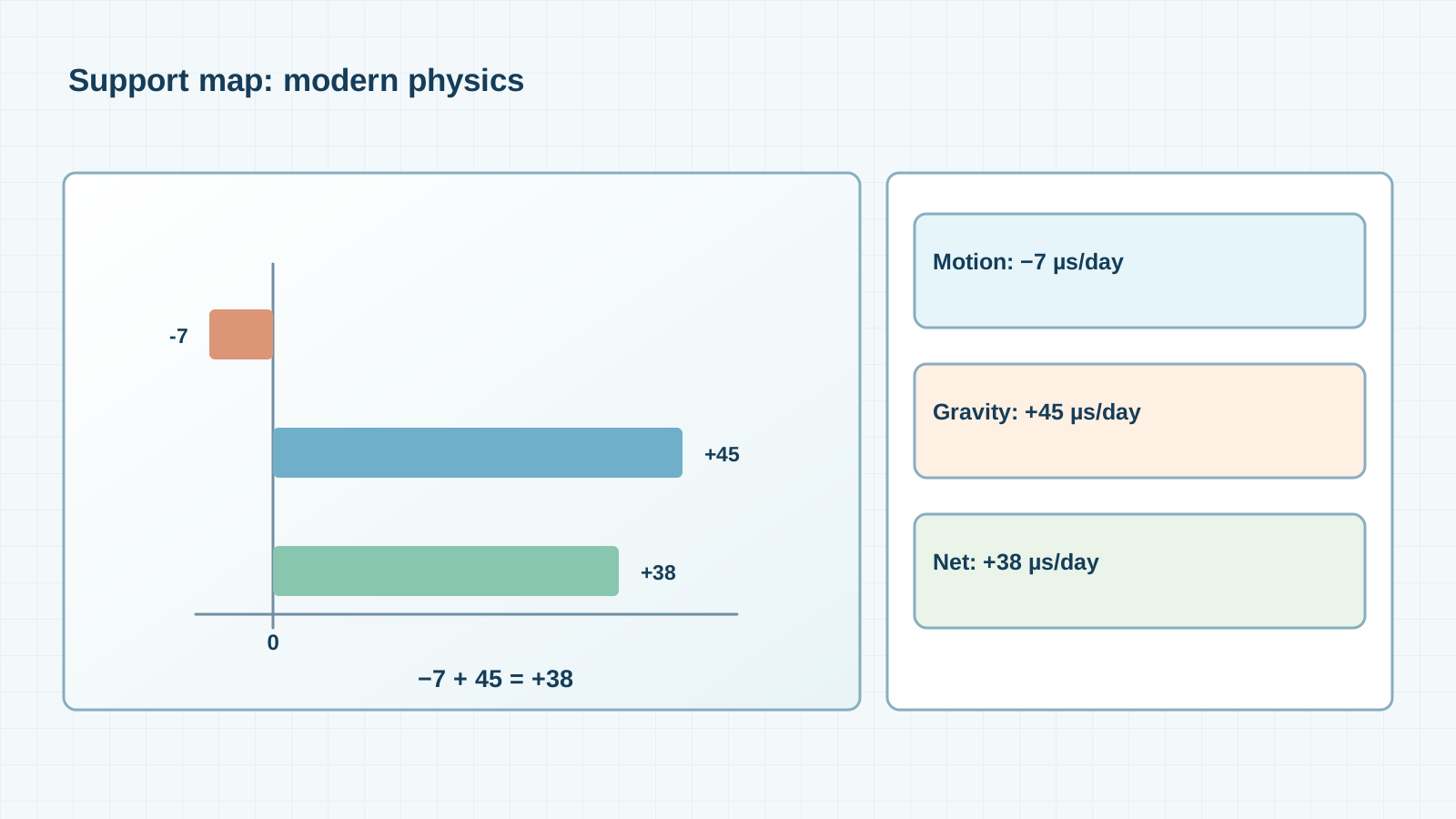
NASA gives approximate GPS values: motion contributes −7 µs per day, while the gravitational difference contributes +45 µs per day. Their sum is −7 + 45 = +38 µs per day relative to ground clocks. The plus sign means the satellite clock would get ahead without the needed correction. This is not a number for every satellite; different heights and speeds change the effects. The diagram puts both contributions and the net change on one number line. Earth size and orbital altitude are not to scale.
Test safely
On graph paper, move seven squares left from zero and forty-five squares right. The result is thirty-eight squares to the right. Explain why ‘it moves, so its clock must run slower’ is incomplete: the second effect is larger. Only paper and arithmetic are needed, not a receiver or precision clock.
A common mistake
Mistake: adding 7 and 45 without signs, or assigning +38 µs/day to every spacecraft. Transfer: in an invented case motion contributes −12 and altitude +20 units. What is the net change? Why is that no substitute for a real GPS calculation? Separate invented figures from NASA’s approximate GPS values.
Support diagram
Check your understanding
Close the text and explain the left-to-right drawing to a new learner. Name an observation, a teaching assumption and something the evidence does not prove. Then answer the transfer question without a hint and check units or direction against the diagram. If you disagree, return to the first unfamiliar word rather than memorising a sentence. A spoken explanation, a drawing and a measurement are different kinds of evidence: label each honestly.
Lab notebook page
Add a line to My World Lab Notebook: question → prediction → controlled conditions → changed condition → observation or calculation → conclusion → limit. Put a scale on a drawing or mark it ‘schematic’. If you ran no experiment, write ‘supplied calculation’, not ‘we measured’. Revisit the entry after the next lesson and note what became clearer.
Evidence source: assets.science.nasa.gov.
Next lesson: How does energy from a nucleus reach an electrical outlet?
If you have found a mistake or a typo in this article, tell us about it
Comments (0)
Log in to leave a comment →
No comments yet. Be the first.