


Physics around us: from a first experiment to your own lab Lesson 89 of 92
Why can bright red light fail where faint blue light works?
Learn photons and the photoelectric threshold without hazardous ultraviolet light.
Question and prediction
You already know frequency: how many wave cycles occur each second. Imagine light must free an electron from a surface. Will making the same colour brighter always help? First separate the number of arriving portions of light from the energy of each portion. These are different ways to change illumination.
New words without gaps
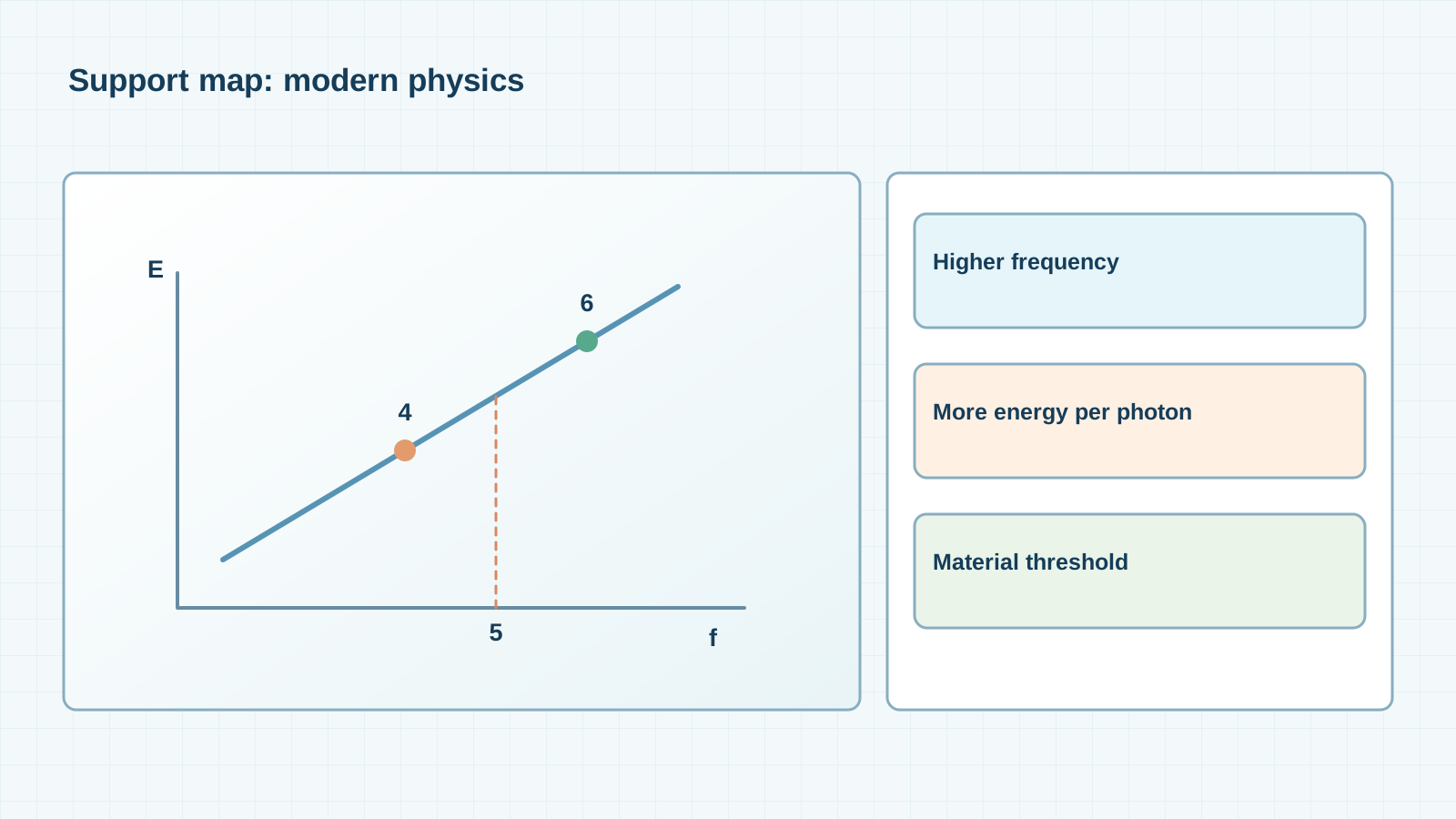
A photon is one packet of electromagnetic energy. Higher frequency means more energy in each photon: E = h·f, where E is one photon’s energy, f is frequency and h is Planck’s constant. The photoelectric effect is electrons leaving a suitable material after it absorbs light. Threshold frequency is the lowest frequency at which one photon can provide enough energy to free an electron from that material. Brightness often tracks photon number, but at fixed frequency it does not increase each photon’s energy.
Work through supplied data
Invented teaching case, not a named metal: a surface has a threshold of 5 arbitrary frequency units. Frequency 4 cannot release an electron by this single-photon process even with many photons; frequency 6 may release one if absorbed. The units and values are for comparison, not measured data. The vertical line on the map is the threshold; photon count is a separate dimension.
Test safely
Make ten cards labelled 4 and two labelled 6. Suppose one attempt at release needs one card worth at least 5. Count the cards that pass; do not merge ten fours into a single photon. This is a simple threshold model, not an actual experiment. Do not use UV lamps, lasers or exposed electrical circuits.
A common mistake
Mistake: substituting total brightness for one photon’s energy. Real materials also reflect, absorb and lose energy; cards omit those effects. Transfer: if frequency doubles, what happens to one photon’s energy under E = h·f? What if only the number of photons at the original frequency doubles?
Support diagram
Check your understanding
Close the text and explain the left-to-right drawing to a new learner. Name an observation, a teaching assumption and something the evidence does not prove. Then answer the transfer question without a hint and check units or direction against the diagram. If you disagree, return to the first unfamiliar word rather than memorising a sentence. A spoken explanation, a drawing and a measurement are different kinds of evidence: label each honestly.
Lab notebook page
Add a line to My World Lab Notebook: question → prediction → controlled conditions → changed condition → observation or calculation → conclusion → limit. Put a scale on a drawing or mark it ‘schematic’. If you ran no experiment, write ‘supplied calculation’, not ‘we measured’. Revisit the entry after the next lesson and note what became clearer.
Evidence source: www.energy.gov.
Next lesson: Why does a gas have its own set of coloured lines?
If you have found a mistake or a typo in this article, tell us about it
Comments (0)
Log in to leave a comment →
No comments yet. Be the first.