

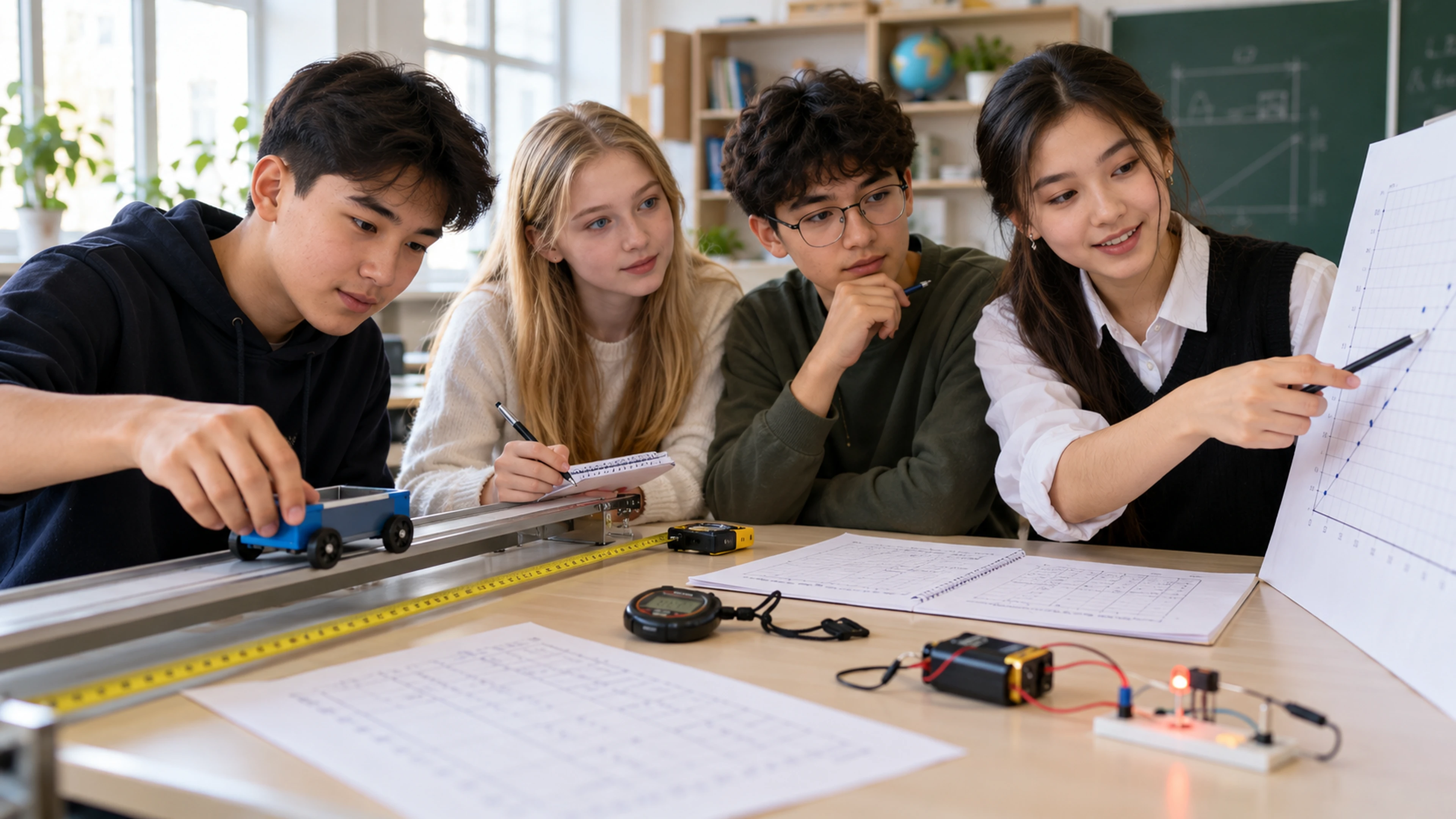
Physics around us: from a first experiment to your own lab Lesson 98 of 100
What do the numbers prove, and what does a source prove?
Separate supplied data, physics explanation and guesses.
Question and prediction
It is easy to write “Fabric always stops every cart better”. Six practice numbers have not earned “always”. It is just as easy to copy a definition of friction and call it a personal observation. A careful researcher labels where each important sentence came from.
New words without gaps
Data are outcomes recorded under a stated procedure. A source is a text or record where someone else can check an explanation; cite the relevant page. A claim is a statement we try to support. A limitation is a condition beyond which evidence is insufficient. OpenStax explains contact forces and friction, but cannot verify the invented 82 and 45 cm in our exercise.
Work through supplied data
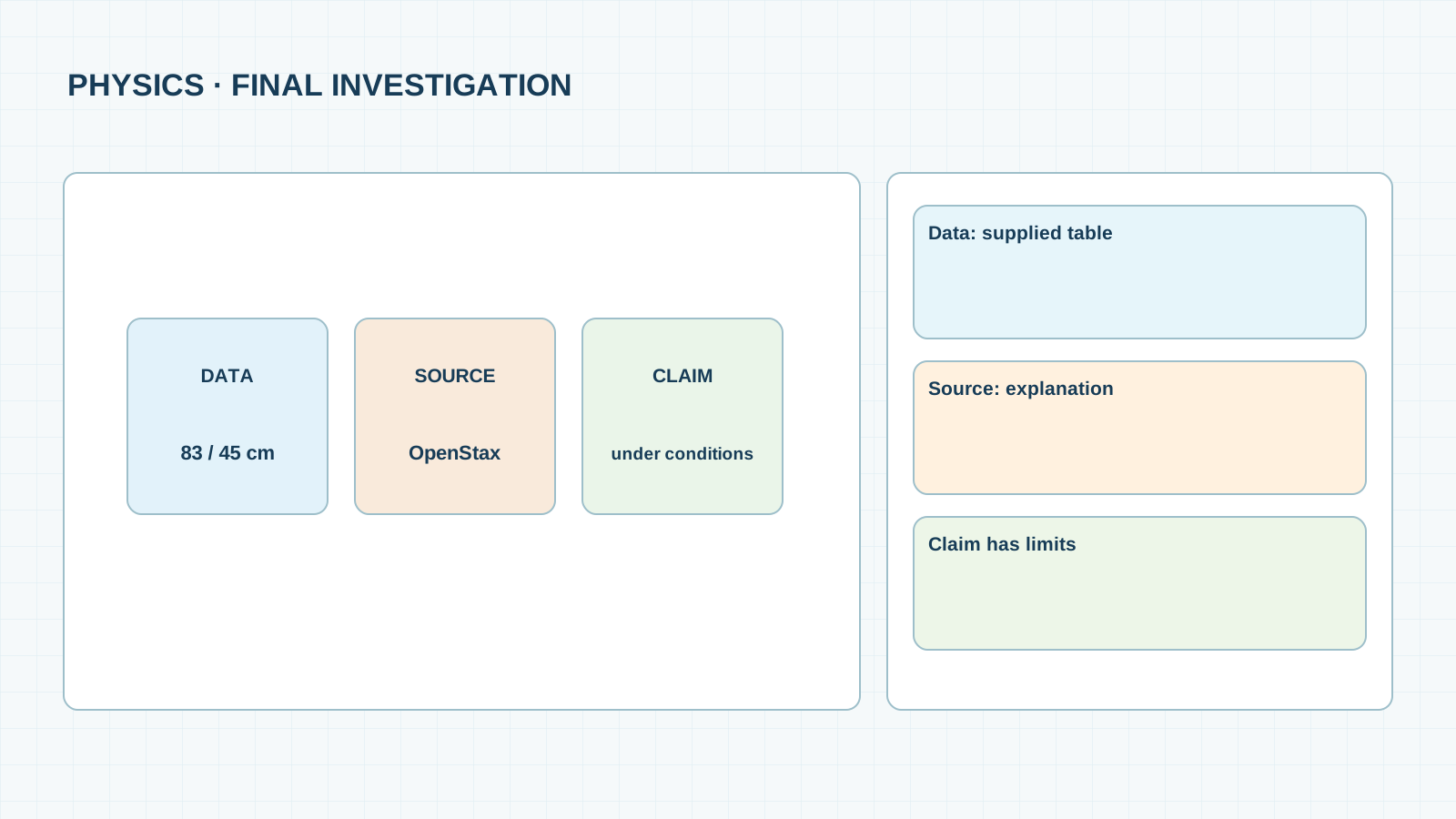
Three lines: “means of 83 and 45 cm” is a calculation from supplied data; “a contact force can oppose motion” is a textbook explanation; “every cart loses exactly 38 cm” is unsupported generalisation. Distance is measured in cm; force in N. A textbook link does not turn a calculation into your own experiment.
Test safely
Make a claim log: sentence; kind of support; exact table row or page link; limit. For outside text write the organisation, page title and address. If you did not run the trial, label its numbers “supplied for practice”, not “we measured”.
A common mistake
Mistake: believing one citation supports every nearby sentence. Transfer: a friend says smooth floors are always more dangerous than carpets. What new conditions and observations would such a real-world conclusion need?
Support diagram
Check your understanding
Close the text and explain the left-to-right drawing to a new learner. Name an observation, a teaching assumption and something the evidence does not prove. Then answer the transfer question without a hint and check units or direction against the diagram. If you disagree, return to the first unfamiliar word rather than memorising a sentence. A spoken explanation, a drawing and a measurement are different kinds of evidence: label each honestly.
Lab notebook page
Add a line to My World Lab Notebook: question → prediction → controlled conditions → changed condition → observation or calculation → conclusion → limit. Put a scale on a drawing or mark it ‘schematic’. If you ran no experiment, write ‘supplied calculation’, not ‘we measured’. Revisit the entry after the next lesson and note what became clearer.
Checkable source for the explanation: OpenStax: Friction.
If you have found a mistake or a typo in this article, tell us about it
Comments (0)
Log in to leave a comment →
No comments yet. Be the first.