

Physics around us: from a first experiment to your own lab Lesson 102 of 104
Can a temperature drop be converted into joules?
Connect water mass, specific heat capacity and temperature change without mistaking a model for a meter.
The question
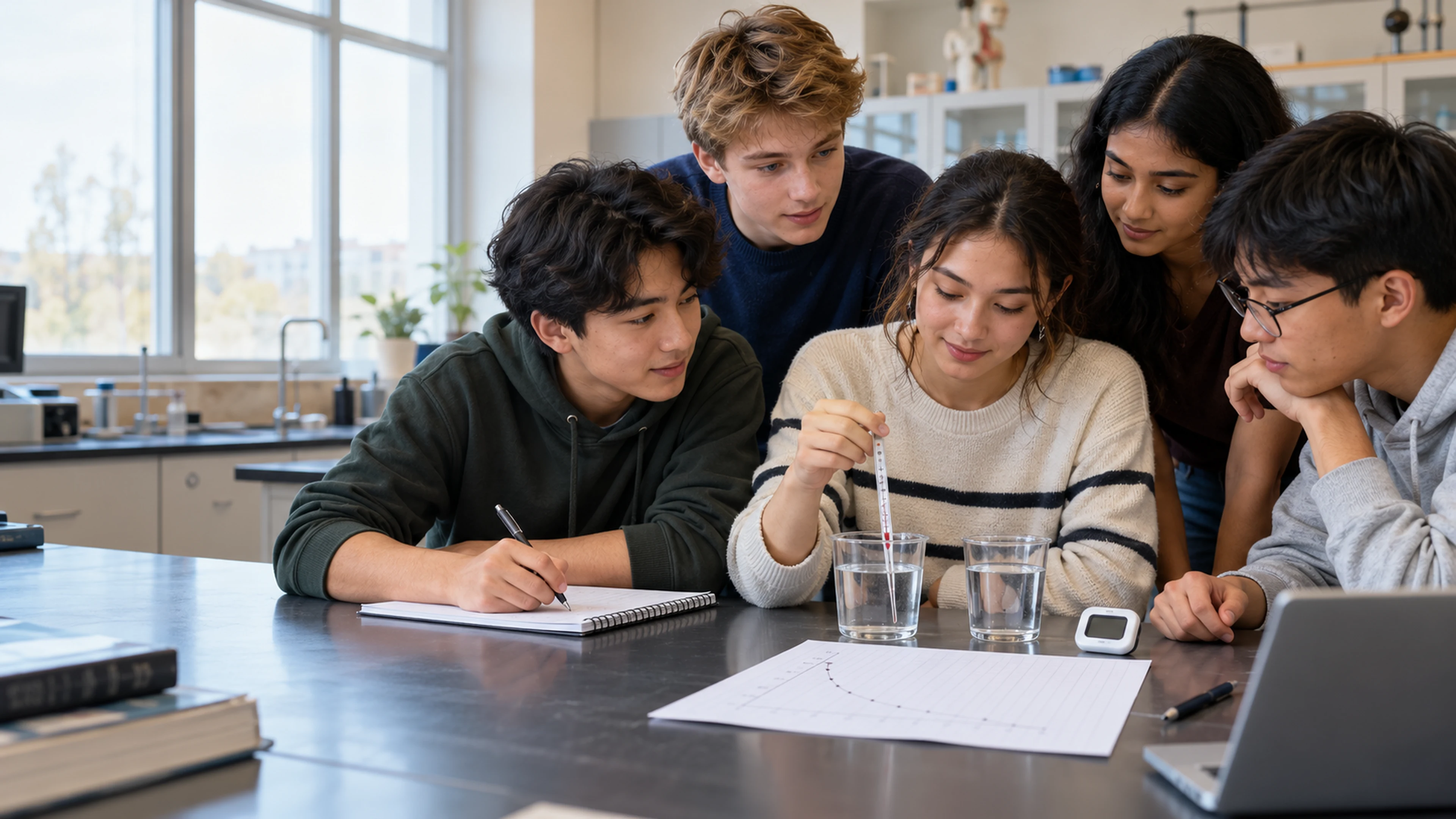
The first investigation gave drops of 9 °C and 6 °C. It is tempting to say the open cup lost “three more joules”. But degrees and joules describe different quantities. We also need water mass and its specific heat capacity. Use the same supplied data so the calculation stays connected to the observation.
Concept map
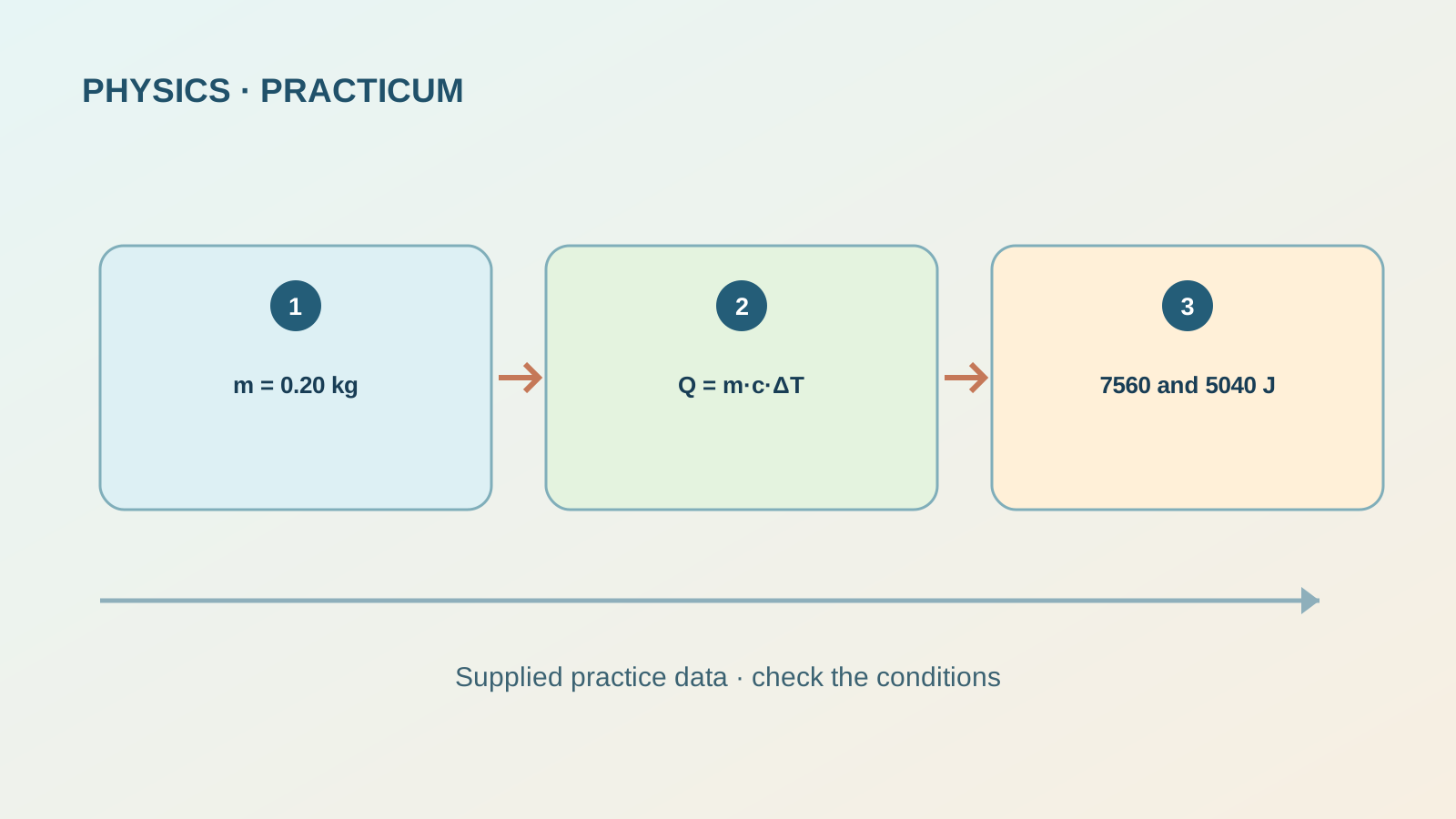
The mass of water tells us how many kilograms of water we used; its unit is the kilogram (kg). Specific heat capacity c tells us the energy needed to warm 1 kg of a substance by 1 °C. For liquid water, a school-level approximation is c = 4200 J/(kg·°C). A joule (J) is a unit of energy. With constant mass and no change of state, the magnitude of energy given up by the water is estimated by Q = m·c·ΔT. ΔT means the size of the temperature change, not a new measuring device.
Worked numbers
Suppose each cup contains 0.20 kg of water. Open cup: Q = 0.20 × 4200 × 9 = 7560 J. Covered cup: Q = 0.20 × 4200 × 6 = 5040 J. The estimated difference is 2520 J. This estimates energy given up by the water in fifteen minutes under a simplified model. It is not automatically the loss from the whole system: the glass stores energy, water can evaporate, and the room and lid exchange energy. We did not measure evaporated mass either.
Safe practice
Draw a support diagram: water → cup wall/air/vapour → surroundings. Label a plausible transfer route on each arrow. Check the units: kg × J/(kg·°C) × °C = J. Recalculate the covered cup for 0.10 kg of water and the same 6 °C drop: the result is 2520 J. That is a mathematical comparison, not a new measurement. Do not handle boiling water or use electrical weighing equipment beside water.
Check your reasoning
Self-check: why can the 3 °C difference between cups alone not determine Q? When would a calculation using c for liquid water be insufficient? Transfer: if one cup holds twice as much water, does the same temperature drop mean the same energy loss?
Investigation map
Lab notebook
Give your notebook three columns: “My prediction”, “What the data show”, and “What the data cannot prove”. Fill the first before looking at the worked answer; revise an explanation that fails the check. If you perform a real experiment, keep your own readings distinct from the supplied practice values.
If you have found a mistake or a typo in this article, tell us about it
Comments (0)
Log in to leave a comment →
No comments yet. Be the first.