


Physics around us: from a first experiment to your own lab Lesson 104 of 104
“Saves energy”: how can we test that claim?
Build an honest conclusion from a question, comparison, calculation and limits.
The question
An advert promises: “this lid saves 30% of electricity when heating water.” Our covered cup was indeed 3 °C warmer after fifteen minutes. Does that establish the advertised percentage? No. Cooling water that was already warm and measuring electricity while heating are different investigations. The cup experiment can, however, help us frame a testable question.
Concept map
A criterion is a condition of success chosen beforehand. A control is the comparison version without the change being tested. Reproducibility means another person could follow the described procedure. Measurement uncertainty is a range of doubt, not a reason to erase an awkward result. To compare consumption, hold the starting and target temperatures, water mass, appliance, vessel and room conditions alike, changing only the lid. Energy consumed needs a suitable certified meter for measurement, or reliable rated power and time for an estimate.
Worked numbers
Here is a supplied calculation only: suppose the appliance used 0.060 kWh without the lid and 0.054 kWh with it. The difference is 0.006 kWh. Relative saving for these invented numbers is 0.006 / 0.060 × 100% = 10%, not 30%. Repeated trials might range from 0.059–0.061 and 0.053–0.055 kWh, for example. This illustrates a method; it is not a product test, a saving guarantee or an estimate of any family’s bill.
Safe practice
Write a paper plan with a question, prediction, changed variable, measured quantity, five conditions kept alike, at least three repeats, a table and the percentage formula. Separate what the supplied data say from what you would still have to measure. There is no need to work with a mains-powered heater yourself. Without a safely organised laboratory and an adult specialist, stay with the paper model and appliance specifications, and do not present those as live meter readings.
Check your reasoning
Checkpoint: write a conclusion in three sentences: what the numbers show, what they cannot prove and what you would measure next. Check that the percentage uses 0.060 kWh, the no-lid baseline, as its denominator rather than 0.054. Transfer: could you promise the same percentage for another water volume and kettle? Explain why or why not.
Investigation map
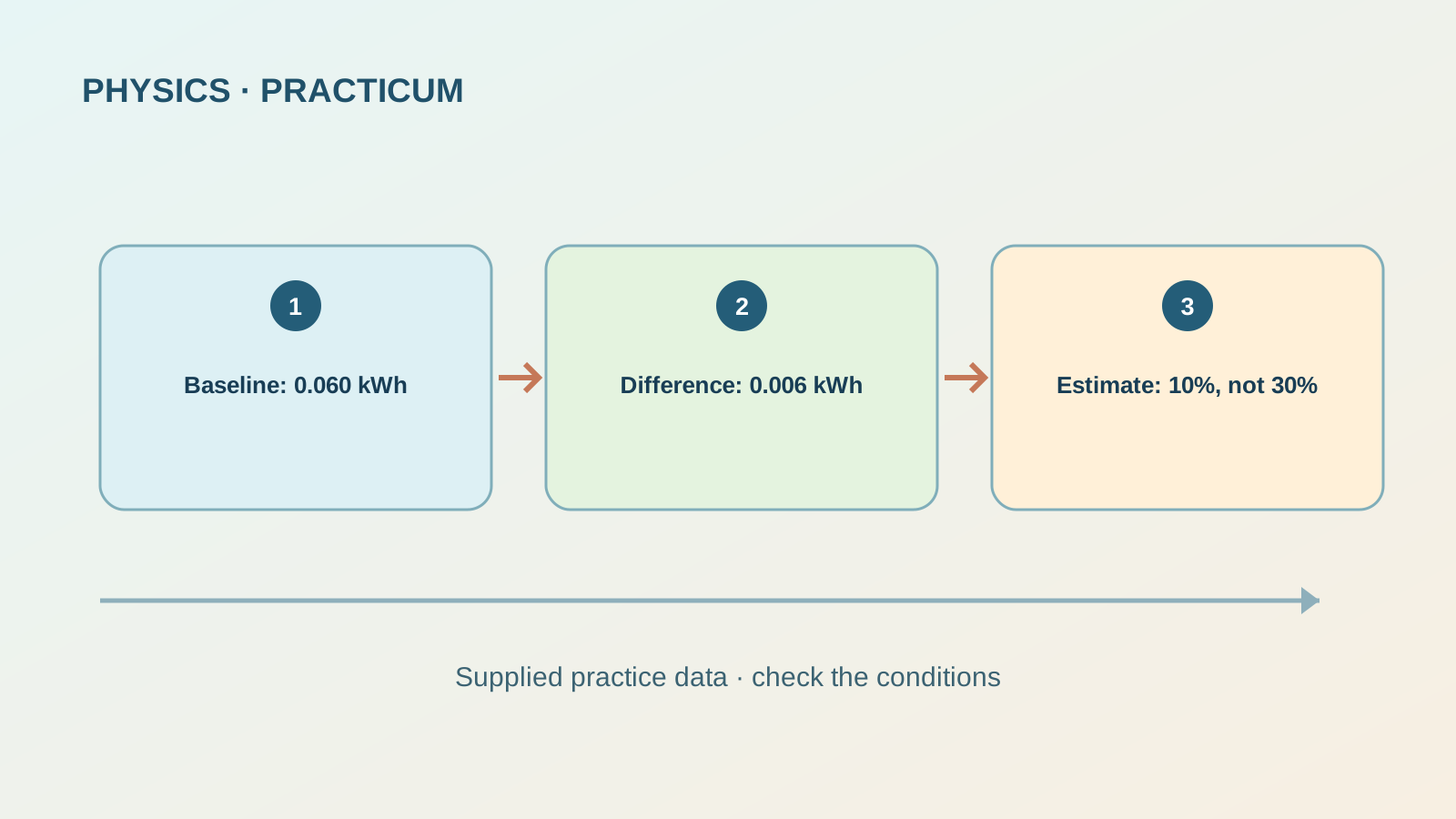
Lab notebook
Give your notebook three columns: “My prediction”, “What the data show”, and “What the data cannot prove”. Fill the first before looking at the worked answer; revise an explanation that fails the check. If you perform a real experiment, keep your own readings distinct from the supplied practice values.
If you have found a mistake or a typo in this article, tell us about it
Comments (0)
Log in to leave a comment →
No comments yet. Be the first.