


Physics around us: from a first experiment to your own lab Lesson 95 of 100
Why is one result not enough?
Repeats show spread but do not prove absolute accuracy.
Question and prediction
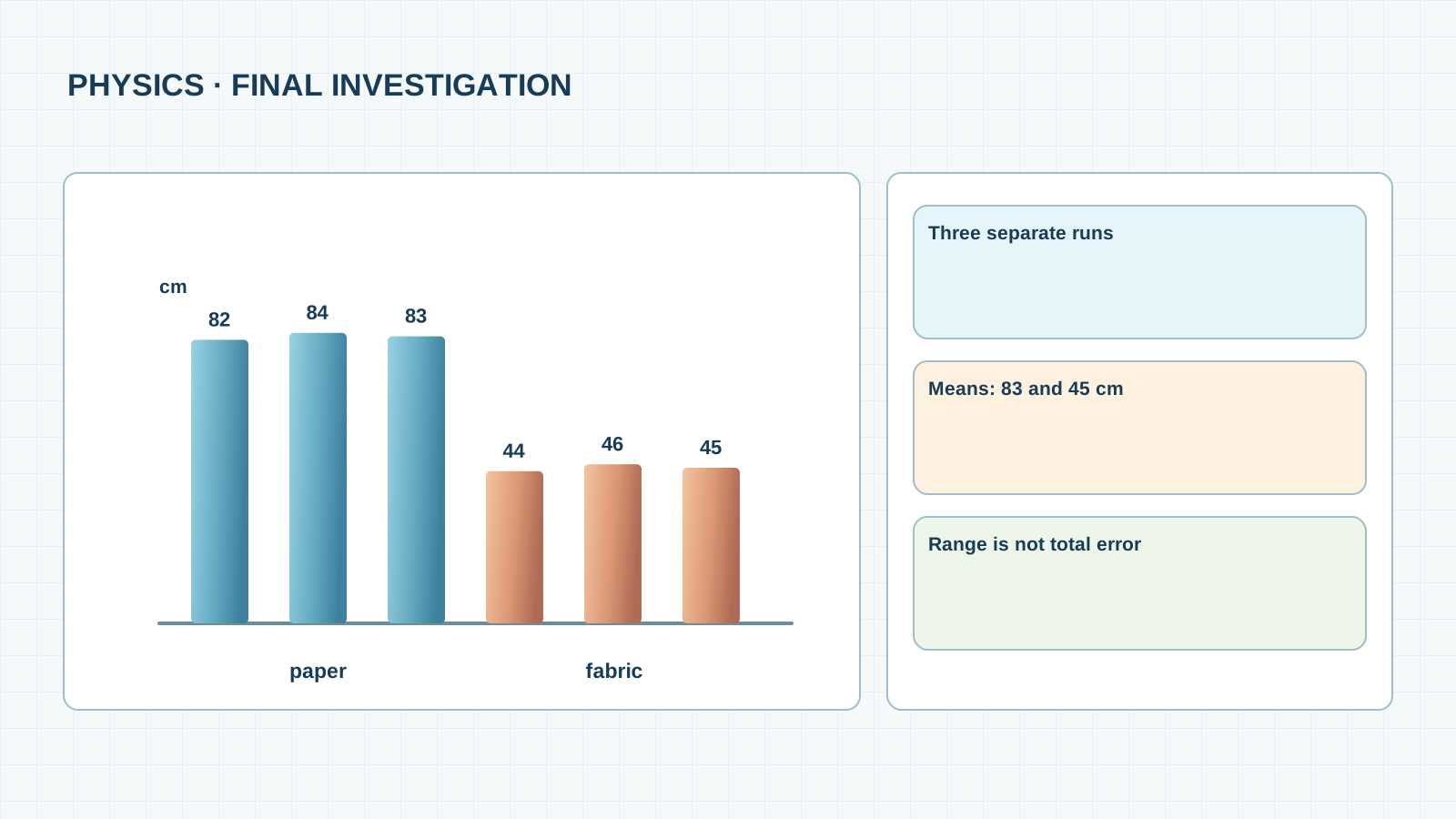
Three paper runs gave 82, 84 and 83 cm. That is no reason to choose the prettiest number and hide the others. Small differences may come from release, surface or ruler reading. Predict a sensible summary value and how you would report the spread.
New words without gaps
The arithmetic mean is the total divided by the number of readings. The range is maximum minus minimum. Repeatability means readings are close under one method. Measurement uncertainty describes reasonable possible values after considering tool and method; the range of three trials is not automatically total uncertainty. A systematic error, such as a shifted zero, can persist in every trial.
Work through supplied data
Supplied calculation: (82 + 84 + 83) / 3 = 83 cm; range 84 − 82 = 2 cm. On fabric, (44 + 46 + 45) / 3 = 45 cm, also with range 2 cm. “83 cm, individual values 82–84 cm” is more honest than “83.000 cm”. We have not separately evaluated accuracy of the whole method.
Test safely
Recalculate both means without looking. Now imagine the zero shifted by 5 cm for all six readings: ranges stay the same, but the values are wrong. Propose an independent zero check with another ruler. If you did not run the experiment, never call these supplied numbers your observations.
A common mistake
Mistake: treating half the range as a proven bound on every error. Transfer: a faulty ruler gives 40, 40, 40 cm. Why does their agreement not prove correctness?
Support diagram
Check your understanding
Close the text and explain the left-to-right drawing to a new learner. Name an observation, a teaching assumption and something the evidence does not prove. Then answer the transfer question without a hint and check units or direction against the diagram. If you disagree, return to the first unfamiliar word rather than memorising a sentence. A spoken explanation, a drawing and a measurement are different kinds of evidence: label each honestly.
Lab notebook page
Add a line to My World Lab Notebook: question → prediction → controlled conditions → changed condition → observation or calculation → conclusion → limit. Put a scale on a drawing or mark it ‘schematic’. If you ran no experiment, write ‘supplied calculation’, not ‘we measured’. Revisit the entry after the next lesson and note what became clearer.
If you have found a mistake or a typo in this article, tell us about it
Comments (0)
Log in to leave a comment →
No comments yet. Be the first.