

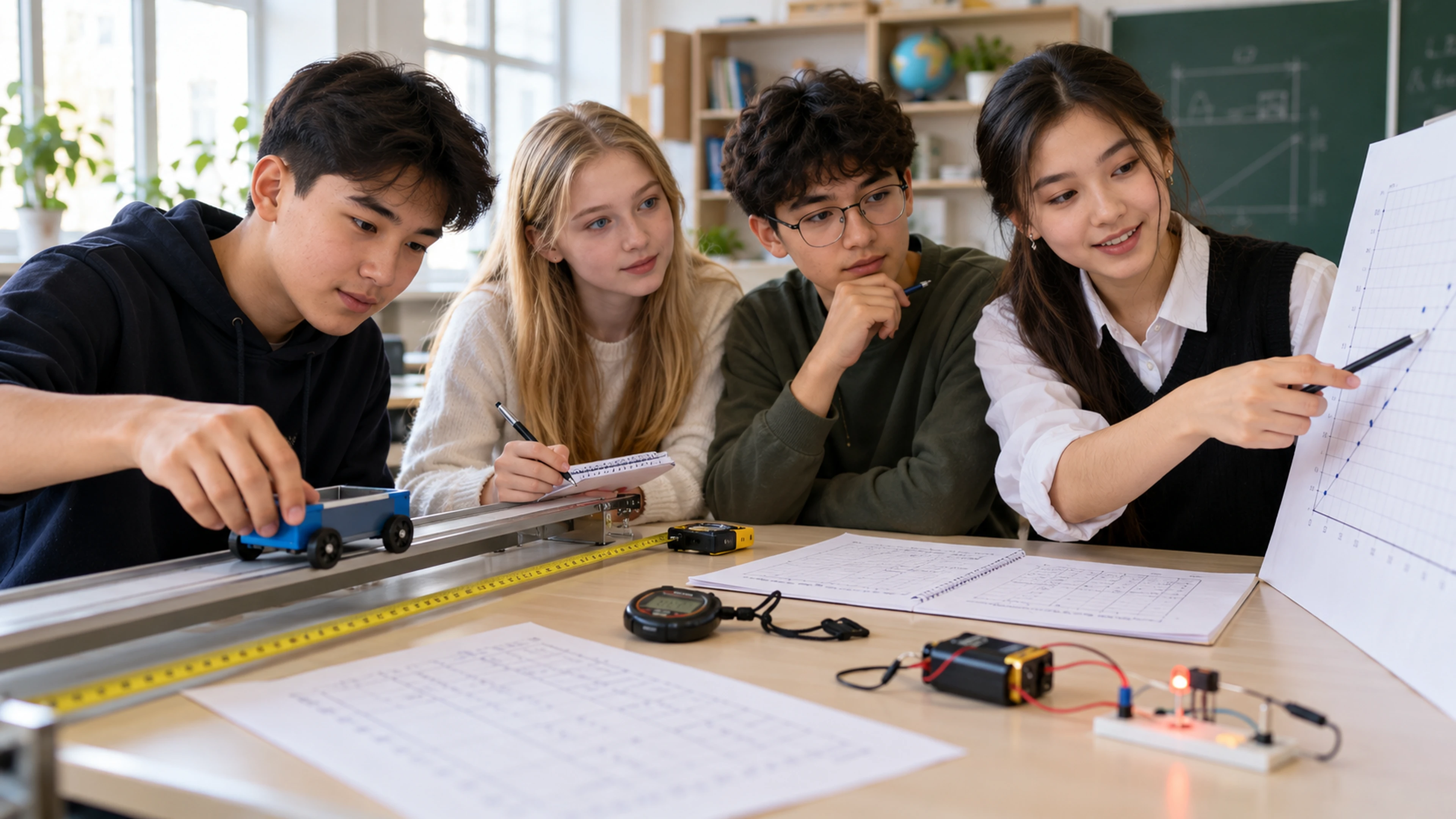
Physics around us: from a first experiment to your own lab Lesson 100 of 100
How do you defend an investigation?
Finish the course with a reproducible report and an honest conclusion.
Question and prediction
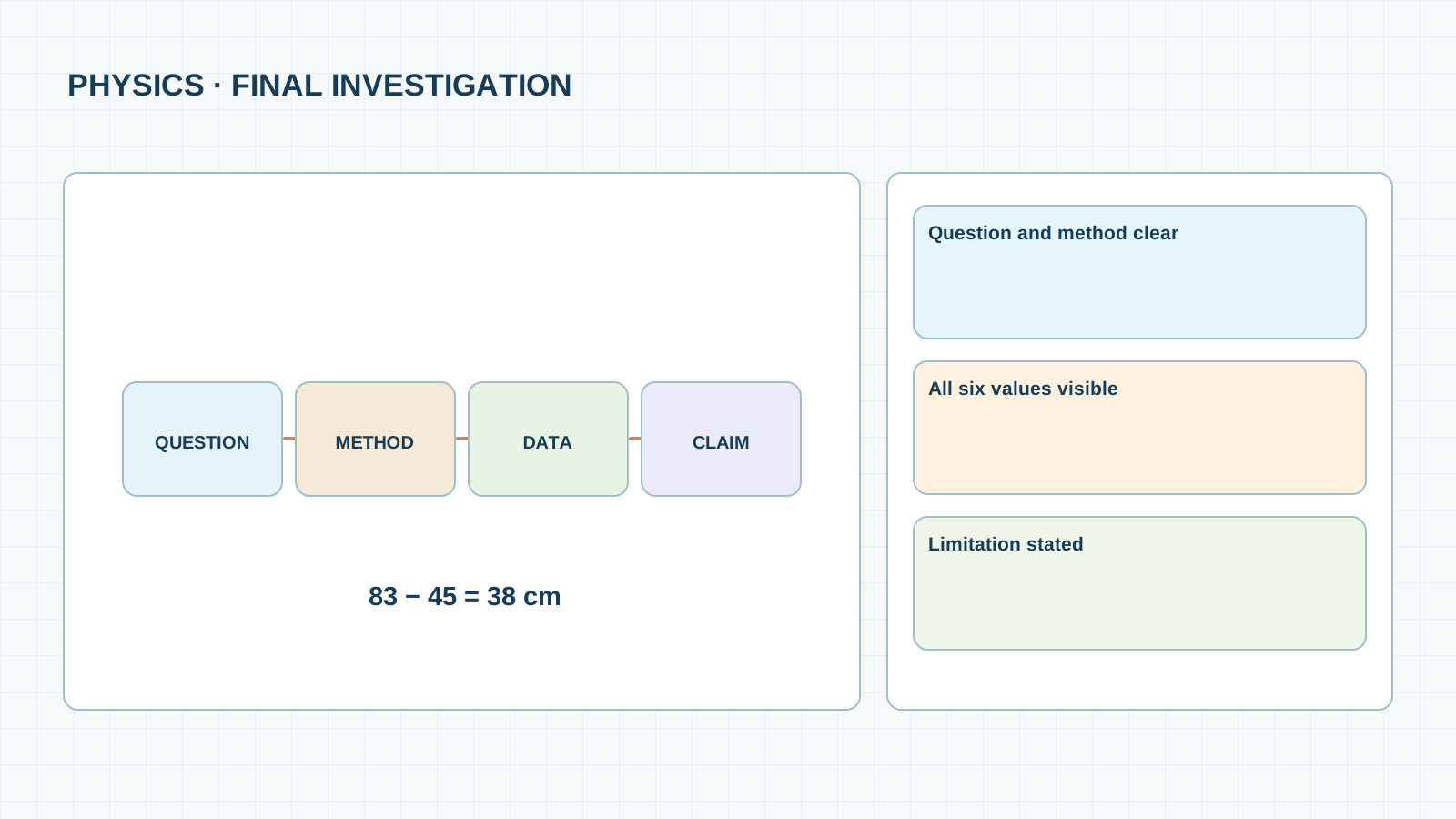
A classmate asks, “Where did 38 cm come from? Why blame fabric? What if the ruler was damaged?” A strong defence does not require pretending to know everything. Open the lab notebook, show the raw values and calculation, name the limits of the claim and propose another check.
New words without gaps
Reproducibility means someone else can follow your description and obtain comparable, not necessarily identical, values. A conclusion answers the opening question only under tested conditions. Evidence here includes method, raw readings, calculation and a checkable source for the explanation. Feedback is a specific comment that improves a method. An unexpected result does not make an experiment pointless.
Work through supplied data
A model based on supplied data: “Paper runs were 82, 84, 83 cm; fabric runs were 44, 46, 45 cm. Means were 83 and 45 cm, differing by 38 cm. In this set the cart ran less far on fabric. We did not perform actual controls or measure a friction coefficient.” If you ran a real test, replace the supplied numbers with your own notebook, not the reverse.
Test safely
Put on one page: question, prediction, sketch with zero, materials and safety, every trial, means, zero-based chart, conclusion, rival cause, exact source and next test. Give your instructions to another person without spoken hints. Note which step was unclear to them and rewrite that step.
A common mistake
Mistake: declaring the result “proved forever” from six supplied numbers. In your defence answer: what did you change, what observation could overturn the claim, and how will you improve the next trial? An honest answer grounded in numbers matters more than polished speech.
Support diagram
Check your understanding
Close the text and explain the left-to-right drawing to a new learner. Name an observation, a teaching assumption and something the evidence does not prove. Then answer the transfer question without a hint and check units or direction against the diagram. If you disagree, return to the first unfamiliar word rather than memorising a sentence. A spoken explanation, a drawing and a measurement are different kinds of evidence: label each honestly.
Lab notebook page
Add a line to My World Lab Notebook: question → prediction → controlled conditions → changed condition → observation or calculation → conclusion → limit. Put a scale on a drawing or mark it ‘schematic’. If you ran no experiment, write ‘supplied calculation’, not ‘we measured’. Revisit the entry after the next lesson and note what became clearer.
If you have found a mistake or a typo in this article, tell us about it
Comments (0)
Log in to leave a comment →
No comments yet. Be the first.