

Physics around us: from a first experiment to your own lab Lesson 101 of 104
Why do two cups of water cool differently?
Plan a safe cooling comparison and read temperature against time.
The question
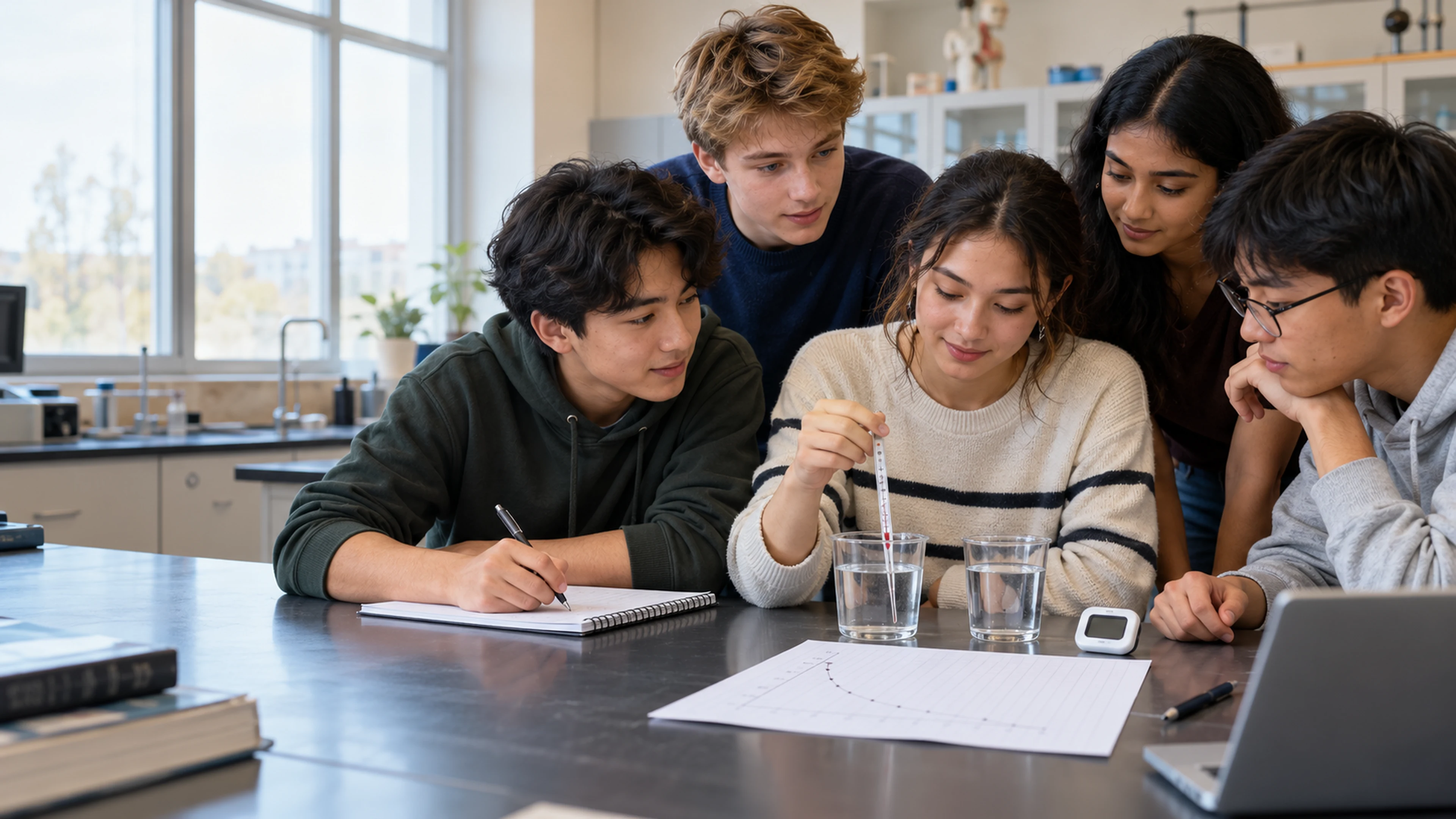
Pour equal amounts of warm water into two identical cups and cover one. Which will be warmer after fifteen minutes? Write a prediction and a reason first. A lid may reduce evaporation and air movement above the water, but it cannot stop all heat transfer. That is why we compare readings instead of promising to “keep all the heat”.
Concept map
Temperature describes the thermal state of a body; a thermometer reads it in degrees Celsius (°C). Heat transfer moves energy from a warmer region towards a cooler one. Conduction acts through contact, convection involves moving liquid or gas, and evaporation carries energy away with escaping water molecules. Several routes can operate at once. Begin timing both cups at the same moment.
Worked numbers
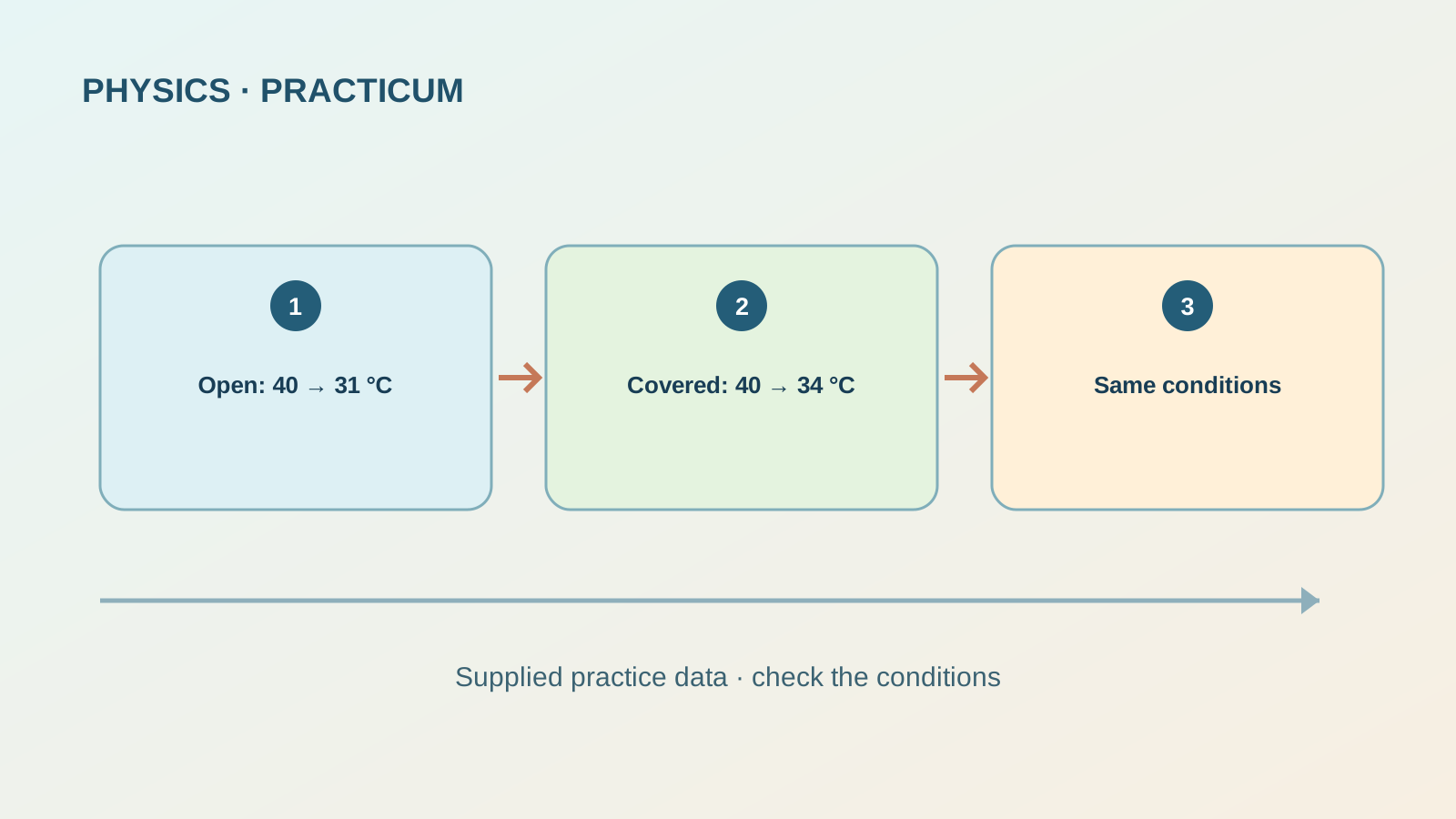
These are supplied practice data, not our measurements: at minute 0 both cups are at 40 °C; at 5 minutes the open cup is 36 °C and the covered one 37 °C; at 10 minutes they are 33 and 35 °C; at 15 minutes they are 31 and 34 °C. The open cup drops by 40 − 31 = 9 °C and the covered one by 40 − 34 = 6 °C. Their final readings differ by 3 °C. Temperature change alone does not yet tell us energy in joules.
Safe practice
For a real investigation use only comfortably warm water, about 35–40 °C, stable matching cups and a thermometer. Do not use boiling water or electrical equipment. Add equal volumes, put both cups beside each other away from the table edge, and read every 5 minutes. Keep the thermometer clear of the cup wall. Without a thermometer, plot the supplied data: minutes on the horizontal axis, °C vertically, two labelled series, and a clear note that the values are provided for practice.
Check your reasoning
Check: why would “the lid made heat” be wrong? Name two heat-transfer routes and the conditions held alike. Transfer: if one cup stands in direct sunlight, can the entire difference still be attributed to its lid?
Investigation map
Lab notebook
Give your notebook three columns: “My prediction”, “What the data show”, and “What the data cannot prove”. Fill the first before looking at the worked answer; revise an explanation that fails the check. If you perform a real experiment, keep your own readings distinct from the supplied practice values.
Next lesson: Can a temperature drop be converted into joules?
If you have found a mistake or a typo in this article, tell us about it
Comments (0)
Log in to leave a comment →
No comments yet. Be the first.