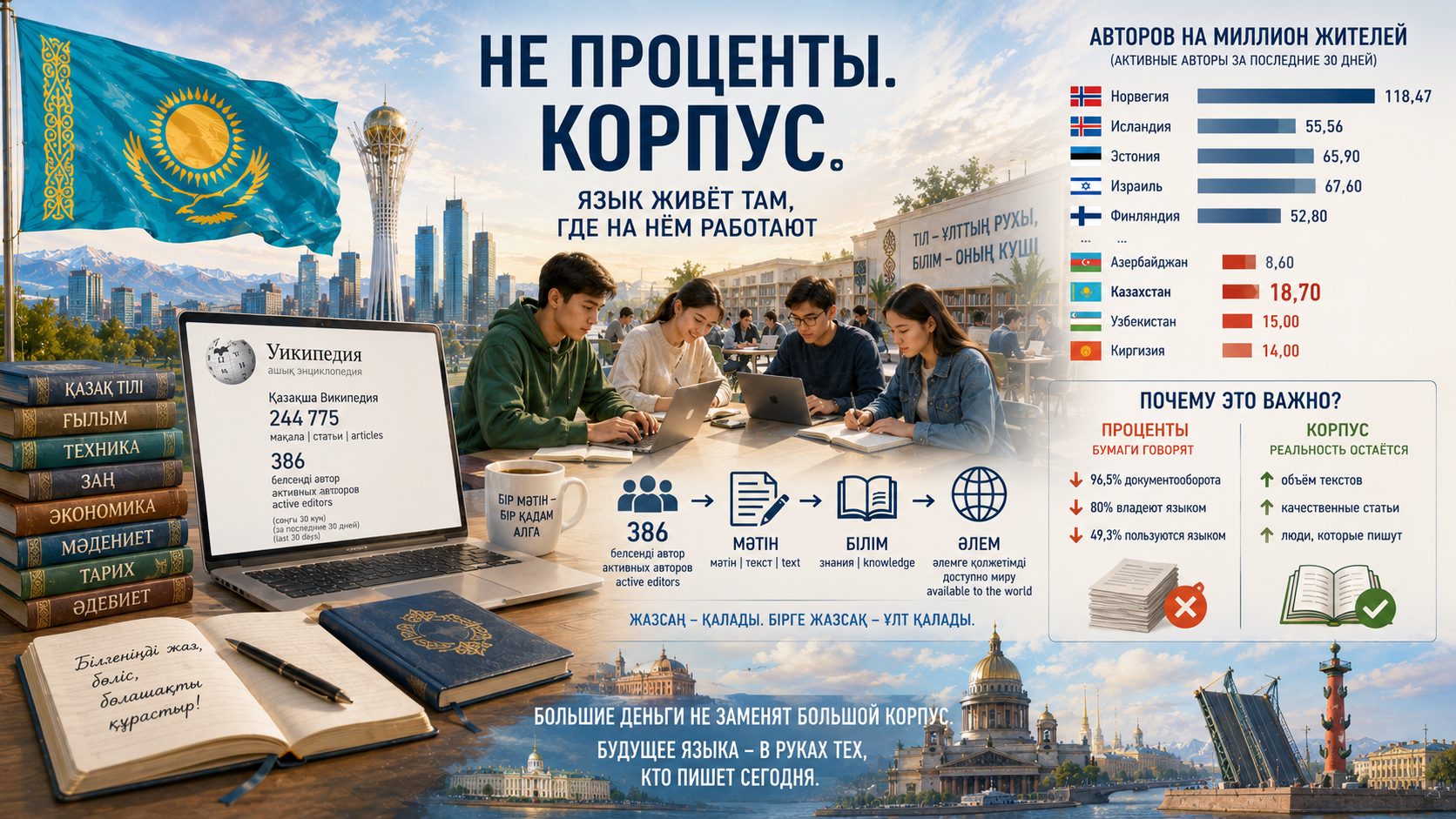
A language was safe as long as enough people spoke it. That rule has stopped working: machines learn from text, and a machine's ability to speak a language depends on how much has been written in it. Iceland, with 386,000 people, has 215 active encyclopedia editors; Kazakhstan, with twenty million, has just 386.
History is written by the victors is only half true. More often it is written by chance: what reaches us is not the most important but the most durable. We know antiquity from a few per cent of texts that survived fire and mould — brilliant books burned, mediocre ones lasted because there were many copies.
Almost every building your life passes through outlived those who built it and will outlive you. Architecture is the only art we live inside, and unlike a book it cannot be closed. A cramped yard without trees and a square without a bench teach something silently, every day, more surely than any slogan.
When people speak of the strength of states they think of economies and armies. There is a third: a film, a book, a song or an athlete does more for a country's image than a dozen official statements. But soft power has an honest condition — it does not work to order. Propaganda repels; sincerity attracts.
We are given one life, one body, one era, one country of birth — unfairly little for a creature able to imagine infinity. A book is the single loophole out of that narrowness: another consciousness thrown open. Film shows you the hero's face; a book seats you inside their head. It is hard to hate somebody whose eyes you once borrowed.
An opinion of a person forms in the first few seconds, long before they say a word, and what we read at that moment is not character but clothing. People adorned themselves before they built solid shelter: dress has always been a message about who I am and whom I belong to. Where the line with vanity runs.
You can know not a single word of another language and still weep at a song in it. Music speaks not to reason but to something older: rhythm is a heartbeat and a footstep, melody the intonation by which we read feeling before we understand words. That is why it unites where words divide.
Kazakh culture holds a rare combination: a deep nomadic tradition and a young, searching modernity. The question is not which to choose but how to join them. Heritage without development turns into a museum; modernity without roots turns into imitation. Living traditions are not the preserved ones but the rethought ones.
A language does not merely convey a thought — in part it forms it. Every language has turns of phrase another lacks, and with them shades of meaning visible in one and lost in another. Multilingualism is sold as a competitive advantage, but that is the dull half of the truth: the point is protection from a single version of events.
People have told stories for longer than they have written laws or built cities. Statistics report facts; a story gives understanding. You can read that a million people left their homes and feel nothing, then see a single life and understand everything. Why cinema and books are how a society thinks about itself.
The theatre has been pronounced dead since the invention of cinema, then television, then the internet, then streaming. More than a century on, some of its killers went out of fashion before it did. A film is the same on Monday and on Friday; a performance never repeats. Why that irreproducibility is the thing it sells.
A language is not only a means of communication but a way of thinking and of remembering who you are. Losing it means losing not a dictionary but part of your view of the world. Why the choice between the native and the useful is false: Kazakh does not stand in the way of Russian or English — each strengthens the other.


 Culture