


Mathematics: from foundations to higher mathematics Lesson 32 of 41
Checkpoint: build and defend an algebraic model
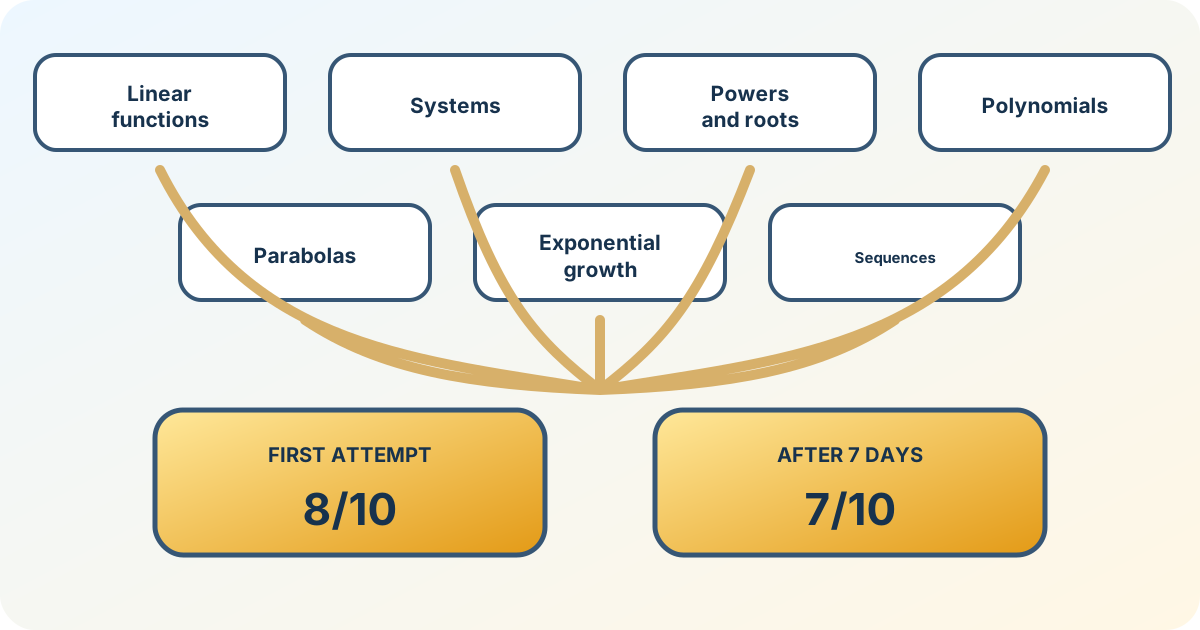
Ten new tasks assess functions, systems, powers, polynomials, quadratic and exponential models, and sequences through explanation, checking, and transfer.
This text was translated with AI.
Where we are on the map
This final checkpoint tests building a model from a real situation and defending its limits, rather than isolated operations.
Begin with a familiar image
An engineering drawing must survive measurements, loads, and checks. A mathematical model likewise needs evidence beyond an attractive formula.
Precise meaning
Mastery requires choosing a formula, defining variables, calculating, checking with another representation, and stating where the model no longer applies.
The lesson’s support signal
meaning → model → calculation → check → explain in your own words
situation → quantities → model → calculate → graph/inverse check → boundary → explanation
Worked example
A linear fare, a system of two conditions, and exponential growth need different formulas; the type of change in the data determines the choice.
Example with a fading prompt
Change the numbers in the example and repeat the solution without copying its steps. Estimate first, calculate exactly, and check against the original condition.
Recall without a prompt
- Define the main idea in one sentence.
- Rebuild the support signal from memory.
- Solve the example with different numbers and explain why every step is valid.
Find and correct the mistake
Using a straight line for every growth process is wrong. Constant difference suggests linear change; constant factor suggests exponential change.
Transfer to a new setting
Apply the same relationship to something you can measure yourself. Name the quantities, units, and the boundary within which the model is valid. Check the answer by a second representation or an inverse operation.
Exercise
Required. Solve all ten tasks, reach at least 8/10 with explained checks, repair errors, and repeat a changed version after seven days.
With your own data. Create one everyday example with the same structure and show it in words, a formula, and a check.
Optional. Seven days later, change the numbers and repeat without the support map.
Open perspective
Later blocks apply this algebraic language to geometry, probability, calculus, and modeling with real data.
If you have found a mistake or a typo in this article, tell us about it
Comments (0)
Log in to leave a comment →
No comments yet. Be the first.