


Mathematics: from foundations to higher mathematics Lesson 41 of 47
Checkpoint: geometry and space
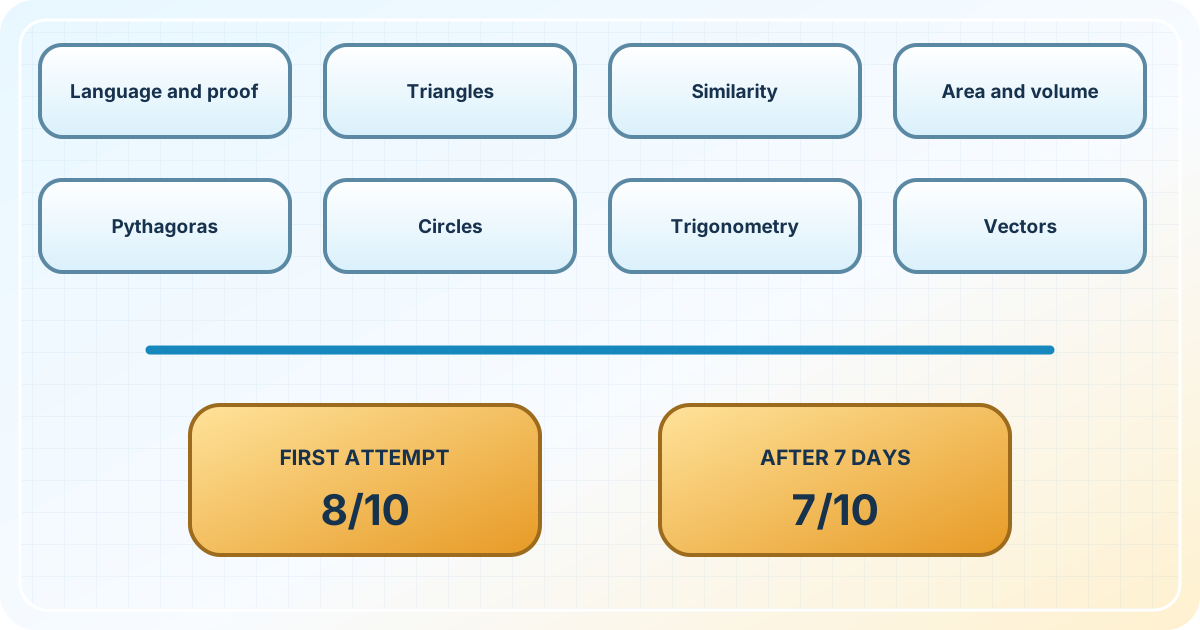
Ten new problems test definitions, proof, similarity, measurement, right triangles, circles, trigonometry, and vectors.
This text was translated with AI.
Where we are on the map
This closes the geometry block; every solution needs a diagram, conditions, reasons, and a check.
Begin with a familiar image
An architect does not accept a drawing because it looks right: dimensions, angles, scale, and calculations must agree.
Precise meaning
Mastery means choosing a theorem with its conditions, building a chain of reasons, preserving units, and transferring the method.
The lesson’s support signal
meaning → model → calculation → check → explain in your own words
diagram → given/seek → theorem with conditions → calculate → units → independent check
Worked example
One problem may use similarity for a length, Pythagoras for a diagonal, and area for material; every transition needs a reason.
Example with a fading prompt
Change the numbers in the example and repeat the solution without copying its steps. Estimate first, calculate exactly, and check against the original condition.
Recall without a prompt
- Define the main idea in one sentence.
- Rebuild the support signal from memory.
- Solve the example with different numbers and explain why every step is valid.
Find and correct the mistake
Using a correct formula on the wrong figure is an error. Check the right angle, side correspondence, and dimension first.
Transfer to a new setting
Apply the same relationship to something you can measure yourself. Name the quantities, units, and the boundary within which the model is valid. Check the answer by a second representation or an inverse operation.
Exercise
Required. Complete ten problems. Include a diagram, reasoning, and a check for each one.
- One of a pair of vertical angles is 47°. Find the other three and justify every answer.
- An isosceles triangle has a vertex angle of 38°. Find both base angles.
- In △ABC and △DEF, AB=DE=6, BC=EF=8, and AC=DF=10. Prove congruence and name corresponding vertices.
- A wall is 4.6 cm long on a 1:200 plan. Find its real length and the area scale factor.
- Find the area of a triangle with base 9 cm and height 6 cm, then the volume of a height-5-cm prism with that base.
- A rectangular site has sides 9 m and 12 m. Find its diagonal and check by reversing the calculation.
- A disk has diameter 10 cm. Find exact circumference and area, then approximate both to two decimals.
- A right triangle has hypotenuse 14 m and an acute angle of 35°. Find both legs and check them with Pythagoras.
- For
a=(4,−2)andb=(−1,5), find their sum, the magnitude of a, and their dot product. - Design a method to measure an inaccessible height; state assumptions and the largest source of error.
Pass target: at least 8/10, including problem 3 or 10. After seven days, complete a changed version with a target of at least 7/10.
With your own data. Create one everyday example with the same structure and show it in words, a formula, and a check.
Optional. Seven days later, change the numbers and repeat without the support map.
Open perspective
The next block studies continuous change and accumulation through limits, derivatives, and integrals.
If you have found a mistake or a typo in this article, tell us about it
Comments (0)
Log in to leave a comment →
No comments yet. Be the first.