


Mathematics: from foundations to higher mathematics Lesson 44 of 51
Derivative applications: growth, extrema, and optimization
We read a derivative sign chart, find extrema, and solve an optimization problem while checking the feasible domain and its boundaries.
This text was translated with AI.
Where we are on the map
The derivative becomes a tool for reconstructing function behavior across its domain.
Begin with a familiar image
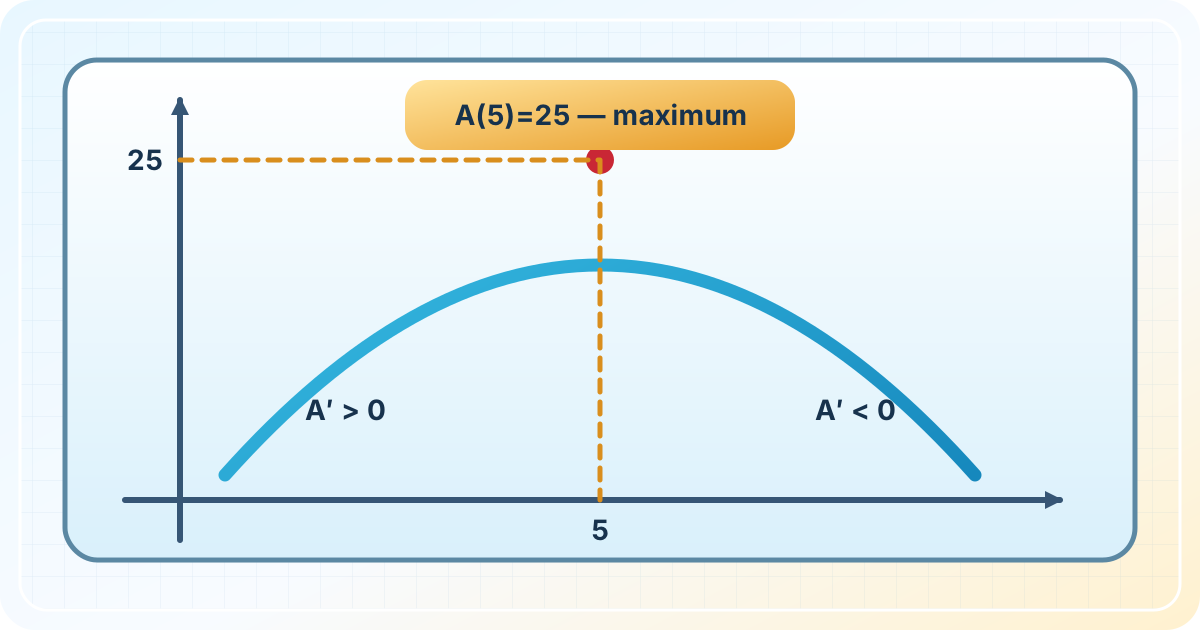
A hill has positive slope uphill, negative slope downhill, and zero slope at the top. Yet zero slope alone does not guarantee a peak; the surrounding sign must be checked.
Precise meaning
Critical points occur where f′(x)=0 or the derivative is undefined. A +→− change gives a local maximum and −→+ a minimum. Applied problems compare critical points with feasible boundaries.
The lesson’s support signal
meaning → model → calculation → check → explain in your own words
goal → variable → constraints → function → derivative → critical points → boundaries → conclusion
Worked example
A rectangle of perimeter 20 has sides x and 10−x, so A=x(10−x). Since A′=10−2x=0 at x=5 and the sign changes from plus to minus, the maximum area is 25.
Example with a fading prompt
Change the numbers in the example and repeat the solution without copying its steps. Estimate first, calculate exactly, and check against the original condition.
Recall without a prompt
- Define the main idea in one sentence.
- Rebuild the support signal from memory.
- Solve the example with different numbers and explain why every step is valid.
Find and correct the mistake
Solving f′(x)=0 and calling every solution a maximum is wrong. Check a sign change, second derivative, or function values, and include boundaries on a closed domain.
Transfer to a new setting
Apply the same relationship to something you can measure yourself. Name the quantities, units, and the boundary within which the model is valid. Check the answer by a second representation or an inverse operation.
Exercise
Required. Squares of side x are cut from the corners of a 24×18 cm sheet to form an open box. Write volume, feasible x, and derivative; find the best x to one decimal.
With your own data. Create one everyday example with the same structure and show it in words, a formula, and a check.
Optional. Seven days later, change the numbers and repeat without the support map.
Open perspective
The inverse question reconstructs accumulated quantity from a known rate of change; this is the integral.
If you have found a mistake or a typo in this article, tell us about it
Comments (0)
Log in to leave a comment →
No comments yet. Be the first.