


Mathematics: from foundations to higher mathematics Lesson 40 of 47
Vectors in space: magnitude, direction, and adding displacements
We represent displacement with components, add vectors, find magnitude, and use a dot product to check an angle.
This text was translated with AI.
Where we are on the map
We move from the address of a point to a directed change between points.
Begin with a familiar image
The instruction “walk 5 metres” is incomplete without direction. A vector stores both size and direction.
Precise meaning
Vectors add componentwise. The magnitude of (x,y) is √(x²+y²). a·b=|a||b|cosθ; zero for nonzero vectors means perpendicular.
The lesson’s support signal
meaning → model → calculation → check → explain in your own words
start and end → components → operation → magnitude → direction/dot-product check
Worked example
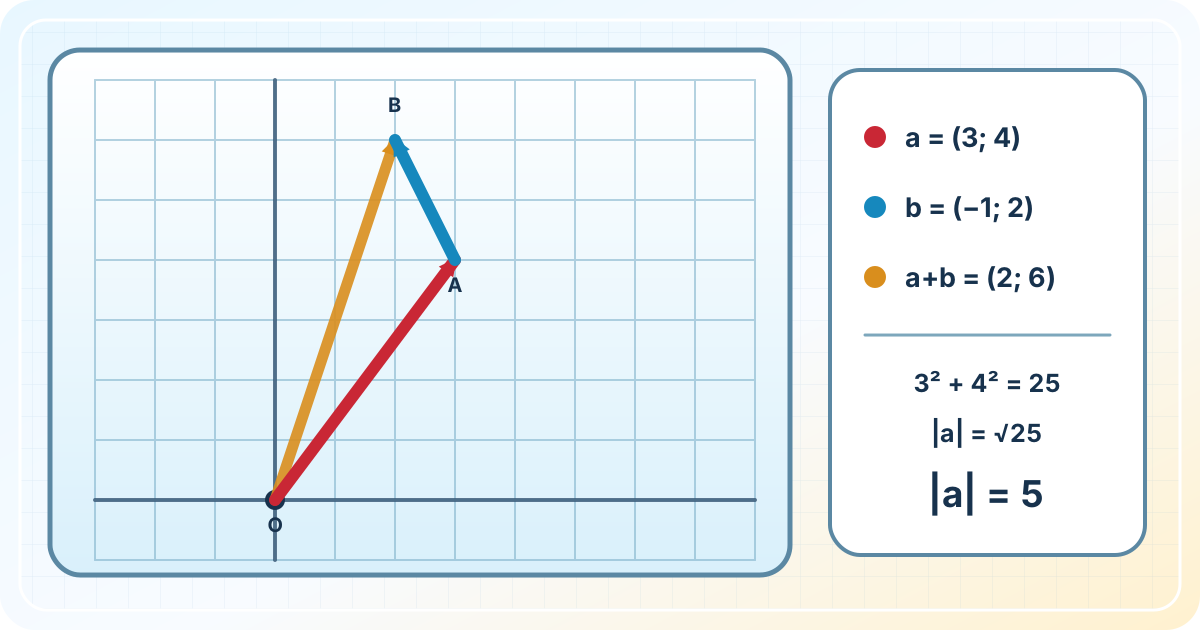
For a=(3,4) and b=(−1,2), a+b=(2,6), |a|=5, and a·b=5.
Example with a fading prompt
Change the numbers in the example and repeat the solution without copying its steps. Estimate first, calculate exactly, and check against the original condition.
Recall without a prompt
- Define the main idea in one sentence.
- Rebuild the support signal from memory.
- Solve the example with different numbers and explain why every step is valid.
Find and correct the mistake
Finding the length of (3,4) as 3+4=7 is wrong; perpendicular components require Pythagoras, giving 5.
Transfer to a new setting
Apply the same relationship to something you can measure yourself. Name the quantities, units, and the boundary within which the model is valid. Check the answer by a second representation or an inverse operation.
Exercise
Required. For a=(2,−3,6) and b=(1,4,−2), find sum, difference, |a|, and dot product.
With your own data. Create one everyday example with the same structure and show it in words, a formula, and a check.
Optional. Seven days later, change the numbers and repeat without the support map.
Open perspective
The checkpoint combines proof, scale, measurement, circles, trigonometry, and vectors.
If you have found a mistake or a typo in this article, tell us about it
Comments (0)
Log in to leave a comment →
No comments yet. Be the first.