


Mathematics: from foundations to higher mathematics Lesson 23 of 41
Inequalities: a set of values rather than one answer
We read an inequality as a region on a number line, find its boundary, and explain why the sign reverses when multiplying by a negative.
This text was translated with AI.
Where we are on the map
An equation may identify a point; an inequality describes an entire region of valid values.
Begin with a familiar image
If an elevator carries at most 600 kg, many loads from 0 to 600 are valid rather than one exact weight.
Precise meaning
< and > exclude the boundary; ≤ and ≥ include it. Multiplication by a negative reverses number-line order, so the sign reverses.
The lesson’s support signal
meaning → model → calculation → check → explain in your own words
find boundary → included? → shade line → test one valid and one invalid value
Worked example
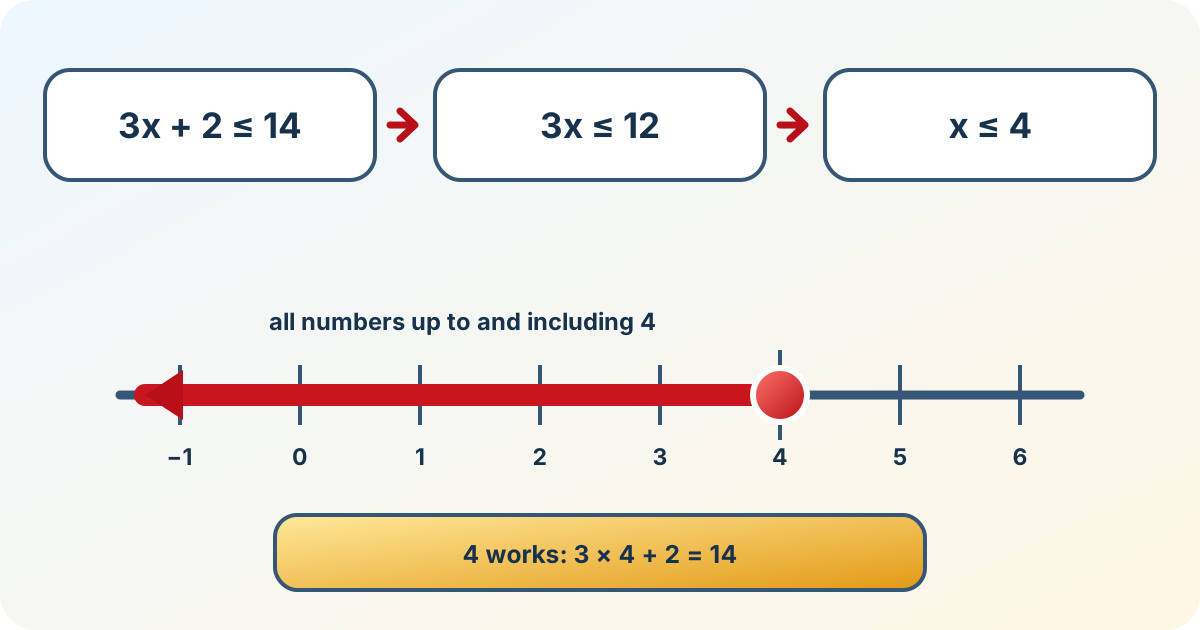
3x+2≤14; 3x≤12; x≤4. The boundary 4 works, while 5 does not.
Example with a fading prompt
Change the numbers in the example and repeat the solution without copying its steps. Estimate first, calculate exactly, and check against the original condition.
Recall without a prompt
- Define the main idea in one sentence.
- Rebuild the support signal from memory.
- Solve the example with different numbers and explain why every step is valid.
Find and correct the mistake
Dividing −2x<6 and keeping x<−3 is wrong: division by −2 reverses the order, giving x>−3.
Transfer to a new setting
Apply the same relationship to something you can measure yourself. Name the quantities, units, and the boundary within which the model is valid. Check the answer by a second representation or an inverse operation.
Exercise
Required. Solve 5−2x≥−7, show it on a number line, and test the boundary with two values.
With your own data. Create one everyday example with the same structure and show it in words, a formula, and a check.
Optional. Seven days later, change the numbers and repeat without the support map.
Open perspective
The prealgebra checkpoint combines variables, expressions, equations, coordinates, and inequalities.
If you have found a mistake or a typo in this article, tell us about it
Comments (0)
Log in to leave a comment →
No comments yet. Be the first.