


Mathematics: from foundations to higher mathematics Lesson 3 of 32
Place value: a digit’s position shows the size of its unit
We bundle units into tens, hundreds, and thousands, read zero as an empty place, and expand numbers so written operations make sense.
This text was translated with AI.
Where we are on the map
We move from counting objects to the structure of multidigit numbers.
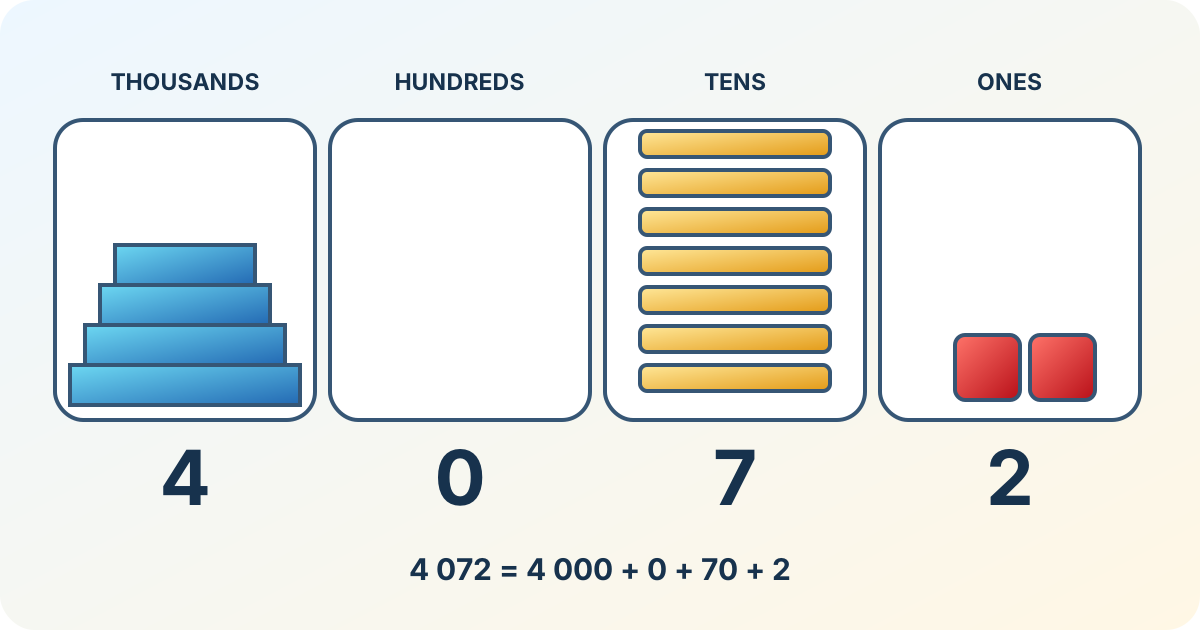
Begin with a familiar image
Just as ten small currency units can be exchanged for one larger unit, ten units in one place are bundled into one unit of the next place.
Precise meaning
Place value is a digit’s position in a numeral. From right to left we have ones, tens, hundreds, and thousands; zero preserves a place that contains no units.
The lesson’s support signal
meaning → model → calculation → check → explain in your own words
10 ones = 1 ten → 10 tens = 1 hundred → 10 hundreds = 1 thousand
Worked example
4,072 = 4 × 1000 + 0 × 100 + 7 × 10 + 2. We read it as four thousand seventy-two.
Example with a fading prompt
Change the numbers in the example and repeat the solution without copying its steps. Estimate first, calculate exactly, and check against the original condition.
Recall without a prompt
- Define the main idea in one sentence.
- Rebuild the support signal from memory.
- Solve the example with different numbers and explain why every step is valid.
Find and correct the mistake
Writing 3,040 = 3 × 1000 + 4 × 100 is wrong: 4 occupies the tens place, so its contribution is 4 × 10.
Transfer to a new setting
Apply the same relationship to something you can measure yourself. Name the quantities, units, and the boundary within which the model is valid. Check the answer by a second representation or an inverse operation.
Exercise
Required. Expand 6,205, 980, and 10,040, name the value of every digit, and round each number to the nearest hundred.
With your own data. Create one everyday example with the same structure and show it in words, a formula, and a check.
Optional. Seven days later, change the numbers and repeat without the support map.
Open perspective
Place value makes regrouping in addition and subtraction understandable.
If you have found a mistake or a typo in this article, tell us about it
Comments (0)
Log in to leave a comment →
No comments yet. Be the first.