


Mathematics: from foundations to higher mathematics Lesson 59 of 59
Final checkpoint: probability, data, logic, graphs, and modeling
Ten tasks test counting, conditional probability, data description, inference, proof, shortest paths, and honest modeling with delayed recall after seven days.
This text was translated with AI.
Where we are on the map
This closes the last block and the full route: choose the tool, calculate, state assumptions, and show an independent check.
Begin with a familiar image
In a real problem, choices, randomness, data, logic, and networks appear together. A reliable solution preserves the source of every number and the boundary of every claim.
Precise meaning
Mastery appears in transfer: recognize structure in an unfamiliar setting, choose a mathematical language, evaluate the result, and change the conclusion when validation disagrees.
The lesson’s support signal
meaning → model → calculation → check → explain in your own words
possibilities → probability → data description → inference → proof → graph algorithm → model → independent check
Worked example
One project may count routes with a graph, estimate demand from a sample, express uncertainty with an interval, and optimize a function. Units and assumptions must connect the parts.
Example with a fading prompt
Change the numbers in the example and repeat the solution without copying its steps. Estimate first, calculate exactly, and check against the original condition.
Recall without a prompt
- Define the main idea in one sentence.
- Rebuild the support signal from memory.
- Solve the example with different numbers and explain why every step is valid.
Find and correct the mistake
Calling a task solved as soon as a number appears is wrong. Without units, validation, uncertainty, and conditions of use, a number cannot safely guide a decision.
Transfer to a new setting
Apply the same relationship to something you can measure yourself. Name the quantities, units, and the boundary within which the model is valid. Check the answer by a second representation or an inverse operation.
Exercise
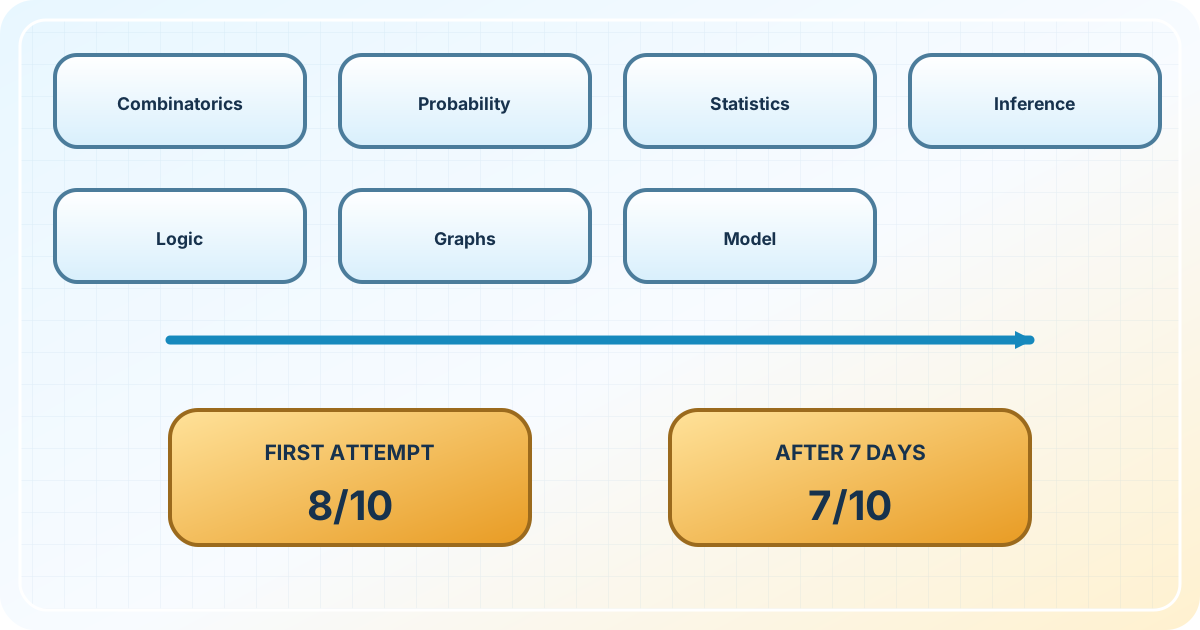
Required. Complete ten mixed tasks from lessons 52–58: compare permutations and combinations; compute sampling-without-replacement probability; explain mean and median; build an interval; negate a claim; write a proof; reconstruct A–F; name Dijkstra’s limit; optimize over integers; and validate your own model. Reach 8/10 now and 7/10 after seven days.
With your own data. Create one everyday example with the same structure and show it in words, a formula, and a check.
Optional. Seven days later, change the numbers and repeat without the support map.
Open perspective
After the course, attach any new area of mathematics to the verified supports on this dependency map.
If you have found a mistake or a typo in this article, tell us about it
Comments (0)
Log in to leave a comment →
No comments yet. Be the first.