


Mathematics: from foundations to higher mathematics Lesson 42 of 51
Limits: describing approach without reaching the point
We move from successive approximations to a function limit, separate the value at a point from nearby behavior, and check the result by table, graph, and algebra.
This text was translated with AI.
Where we are on the map
Sequences showed where values move. We now ask what happens to f(x) as x approaches a chosen point from the left and right.
Begin with a familiar image
If every step halves the remaining distance to a door, we get ever closer. A limit describes that approach; it does not claim a particular step has reached the door.
Precise meaning
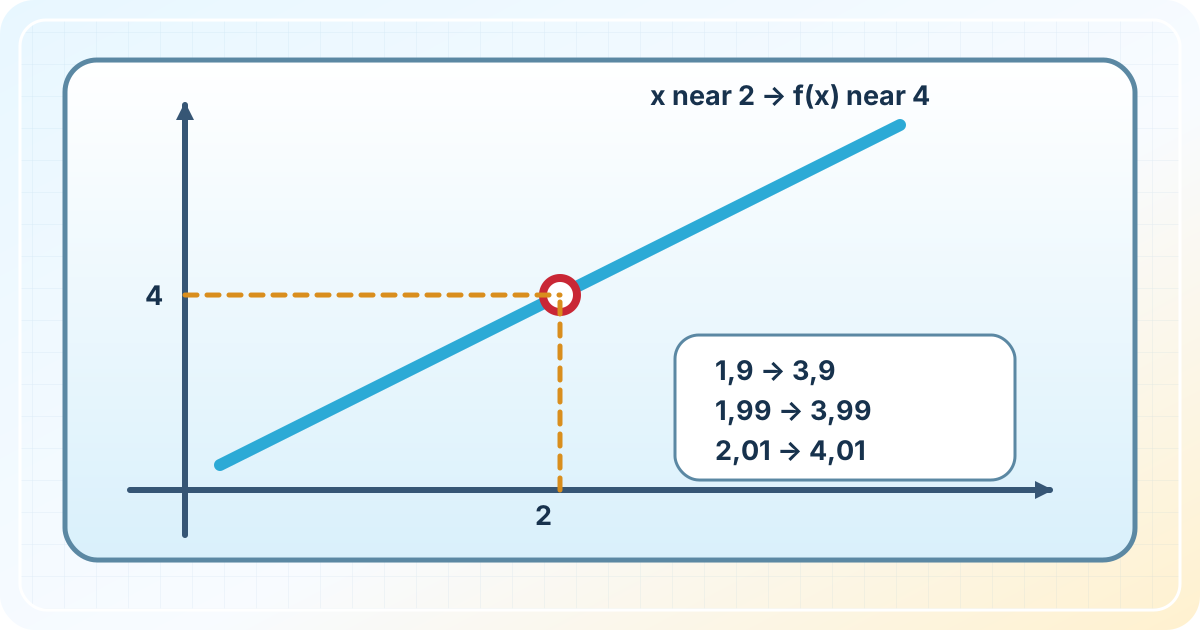
lim(x→a) f(x)=L means f(x) can be made as close to L as desired by taking x sufficiently close to a without setting x equal to a. A two-sided limit exists when both one-sided limits agree. The value f(a) may differ or be undefined.
The lesson’s support signal
meaning → model → calculation → check → explain in your own words
point a → approach from left → approach from right → common L → check with graph and algebra
Worked example
For f(x)=(x²−4)/(x−2) and x≠2, cancellation gives x+2. Thus the limit as x→2 is 4 even though the original expression is undefined at 2.
Example with a fading prompt
Change the numbers in the example and repeat the solution without copying its steps. Estimate first, calculate exactly, and check against the original condition.
Recall without a prompt
- Define the main idea in one sentence.
- Rebuild the support signal from memory.
- Solve the example with different numbers and explain why every step is valid.
Find and correct the mistake
Treating 0/0 as an answer or as zero is wrong. It signals an indeterminate form that requires transformation or another analysis.
Transfer to a new setting
Apply the same relationship to something you can measure yourself. Name the quantities, units, and the boundary within which the model is valid. Check the answer by a second representation or an inverse operation.
Exercise
Required. Find lim(x→5)(x²−25)/(x−5) with a two-sided table, a graph idea, and algebraic cancellation. State the original value at x=5 separately.
With your own data. Create one everyday example with the same structure and show it in words, a formula, and a check.
Optional. Seven days later, change the numbers and repeat without the support map.
Open perspective
A limit shrinks an average slope to shorter intervals and leads to instantaneous change: the derivative.
If you have found a mistake or a typo in this article, tell us about it
Comments (0)
Log in to leave a comment →
No comments yet. Be the first.