


Mathematics: from foundations to higher mathematics Lesson 51 of 59
Checkpoint: matrices, bases, and eigenvector directions
Ten problems test matrix dimensions, linearity, bases, coordinates, eigenpairs, and transformation meaning with an independent check.
This text was translated with AI.
Where we are on the map
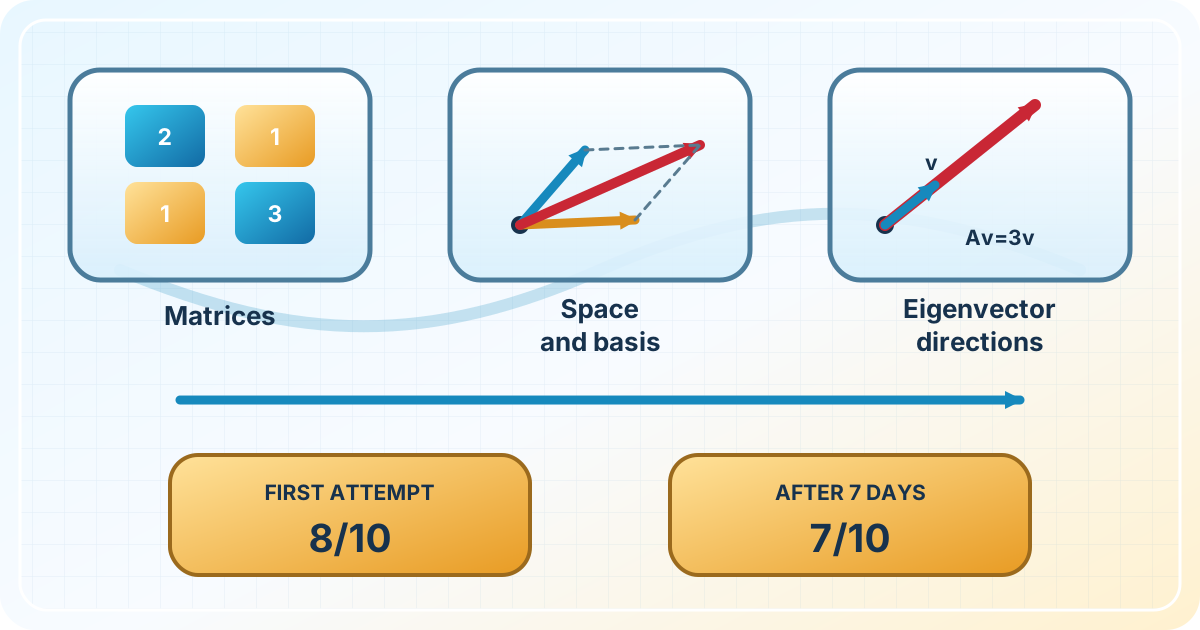
This closes the linear algebra block; a column of numbers is insufficient without dimensions, geometric meaning, and a check against the original transformation.
Begin with a familiar image
Camera settings, a sound mixer, and a network model can share the same matrix form. The mathematics is reliable when rows, columns, coefficients, and basis have clear meanings.
Precise meaning
Mastery means seeing one object as a coefficient table, an action on a vector, a geometric transformation, and a set of checkable equations.
The lesson’s support signal
meaning → model → calculation → check → explain in your own words
dimensions → action → space and basis → special directions → meaning → direct check
Worked example
Matrix A=[[2,1],[1,2]] transforms vectors, while the basis (1,1), (1,−1) reveals the action as independent scale factors 3 and 1.
Example with a fading prompt
Change the numbers in the example and repeat the solution without copying its steps. Estimate first, calculate exactly, and check against the original condition.
Recall without a prompt
- Define the main idea in one sentence.
- Rebuild the support signal from memory.
- Solve the example with different numbers and explain why every step is valid.
Find and correct the mistake
Trusting λ and v without verification is wrong. The equality Av=λv must hold component by component.
Transfer to a new setting
Apply the same relationship to something you can measure yourself. Name the quantities, units, and the boundary within which the model is valid. Check the answer by a second representation or an inverse operation.
Exercise
Required. Complete ten problems and show calculation and verification.
- For a 3×2 matrix A and a 2×4 matrix B, find the size of AB and explain why BA does not exist.
- Find Ax for
A=[[1,2],[3,−1]],x=(2,4). - Verify
A(u+v)=Au+AvforA=[[2,0],[1,3]],u=(1,−1),v=(4,2). - Solve
2x+y=7,x−y=2and check by substitution. - Are
(1,2)and(3,6)independent? Describe their span. - Decompose
(7,1)in basisb₁=(1,1),b₂=(2,−1). - Show that
(1,0),(0,1),(1,1)are dependent. - Name eigenvalues and directions of
D=[[5,0],[0,−1]]. - Verify both eigenpairs of
A=[[2,1],[1,2]]. - Build a real two-input, two-output matrix model and state units and one limitation.
Pass target: at least 8/10, including problem 6 or 10. After seven days, complete a changed version with a target of at least 7/10.
With your own data. Create one everyday example with the same structure and show it in words, a formula, and a check.
Optional. Seven days later, change the numbers and repeat without the support map.
Open perspective
The next block counts possibilities, measures uncertainty, and draws cautious conclusions from data.
If you have found a mistake or a typo in this article, tell us about it
Comments (0)
Log in to leave a comment →
No comments yet. Be the first.