


Mathematics: from foundations to higher mathematics Lesson 56 of 59
Logic and proof: why a conclusion follows from assumptions
We analyze statements, negation, connectives, implication, and quantifiers, then build direct proofs, counterexamples, and contradiction arguments.
This text was translated with AI.
Where we are on the map
Statistical inference required us to distinguish what evidence supports from what does not follow. Logic gives that boundary a precise language.
Begin with a familiar image
“If it rains, the road is wet” does not say rain is the only cause of a wet road. Reversing an implication is a common error.
Precise meaning
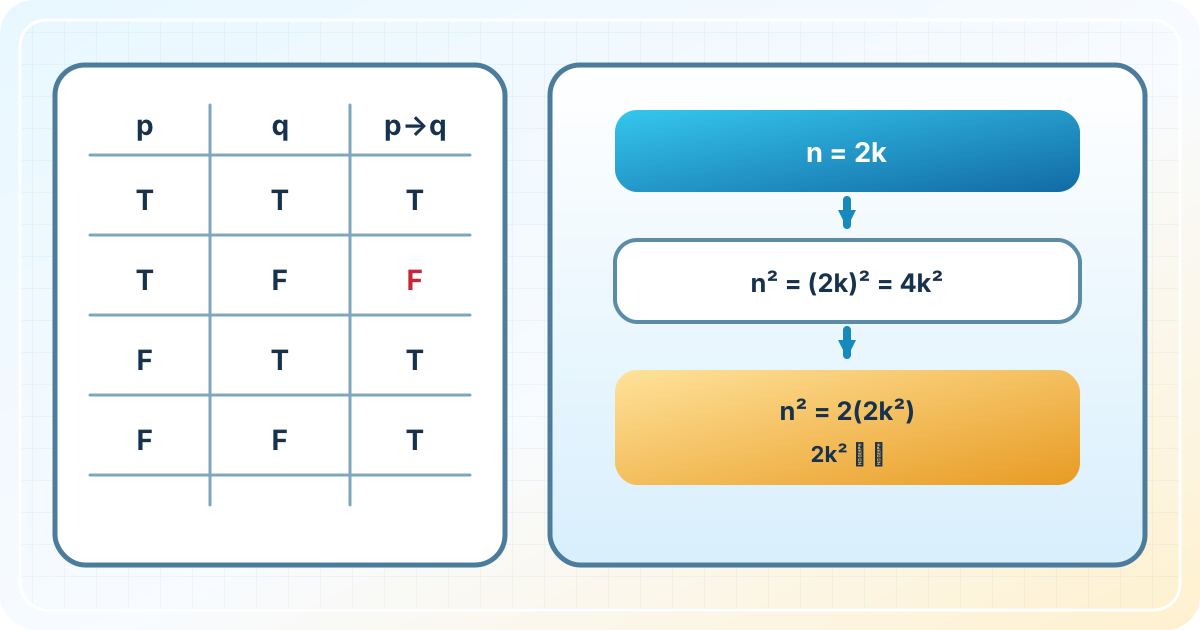
p→q is false only when p is true and q false. Its converse q→p is separate. One counterexample refutes a universal claim. A direct proof moves from assumptions by definitions; contradiction adds the negation of the goal and derives an impossibility. “For every” and “there exists” cannot be interchanged.
The lesson’s support signal
meaning → model → calculation → check → explain in your own words
assumptions → definitions → valid step → intermediate result → goal; check: converse? counterexample? hidden assumption?
Worked example
If n is even, n=2k. Then n²=(2k)²=4k²=2(2k²). Since 2k² is an integer, n² is twice an integer and is even.
Example with a fading prompt
Change the numbers in the example and repeat the solution without copying its steps. Estimate first, calculate exactly, and check against the original condition.
Recall without a prompt
- Define the main idea in one sentence.
- Rebuild the support signal from memory.
- Solve the example with different numbers and explain why every step is valid.
Find and correct the mistake
Using the proved forward implication alone to conclude n is even from n² even is wrong. That is the converse and needs its own proof, for example by contraposition.
Transfer to a new setting
Apply the same relationship to something you can measure yourself. Name the quantities, units, and the boundary within which the model is valid. Check the answer by a second representation or an inverse operation.
Exercise
Required. Complete four tasks: prove sums of multiples of 3 are multiples of 3; refute “all primes are odd”; negate “for every x there exists y>x”; and prove √2 irrational by contradiction.
With your own data. Create one everyday example with the same structure and show it in words, a formula, and a check.
Optional. Seven days later, change the numbers and repeat without the support map.
Open perspective
The next lesson assembles valid local steps into algorithms over nodes and connections.
If you have found a mistake or a typo in this article, tell us about it
Comments (0)
Log in to leave a comment →
No comments yet. Be the first.