


Mathematics: from foundations to higher mathematics Lesson 15 of 59
Ratio: a recipe that survives every scale
We read `2:3` as a relationship between two quantities, build tables of equivalent ratios, and find a unit rate.
Where we are on the map
A fraction measures one quantity; a ratio compares two quantities in a stated order.
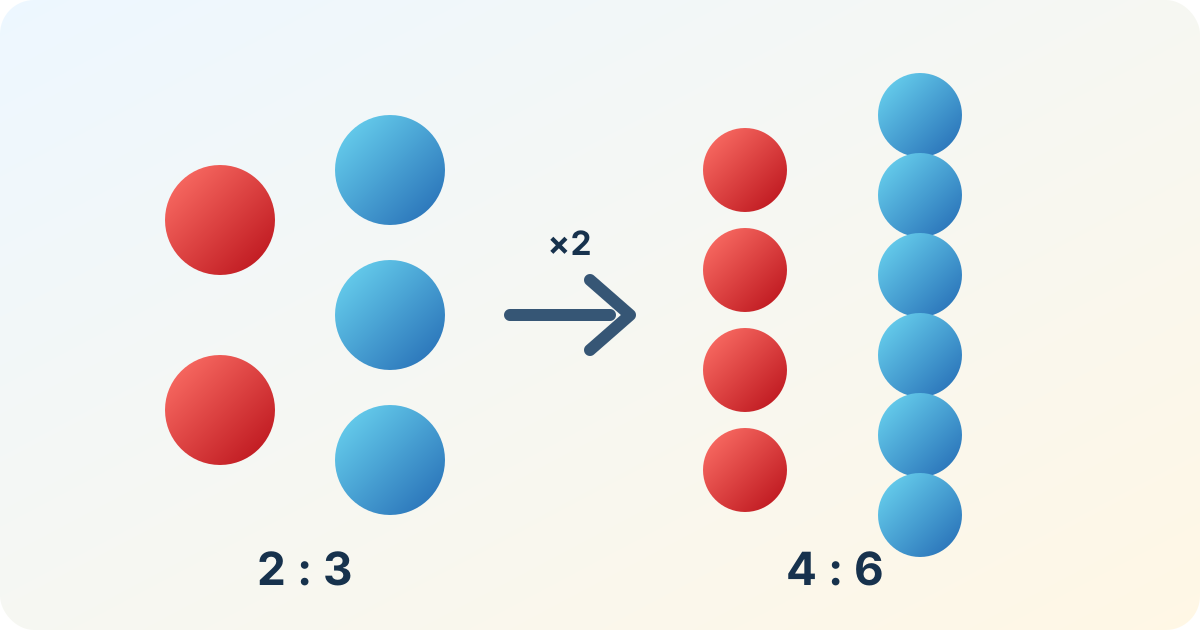
Begin with a familiar image
If a drink uses two parts juice to three parts water, doubling the recipe must change both amounts together.
Precise meaning
Order matters in a:b. After matching units, multiplying or dividing both terms by the same factor preserves the ratio.
The lesson’s support signal
meaning → model → calculation → check → explain in your own words
state the order → align units → find one part → scale both quantities together
Worked example
2:3 = 4:6 because both terms were multiplied by 2. Cross-products confirm it: 2 × 6 = 3 × 4.
Example with a fading prompt
Change the numbers in the example and repeat the solution without copying its steps. Estimate first, calculate exactly, and check against the original condition.
Recall without a prompt
- Define the main idea in one sentence.
- Rebuild the support signal from memory.
- Solve the example with different numbers and explain why every step is valid.
Find and correct the mistake
Changing only the first term from 2:3 to 4:3 does not preserve the recipe; both quantities need the same scale factor.
Transfer to a new setting
Apply the same relationship to something you can measure yourself. Name the quantities, units, and the boundary within which the model is valid. Check the answer by a second representation or an inverse operation.
Exercise
Required. Blue and white paint are mixed in a 3:5 ratio. Find each amount in 32 litres of mixture.
With your own data. Create one everyday example with the same structure and show it in words, a formula, and a check.
Optional. Seven days later, change the numbers and repeat without the support map.
Open perspective
Percent is a widely used ratio language built around one hundred parts.
If you have found a mistake or a typo in this article, tell us about it
Comments (0)
Log in to leave a comment →
No comments yet. Be the first.