


Mathematics: from foundations to higher mathematics Lesson 9 of 32
Decimals: place values to the right of the point
We read decimals as a continuation of base ten, connect them to common fractions, and compare values without mechanically moving a point.
This text was translated with AI.
Where we are on the map
The place-value system now continues below one into tenths, hundredths, and thousandths.
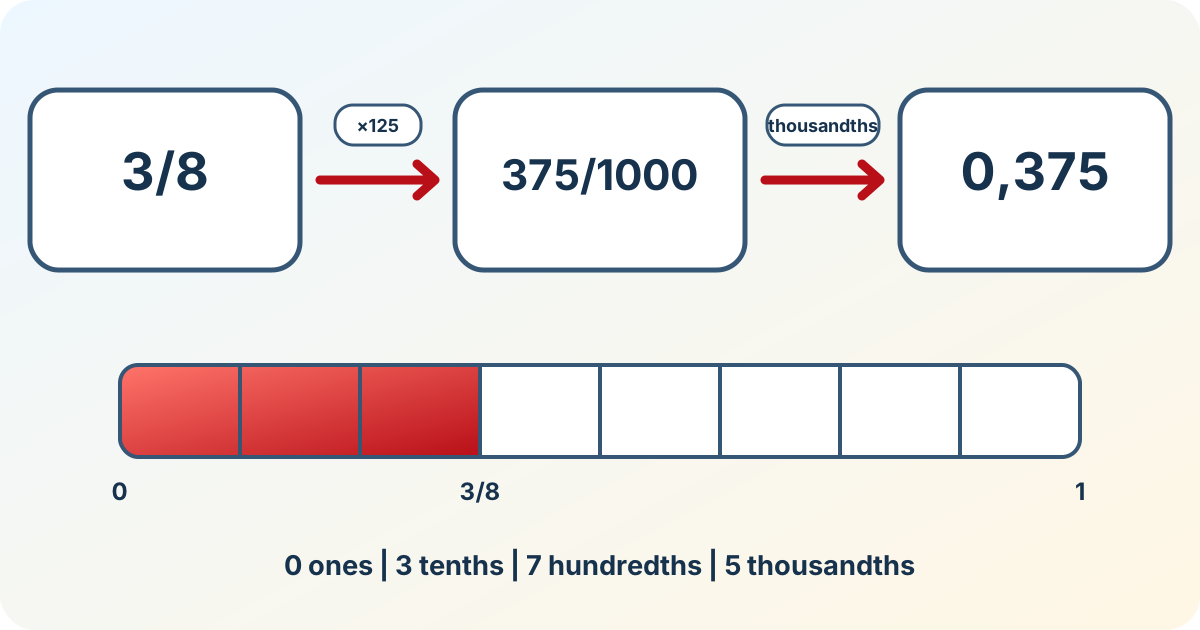
Begin with a familiar image
Dividing one whole into ten equal parts creates tenths; dividing each tenth into ten creates hundredths.
Precise meaning
0.375 means 0 ones, 3 tenths, 7 hundredths, and 5 thousandths. It is 375/1000, which simplifies to 3/8.
The lesson’s support signal
meaning → model → calculation → check → explain in your own words
place name → common fraction → decimal notation → same point on the number line
Worked example
3/8 = 375/1000 = 0.375 because numerator and denominator were both multiplied by 125.
Example with a fading prompt
Change the numbers in the example and repeat the solution without copying its steps. Estimate first, calculate exactly, and check against the original condition.
Recall without a prompt
- Define the main idea in one sentence.
- Rebuild the support signal from memory.
- Solve the example with different numbers and explain why every step is valid.
Find and correct the mistake
Saying 0.5 < 0.45 because 5 < 45 is wrong. Writing equal places gives 0.50 > 0.45.
Transfer to a new setting
Apply the same relationship to something you can measure yourself. Name the quantities, units, and the boundary within which the model is valid. Check the answer by a second representation or an inverse operation.
Exercise
Required. Write 7/20, 13/25, and 9/8 as decimals, place them on a number line, and identify the greatest.
With your own data. Create one everyday example with the same structure and show it in words, a formula, and a check.
Optional. Seven days later, change the numbers and repeat without the support map.
Open perspective
The foundation checkpoint combines number, operations, estimation, negatives, and decimals in one set of tasks.
If you have found a mistake or a typo in this article, tell us about it
Comments (0)
Log in to leave a comment →
No comments yet. Be the first.