


Mathematics: from foundations to higher mathematics Lesson 57 of 59
Graphs and algorithms: nodes, connections, and the best route
We model a network with vertices and edges, distinguish paths and cycles, execute Dijkstra's algorithm by hand, and verify that the route is truly shortest.
This text was translated with AI.
Where we are on the map
Logic supplied rules for valid transitions. A graph turns them into edges between objects, while an algorithm gives a reproducible order of actions.
Begin with a familiar image
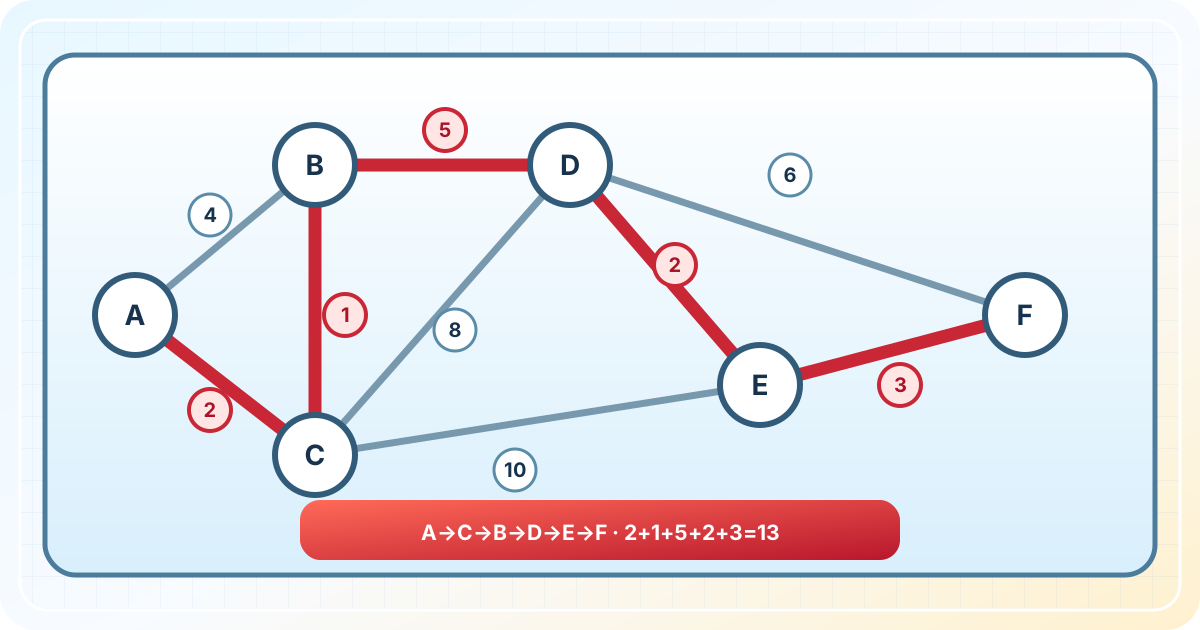
Road maps, social networks, task dependencies, and web links share one structure: objects and connections. Edge weights may mean time, distance, or cost, but their units must be consistent.
Precise meaning
A graph has vertices and edges. Edges may be directed or undirected, weighted or unweighted. A path follows adjacent vertices. With nonnegative weights, Dijkstra repeatedly finalizes the nearest unsettled vertex and relaxes its neighbours. Negative edges require another algorithm.
The lesson’s support signal
meaning → model → calculation → check → explain in your own words
model nodes and edges → weight unit → initial distances → nearest vertex → update neighbours → repeat → reconstruct path
Worked example
From A we get C=2 and B=4. Through C, B improves to 3. Through B, D=8; through D, E=10; through E, F=13. Predecessors give A→C→B→D→E→F, with 2+1+5+2+3=13.
Example with a fading prompt
Change the numbers in the example and repeat the solution without copying its steps. Estimate first, calculate exactly, and check against the original condition.
Recall without a prompt
- Define the main idea in one sentence.
- Rebuild the support signal from memory.
- Solve the example with different numbers and explain why every step is valid.
Find and correct the mistake
Picking the shortest outgoing edge at every intersection and calling the result globally shortest is wrong. A cheap local step can lead to an expensive continuation; the algorithm compares full distances from the start.
Transfer to a new setting
Apply the same relationship to something you can measure yourself. Name the quantities, units, and the boundary within which the model is valid. Check the answer by a second representation or an inverse operation.
Exercise
Required. Use a Dijkstra table to find shortest distances from A to every vertex. Remove edge D–E and recompute the route to F. Give one example where unweighted breadth-first search is the right tool instead.
With your own data. Create one everyday example with the same structure and show it in words, a formula, and a check.
Optional. Seven days later, change the numbers and repeat without the support map.
Open perspective
The next lesson joins data, probability, functions, matrices, and graphs in one testable modeling cycle.
If you have found a mistake or a typo in this article, tell us about it
Comments (0)
Log in to leave a comment →
No comments yet. Be the first.