


Mathematics: from foundations to higher mathematics Lesson 58 of 59
Mathematical modeling capstone: from a real question to a testable solution
We assemble the course into one cycle: state a question, choose quantities and assumptions, build a model, calculate a prediction, compare with data, and refine its domain.
This text was translated with AI.
Where we are on the map
Earlier blocks supplied tools. Choosing whether the question needs a number, function, probability, matrix, or graph is now part of the mathematics.
Begin with a familiar image
A city wants shorter bus waits without unnecessary vehicles. Before a formula, define the route, observation hours, passenger flow, capacity, cost, and acceptable wait.
Precise meaning
A mathematical model is an intentionally simplified representation. It needs a question, inputs, outputs, units, assumptions, equations or an algorithm, parameter data, validation, and a domain of use. Complexity is optional; a testable improvement over a clear baseline is essential. Report prediction error and sensitivity with the answer.
The lesson’s support signal
meaning → model → calculation → check → explain in your own words
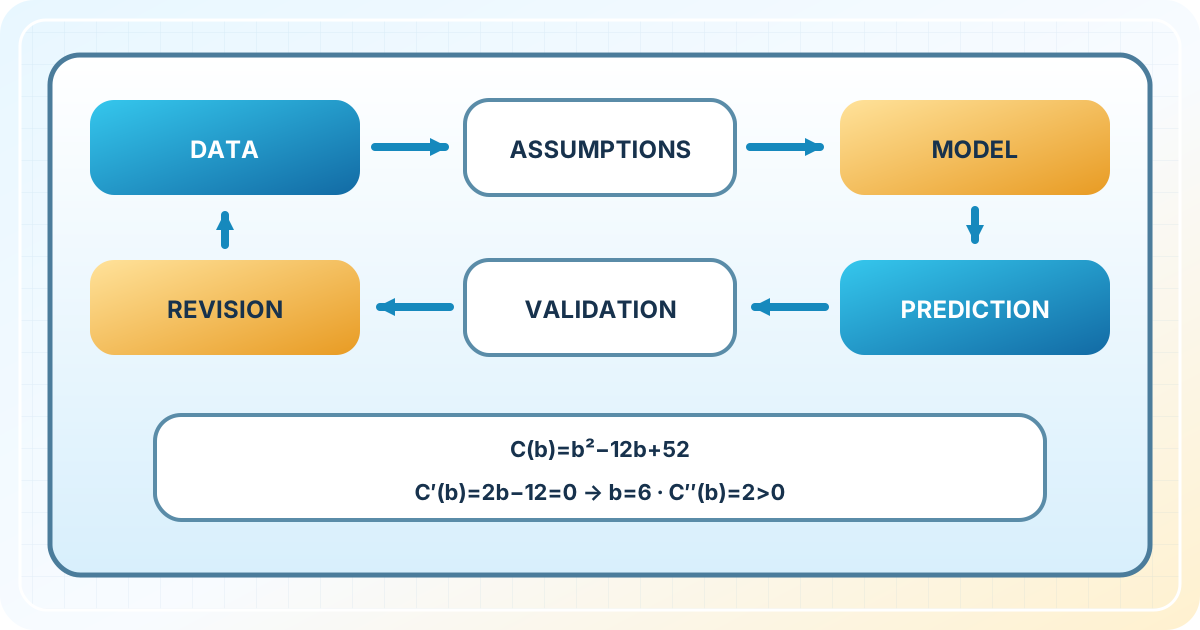
question → data and units → assumptions → model → calculation → prediction → test on new data → revise or reject
Worked example
For C(b)=b²−12b+52, C′(b)=2b−12, so the continuous minimum is b=6; C″(b)=2>0. Buses are whole, so compare 5, 6, 7: costs are 17, 16, 17. Capacity constraints and new-day validation still matter.
Example with a fading prompt
Change the numbers in the example and repeat the solution without copying its steps. Estimate first, calculate exactly, and check against the original condition.
Recall without a prompt
- Define the main idea in one sentence.
- Rebuild the support signal from memory.
- Solve the example with different numbers and explain why every step is valid.
Find and correct the mistake
Finding the formula’s minimum and declaring six buses the real optimum is wrong. Rush hours, failures, route connections, and sample quality may be absent from the model.
Transfer to a new setting
Apply the same relationship to something you can measure yourself. Name the quantities, units, and the boundary within which the model is valid. Check the answer by a second representation or an inverse operation.
Exercise
Required. Prepare a mini-project with a question, at least 20 observations, a data dictionary, graph, model, calculation, held-out validation, error and limitation analysis, and one alternative approach.
With your own data. Create one everyday example with the same structure and show it in words, a formula, and a check.
Optional. Seven days later, change the numbers and repeat without the support map.
Open perspective
The final checkpoint tests tool choice, explicit assumptions, and verification rather than repetition of a familiar calculation.
If you have found a mistake or a typo in this article, tell us about it
Comments (0)
Log in to leave a comment →
No comments yet. Be the first.