


Mathematics: from foundations to higher mathematics Lesson 47 of 51
Checkpoint: change and accumulation
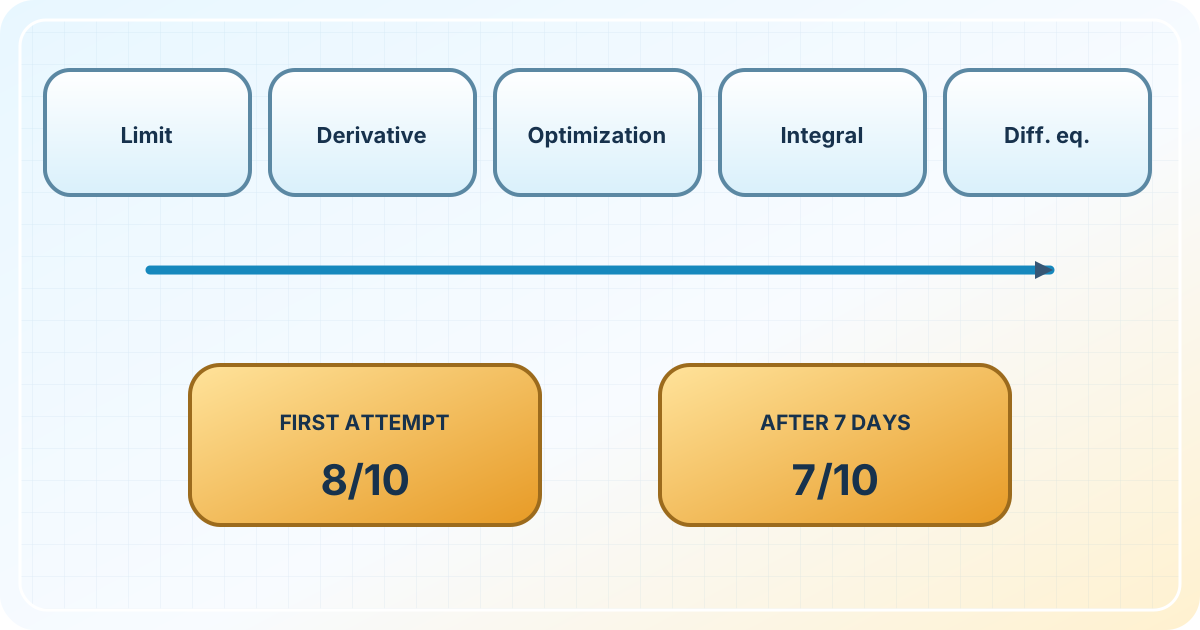
Ten problems test limits, derivatives, function analysis, integrals, and introductory differential models together with meaning and units.
This text was translated with AI.
Where we are on the map
This closes the calculus block; every formula must carry meaning, conditions, units, and an independent check.
Begin with a familiar image
An engineer does not accept a graph because its line looks smooth. Initial data, rate, accumulated total, and boundary behavior must agree.
Precise meaning
Mastery means seeing one process as a verbal law, table or graph, formula, and checkable calculation.
The lesson’s support signal
meaning → model → calculation → check → explain in your own words
meaning → model → limit/derivative/integral → calculation → units → independent check
Worked example
For motion, differentiating position gives velocity, integrating velocity returns displacement, and a differential equation states a law of change.
Example with a fading prompt
Change the numbers in the example and repeat the solution without copying its steps. Estimate first, calculate exactly, and check against the original condition.
Recall without a prompt
- Define the main idea in one sentence.
- Rebuild the support signal from memory.
- Solve the example with different numbers and explain why every step is valid.
Find and correct the mistake
Choosing an operation mechanically from a symbol is wrong. First decide whether the question asks for local rate, total accumulation, limiting behavior, or a function from its change law.
Transfer to a new setting
Apply the same relationship to something you can measure yourself. Name the quantities, units, and the boundary within which the model is valid. Check the answer by a second representation or an inverse operation.
Exercise
Required. Complete ten problems and show meaning, calculation, and a check.
- Find
lim(x→4)(x²−16)/(x−4)and explain the hole. - Let
f(x)=−1for x<0 andf(x)=2for x≥0. Find both one-sided limits and decide whether the limit at zero exists. - Use the definition to differentiate
f(x)=x²+3xand findf′(2). - For
s(t)=t³−6t²+9t, find rest times and intervals of forward and backward motion. - Among rectangles of perimeter 32, find the maximum area and justify it with the derivative sign.
- Evaluate
∫[0,4](3x²−2x)dxand check by differentiating the antiderivative. - Find the signed integral
∫[−2,2]x dxand explain by symmetry. - Velocity is
v(t)=6t−2m/s. Find displacement from t=1 to t=4 and state units. - Solve
y′=0.2y,y(0)=30; check the initial condition and derivative. - Build a cooling model for a drink in a room; name its parameters, limiting temperature, and two model limitations.
Pass target: at least 8/10, including problem 2 or 10. After seven days, complete a changed version with a target of at least 7/10.
With your own data. Create one everyday example with the same structure and show it in words, a formula, and a check.
Optional. Seven days later, change the numbers and repeat without the support map.
Open perspective
The next block turns geometric vectors into systems, matrices, and linear transformations.
If you have found a mistake or a typo in this article, tell us about it
Comments (0)
Log in to leave a comment →
No comments yet. Be the first.