


Mathematics: from foundations to higher mathematics Lesson 33 of 47
The language of geometry: points, lines, angles, and proof
We separate a definition from a drawing, measure angles, and build a first proof as a chain of reasons rather than visual appearance.
This text was translated with AI.
Where we are on the map
We move from algebra into the language of shape and space.
Begin with a familiar image
A map marks a city with a point, a road with a line, and a direction with a ray. The mark is not the object itself: a mathematical point has position only.
Precise meaning
A line extends both ways, a ray has one endpoint, and a segment has two. An angle consists of two rays with a common endpoint. Every proof step needs a definition, given fact, or established property.
The lesson’s support signal
meaning → model → calculation → check → explain in your own words
object → notation → given → claim → reason → conclusion
Worked example
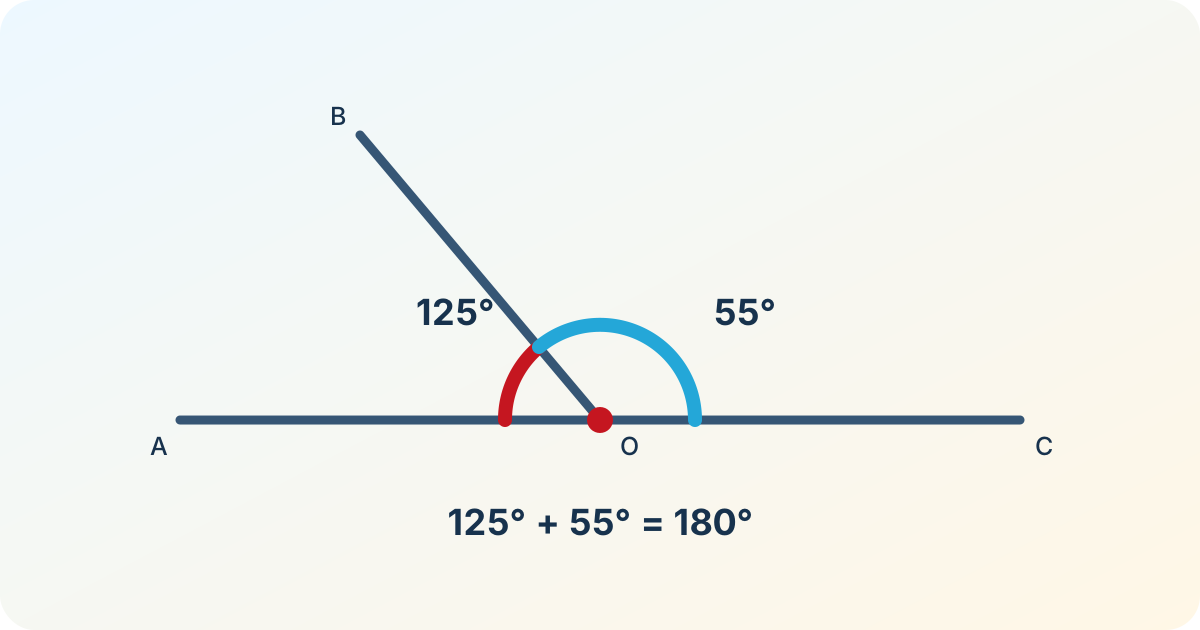
A straight angle is 180°. If one adjacent part is 125°, the other is 180°−125°=55°.
Example with a fading prompt
Change the numbers in the example and repeat the solution without copying its steps. Estimate first, calculate exactly, and check against the original condition.
Recall without a prompt
- Define the main idea in one sentence.
- Rebuild the support signal from memory.
- Solve the example with different numbers and explain why every step is valid.
Find and correct the mistake
“The angles look equal” is not proof: a diagram may be inaccurate, so a mark, measurement, or logical reason is required.
Transfer to a new setting
Apply the same relationship to something you can measure yourself. Name the quantities, units, and the boundary within which the model is valid. Check the answer by a second representation or an inverse operation.
Exercise
Required. Draw two intersecting lines. If one angle is 38°, find the other three and justify them with adjacent and vertical angle properties.
With your own data. Create one everyday example with the same structure and show it in words, a formula, and a check.
Optional. Seven days later, change the numbers and repeat without the support map.
Open perspective
Triangles combine definitions and congruence tests into the first systematic proofs.
If you have found a mistake or a typo in this article, tell us about it
Comments (0)
Log in to leave a comment →
No comments yet. Be the first.