


How we will learn mathematics: from memorizing to understanding
The course follows a dependency map: every new step rests on an earlier idea, and understanding is checked through explanation and transfer to a new situation.
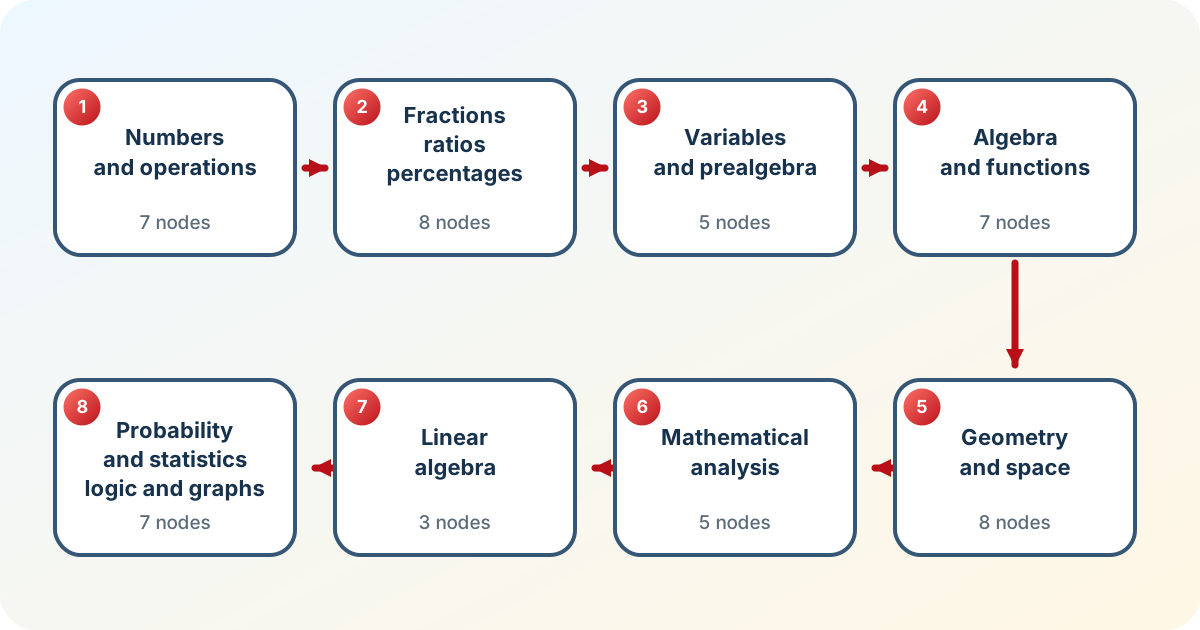
Where we are on the map
This is the map of the whole route. After diagnosis, we move through numbers, fractions, prealgebra, and functions in a deliberate order.
Begin with a familiar image
A house is built from its foundation, then its walls, and only then its upper floors. Mathematics works the same way: fractions depend on the idea of number, while equations depend on the meaning of operations.
Precise meaning
Topics are ordered by what they require, rather than by a school grade label. A mistake is useful evidence: it points to the support idea that needs to be rebuilt.
The lesson’s support signal
meaning → model → calculation → check → explain in your own words
image → compact support → explain in your own words → apply → recall later
Worked example
If a learner cannot solve a percentage problem, we do not begin with another formula. We first check whether one hundredth, fractions, and decimal notation are understood.
Example with a fading prompt
Change the numbers in the example and repeat the solution without copying its steps. Estimate first, calculate exactly, and check against the original condition.
Recall without a prompt
- Define the main idea in one sentence.
- Rebuild the support signal from memory.
- Solve the example with different numbers and explain why every step is valid.
Find and correct the mistake
The claim “I read the topic, so I know it” is unreliable. Evidence of learning is explaining without the page, solving with new numbers, and correcting an error.
Transfer to a new setting
Apply the same relationship to something you can measure yourself. Name the quantities, units, and the boundary within which the model is valid. Check the answer by a second representation or an inverse operation.
Exercise
Required. Study the map and name three ideas that feel secure and three that feel uncertain. Complete the diagnosis honestly and mark the first missing support.
With your own data. Create one everyday example with the same structure and show it in words, a formula, and a check.
Optional. Seven days later, change the numbers and repeat without the support map.
Open perspective
The next page does not grade you. It helps you choose the right starting point.
If you have found a mistake or a typo in this article, tell us about it
Comments (0)
Log in to leave a comment →
No comments yet. Be the first.