


Mathematics: from foundations to higher mathematics Lesson 52 of 59
Combinatorics: count possibilities without listing them all
We identify stages of choice, distinguish an ordered selection from a set, and use sum, product, permutation, and combination rules with a small enumeration check.
This text was translated with AI.
Where we are on the map
Multiplication, fractions, and variables now help count all possible solutions before one outcome is chosen.
Begin with a familiar image
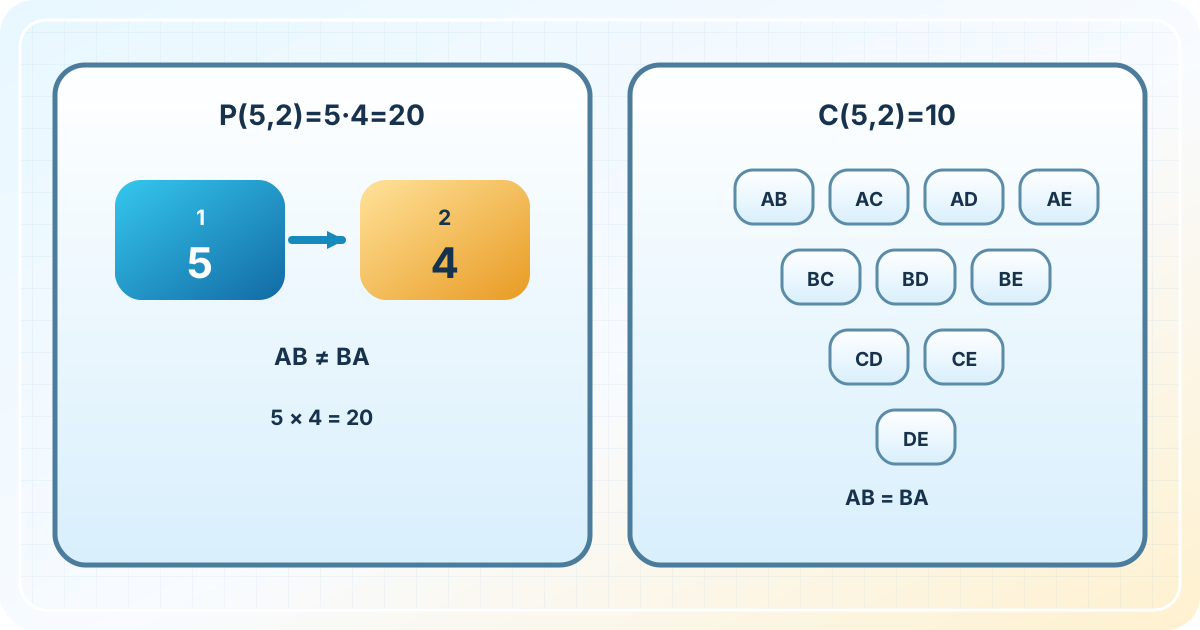
Take five books A, B, C, D, and E. For first and second place, AB and BA are different results. For choosing two books for one shelf, both orders describe the same pair.
Precise meaning
The sum rule adds mutually exclusive cases. The product rule multiplies possibilities across successive stages. P(n,k)=n!/(n−k)! keeps order; C(n,k)=n!/(k!(n−k)!) ignores order. Before using a formula, ask whether repetition is allowed and whether order matters.
The lesson’s support signal
meaning → model → calculation → check → explain in your own words
describe the choice → split into stages → order? → repetition? → sum or product → formula → enumerate to check
Worked example
Choosing a winner and runner-up from five books gives P(5,2)=5·4=20. Choosing two books without ranks counts every pair twice, so C(5,2)=20/2=10. The list AB, AC, AD, AE, BC, BD, BE, CD, CE, DE confirms ten pairs.
Example with a fading prompt
Change the numbers in the example and repeat the solution without copying its steps. Estimate first, calculate exactly, and check against the original condition.
Recall without a prompt
- Define the main idea in one sentence.
- Rebuild the support signal from memory.
- Solve the example with different numbers and explain why every step is valid.
Find and correct the mistake
Using C(5,2)=10 to choose a chair and secretary is wrong. The roles differ, so each pair supports two assignments; the correct count is P(5,2)=20.
Transfer to a new setting
Apply the same relationship to something you can measure yourself. Name the quantities, units, and the boundary within which the model is valid. Check the answer by a second representation or an inverse operation.
Exercise
Required. From 8 students, count ways to choose: (a) a class representative and deputy; (b) a two-person committee; (c) a three-person committee containing one specified student. Check every answer on a smaller four-student case.
With your own data. Create one everyday example with the same structure and show it in words, a formula, and a check.
Optional. Seven days later, change the numbers and repeat without the support map.
Open perspective
The next lesson turns counts of equally possible outcomes into a measure of uncertainty: probability.
If you have found a mistake or a typo in this article, tell us about it
Comments (0)
Log in to leave a comment →
No comments yet. Be the first.