


Mathematics: from foundations to higher mathematics Lesson 49 of 59
Vector spaces and bases: the directions that build a vector
We understand linear combinations, span, independence, basis, and coordinates through two directions that build every plane vector uniquely.
This text was translated with AI.
Where we are on the map
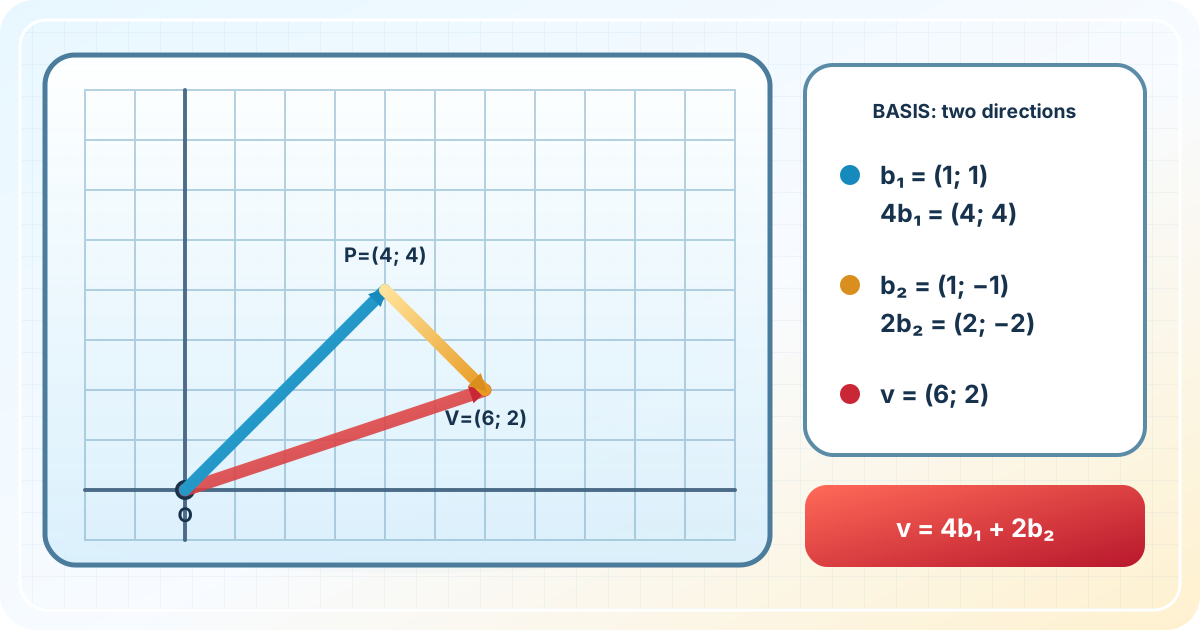
Vector (6, 2) decomposed as four vectors (1, 1) and two vectors (1, −1)
Begin with a familiar image
A city location can be reached along north–south and east–west streets, or along two other nonparallel roads. The selected independent directions act as a basis.
Precise meaning
A linear combination of b₁,…,bₖ is c₁b₁+…+cₖbₖ. Their span contains every vector obtainable this way. The vectors are linearly independent when only zero coefficients produce the zero vector. A basis is independent and spans the whole space; its number of vectors is the dimension.
The lesson’s support signal
meaning → model → calculation → check → explain in your own words
vectors → linear combinations → span → independence → basis → coordinates
Worked example
Take b₁=(1,1), b₂=(1,−1), and v=(6,2). Solving c₁+c₂=6, c₁−c₂=2 gives c₁=4, c₂=2. Thus v=4b₁+2b₂. The coordinates are unique because b₁ and b₂ are not parallel.
Example with a fading prompt
Change the numbers in the example and repeat the solution without copying its steps. Estimate first, calculate exactly, and check against the original condition.
Recall without a prompt
- Define the main idea in one sentence.
- Rebuild the support signal from memory.
- Solve the example with different numbers and explain why every step is valid.
Find and correct the mistake
Calling a=(1,2) and b=(2,4) a basis of the plane merely because there are two vectors is wrong. They are parallel and span only one line.
Transfer to a new setting
Apply the same relationship to something you can measure yourself. Name the quantities, units, and the boundary within which the model is valid. Check the answer by a second representation or an inverse operation.
Exercise
Required. For a=(1,2,0), b=(0,1,1), and c=(1,3,1), determine dependence. Find two independent vectors spanning the same plane and represent r=(2,5,1).
With your own data. Create one everyday example with the same structure and show it in words, a formula, and a check.
Optional. Seven days later, change the numbers and repeat without the support map.
Open perspective
Some directions are not turned by a matrix; they are only stretched, compressed, or reversed. These are eigenvector directions.
If you have found a mistake or a typo in this article, tell us about it
Comments (0)
Log in to leave a comment →
No comments yet. Be the first.