


Mathematics: from foundations to higher mathematics Lesson 34 of 47
Triangles and congruence: when three facts are enough
We classify triangles, use the angle sum, and prove congruence with exact tests instead of comparing drawings.
This text was translated with AI.
Where we are on the map
Points, lines, and angles now form the first rigid shape.
Begin with a familiar image
A triangular brace cannot change shape without changing a side length, which is why frames and bridges use triangles for rigidity.
Precise meaning
Congruent triangles coincide when superimposed. SSS, SAS, and ASA are sufficient tests. Three angles determine shape but not size.
The lesson’s support signal
meaning → model → calculation → check → explain in your own words
match vertices → sufficient test → congruent triangles → corresponding parts equal
Worked example
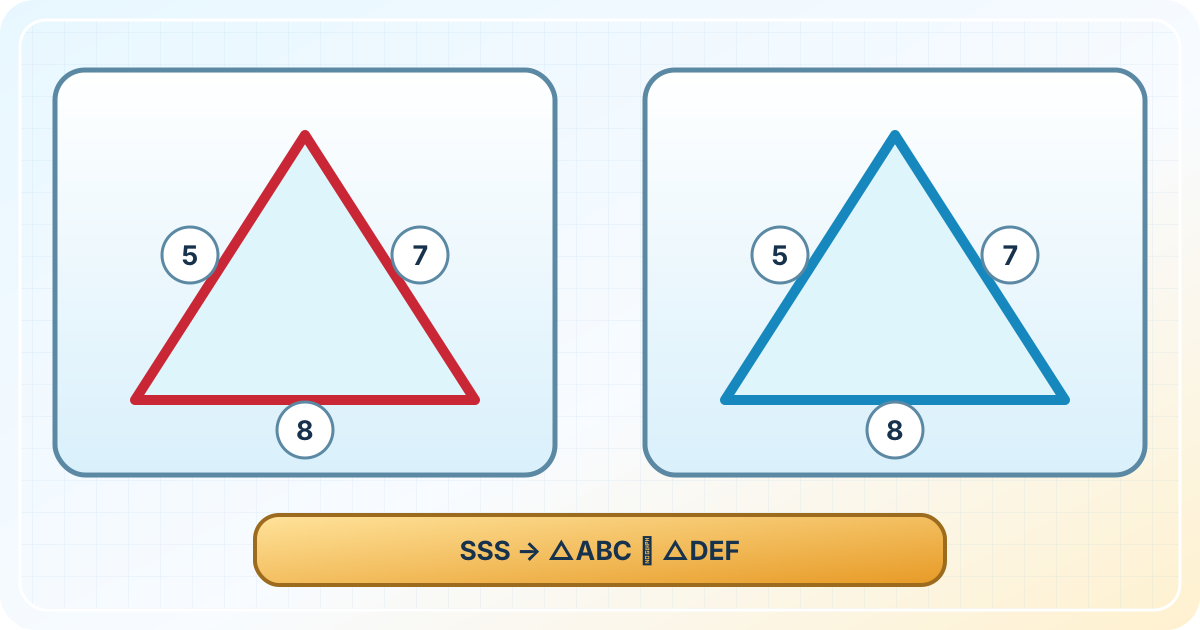
If corresponding sides of two triangles are 5, 7, and 8, SSS proves congruence and all matching angles are equal.
Example with a fading prompt
Change the numbers in the example and repeat the solution without copying its steps. Estimate first, calculate exactly, and check against the original condition.
Recall without a prompt
- Define the main idea in one sentence.
- Rebuild the support signal from memory.
- Solve the example with different numbers and explain why every step is valid.
Find and correct the mistake
Treating SSA as a general test is wrong: two sides and a non-included angle can produce two different triangles.
Transfer to a new setting
Apply the same relationship to something you can measure yourself. Name the quantities, units, and the boundary within which the model is valid. Check the answer by a second representation or an inverse operation.
Exercise
Required. An isosceles triangle has a base angle of 52°. Find the other angles and prove the base angles equal.
With your own data. Create one everyday example with the same structure and show it in words, a formula, and a check.
Optional. Seven days later, change the numbers and repeat without the support map.
Open perspective
When size changes but shape remains, congruence gives way to similarity and scale.
If you have found a mistake or a typo in this article, tell us about it
Comments (0)
Log in to leave a comment →
No comments yet. Be the first.