


Informatics: build your own digital assistant Lesson 31 of 38
Python loops that know when to stop
Replace three copied commands with a loop, trace the count, and prove stopping on empty and nonempty lists.
Where we are on the map
This is lesson 31 of 72 in the Python block (27–38). The support map shows verifiable transitions. We continue the 0.3 paper contract: five reminder outcomes and the original fictional tasks.
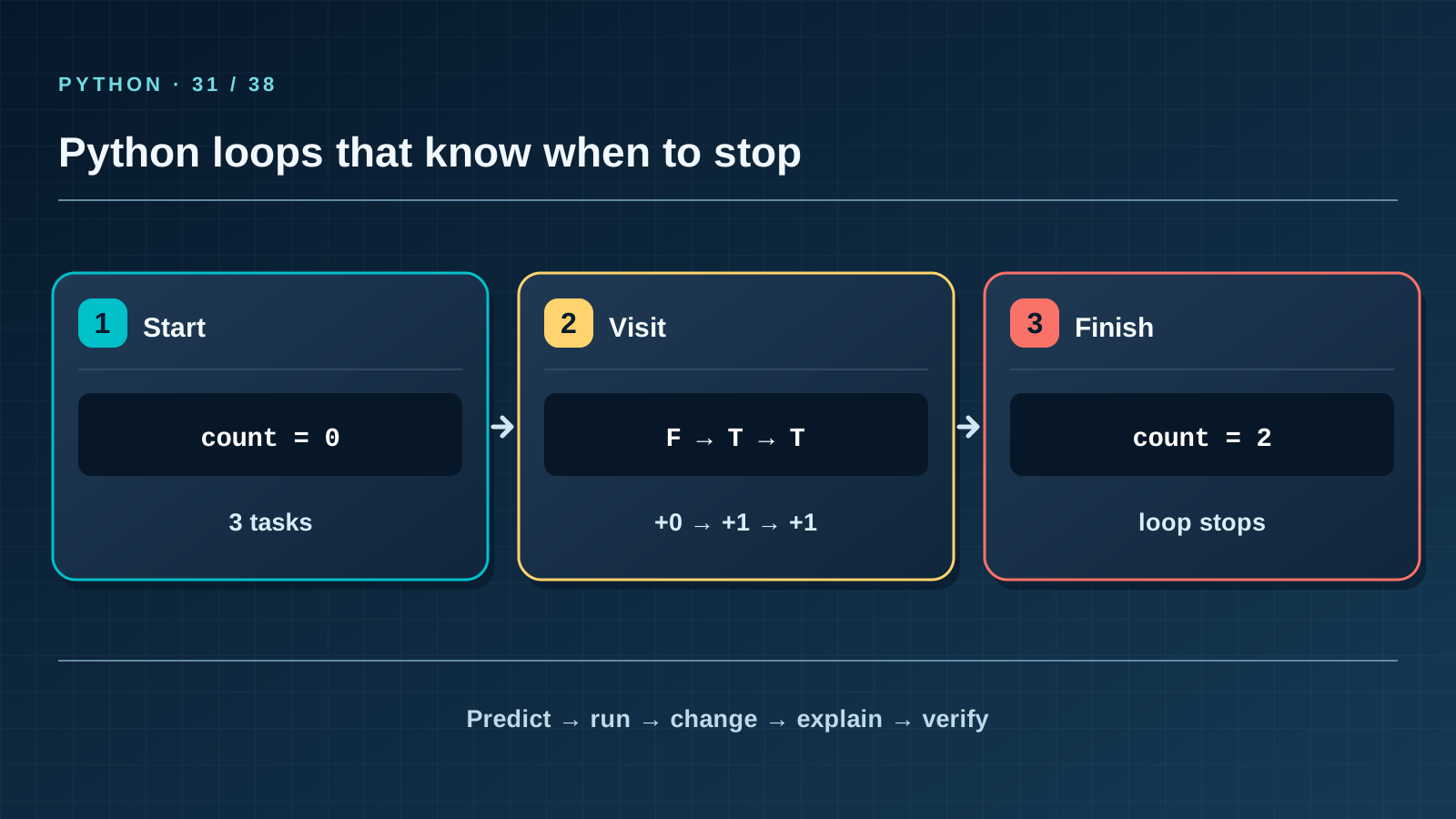
Situation and question
Three tasks can be checked with three separate lines. What about 300? A loop repeats one check for each element. Yet a learner who cannot say when it stops may write a program that hangs or misses the last task. First trace three cards and an empty list.
New words without gaps
A list stores values in a definite order. for done in values takes the next value; one run of the loop body is an iteration. The counter total holds how many True values were found. An invariant is a promise true before and after every iteration: total equals the completed cards already visited. Termination follows from finite list length: nothing remains after the last item. For an empty list the body never runs and the answer is zero.
The lesson’s support signal
Input → check the rule → change state → observable result. Point to where the program reads data, compares it with the contract, and merely reports the result. If a step is absent from the map, find it in the code and add it to your own trace.
Work through it step by step
Lay out False, True, False from left to right. After the first card total=0; after the second it is 1; after the third it remains 1. The code prints that trace. Replace values with []: there are no intermediate lines, only Completed: 0. Compare the paper table with the screen. In a for loop Python moves to the next item itself; you do not increment a separate position.
Predict and check
Cover the output block. Trace names line by line and write the exact predicted text, including case and line order. Only then run the code with python3 from step-03 and compare character by character. Change one input and predict again before running. If results differ, find the first divergent line instead of adjusting the prediction afterwards.
tasks = [{"done": False}, {"done": True}, {"done": True}]
count = 0
for task in tasks:
    if task["done"]:
        count += 1
print(count)
Expected output
2
Catch the error
Putting total = 0 inside the loop restarts the count for every card. Incrementing it for every item without checking done counts list length, not completed tasks. Use False, False, True as a counterexample to both mistakes.
Project change
Replace the 0.3 paper counter with count_done. Compare it with four acceptance cards in cases.json; the original three tasks should yield 1.
Task and evidence
Write count_done for the project’s list of task dictionaries. Check four cases: empty, all False, a three-item mixture, and all True. Show every intermediate count for the mixture. Then remove printing from the function and return the number so a test can compare it with the expected result.
Transfer to a new setting
Count books marked borrowed=True instead of completed tasks. What changes in the condition, and what stays the same in the invariant? Explain why an empty shelf still gives zero.
Return after 1, 7, and 30 days
After 1 day, recall the rule and one boundary case without this page. After 7 days, explain a new error example to a classmate. After 30 days, rerun the project test, check earlier records and output still match, and transfer the rule to a different task again.
Next lesson
If you have found a mistake or a typo in this article, tell us about it
Comments (0)
Log in to leave a comment →
No comments yet. Be the first.