


Informatics: build your own digital assistant Lesson 17 of 18
How to detect damaged data
Practice detecting changed data and see why a simple checksum cannot guarantee authenticity.
This text was translated with AI.
Where we are on the map
The previous block showed how to find files and separate a program from its data. Now we ask how data can carry meaning that another person and another program will read in the same way. State your first guess, test it with numbers, and record what you had to revise.
Everyday analogy and exact model
A cashier checks the number of items against a receipt. A mismatch shows a problem; a match does not prove that every item is unchanged. File transfers need a similar but more exact comparison.
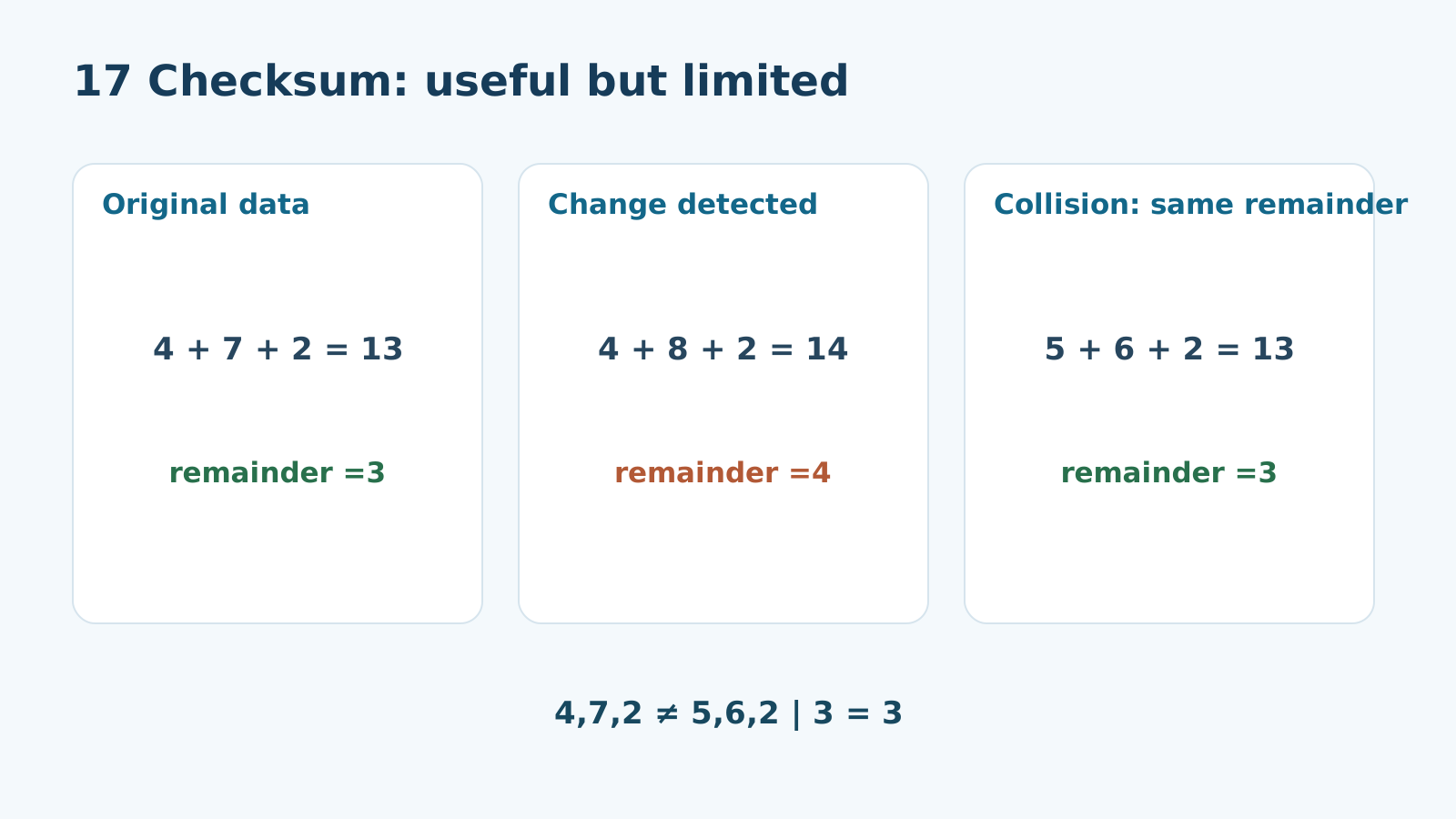
For a classroom checksum, add 4, 7, 2 and take the remainder after division by 10: 13 mod 10 = 3. If 7 changes to 8, the checksum becomes 14 mod 10 = 4, so the change is noticed. Yet 5, 6, 2 also gives 13 mod 10 = 3. Different data with the same checksum form a collision. Cryptographic hashes such as SHA-256 make accidental matches vastly less likely, but a hash without a trusted source does not prove who created a file.
Where the analogy ends
An integrity check detects change only against a retained reference. A checksum cannot repair an error by itself, replace a backup, or prove authorship if someone can replace both file and advertised hash.
The lesson’s support signal
data → calculate sum → keep reference → calculate again → compare; a match is not proof of authorship
Worked example
For 4,7,2 obtain 3. Change 7 to 8 and obtain 4. Change 4 to 5 and 7 to 6 and obtain 3 again. These steps show both detection and the method’s limit.
Predict before observing
Can the classroom checksum distinguish 4,7,2 from 5,6,2? Calculate both remainders first. Both are 3, so it cannot.
Do not jump straight to the answer. Write your prediction and its reason first. Compare each intermediate step as well as the final result. If you were right by chance, repeat with different values.
Reconstruct without a hint
Invent another three-digit list totaling 13 without looking at the example. Check that data differ but the remainder is the same.
Cover the worked example with paper. Reconstruct the chain from the short support signal, explain every transition aloud, and then reveal the example to check yourself. If stuck, look back at only the preceding step.
Find and correct the mistake
“The checksum matches, so the file is certainly authentic and unchanged.” Correct this: a match means only that this method found no difference. Weak checksums have collisions.
Transfer to a new situation
You download a file and its hash from the same unknown website. Comparison can find accidental download damage. Does it prove the website is trustworthy? Explain.
Project change
For three fictional assistant records, note a classroom checksum of numerical ids and label it as an illustration, not security. For genuine file transfers later, plan to use SHA-256 obtained through a trusted channel.
Exercise
Show one change that the classroom checksum detects and another it misses. Say exactly what the method checks and what it does not promise.
Submit evidence that can be checked, rather than saying “I understood”: a table, calculation, file, or precise answer with a reason. Use fictional data. Ask another learner to repeat the action from your description; if they must guess, clarify the rule.
Return after 1, 7, and 30 days
Tomorrow reconstruct the 4,7,2 example. In a week invent a collision. In a month explain why the reference must come from a trusted source.
Next lesson: Mastery checkpoint: the assistant’s data format
If you have found a mistake or a typo in this article, tell us about it
Comments (0)
Log in to leave a comment →
No comments yet. Be the first.