


Informatics: build your own digital assistant Lesson 59 of 72
Encryption, keys, and the limits of protection
A student puts a note in a sealed envelope.
Where we are on the map
Lesson 59 of 72. Digital security block (55–62). We continue a local assistant with three fictional tasks. Each control has a defined boundary: the classroom version does not become a public service.
Situation and question
A student puts a note in a sealed envelope. You can see a letter exists but not read its text. Yet the envelope does not prove who sent it or replace keeping the key safe.
New words without gaps
Encryption turns readable data into a form unreadable without a key. A key is a secret needed for transformation or verification. TLS protects transmission between browser and server when the name and certificate are checked correctly. Disk encryption protects a different part of the journey: the saved file. A hash used for integrity does not encrypt or hide data.
The lesson’s support signal
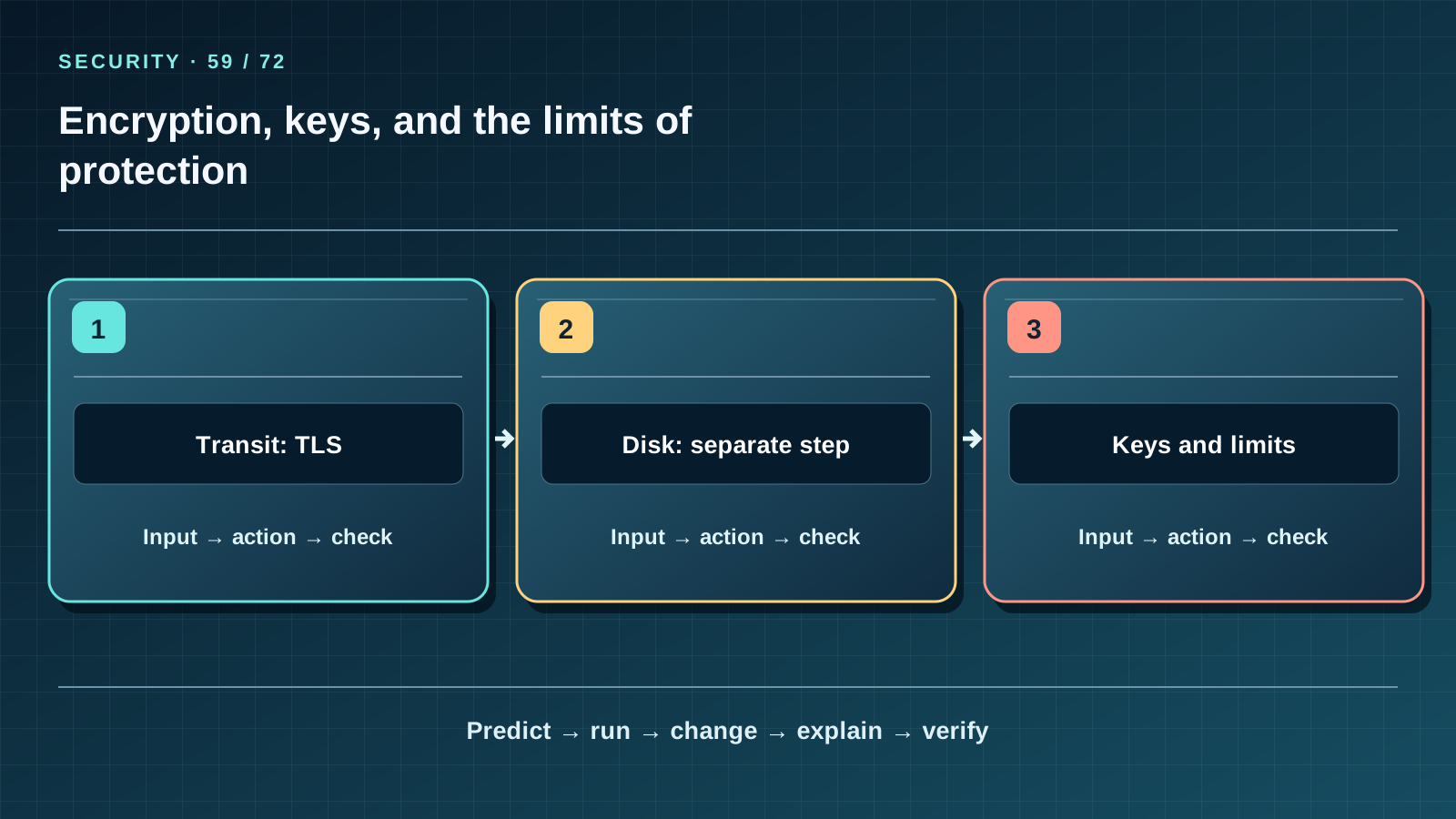
Read the three cells left to right, then cover the third. State the input and action in each cell; predict how the path ends and which observable fact checks it. Compare the drawing with a project file or worked example. If a number on the map cannot be derived from the data, correct the map rather than changing data for a pretty picture.
Work through it step by step
Draw browser → network → server → disk → backup. Mark TLS on the network leg and disk protection at the file. Our step-06 page uses HTTP only on 127.0.0.1; it is not a protected public service example. Its backup.db is unencrypted, so keep it on a trusted device and never place it in a shared cloud folder.
Predict and check
Write the expected output before running code. Execute it in step-06 or step-07, compare every character and explain each line. Then change one safe fictional input and repeat “predict — run — change — explain — verify.” Do not turn an observation on a tiny dataset into a promise about real people.
import hashlib
a = hashlib.sha256(b"20 minutes").hexdigest()
b = hashlib.sha256(b"200 minutes").hexdigest()
print(a == b)
Expected output
False
Catch the error
HTTPS does not hide data from the destination server. A browser padlock alone does not prove the site owner is honest. A hash stored beside a file does not protect against someone who can replace both; authenticity needs another trusted mechanism.
Project change
Release 1.3 preserves the three tasks, four sessions and reminder rules. New operations live in security_assistant.py: validation, a separate backup and restore only into a new file. State which threat each change reduces and which it does not; all teaching data stay fictional.
Task and evidence
For each part of the route, name who could read the data. Explain what must change before a real multiuser service is published.
Transfer to a new setting
A school transfers marks over HTTPS but leaves the file on a shared computer. Which boundary is protected, and which is not?
Return after 1, 7, and 30 days
After 1 day redraw the map from memory and name one boundary of the idea. After 7 days explain it to a friend without reading the lesson and answer 7 of 10 block questions; analyse mistakes with concrete inputs. After 30 days open a fresh project copy, reproduce the check and transfer the idea to a new case. Keep a record of input, expected output and actual output.
Primary reference to check
Next lesson
If you have found a mistake or a typo in this article, tell us about it
Comments (0)
Log in to leave a comment →
No comments yet. Be the first.